Canadian Prime Minister Mark Carney defended his government’s position on recent U.S.–Israeli military action against Iran, arguing that Canada’s support must be understood in the context of what he described as decades of repeated violations of international law by the Iranian regime.
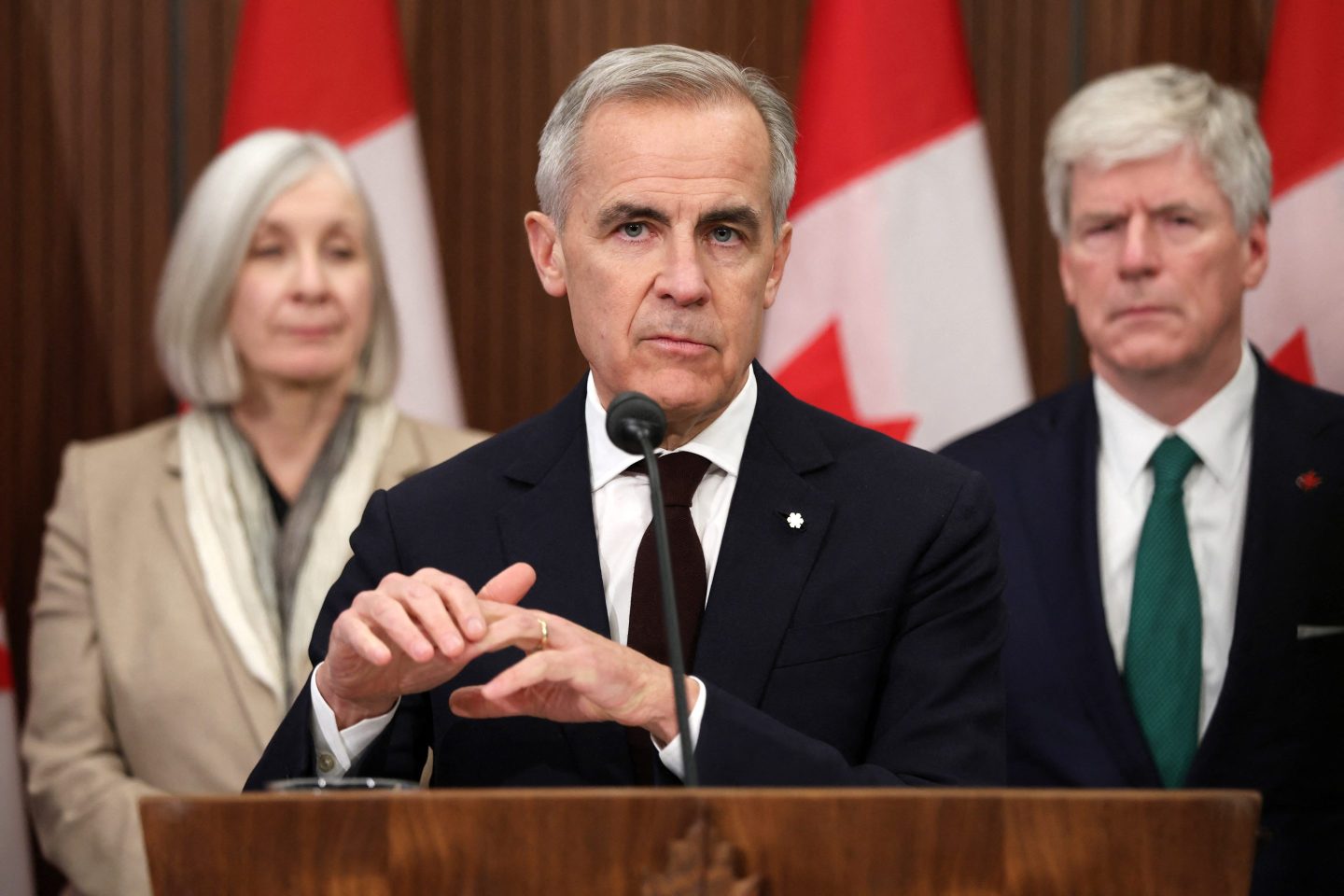
The remarks came in response to a question referencing Carney’s earlier speech at the World Economic Forum in Davos, where he emphasized the prohibition on the use of force inconsistent with the United Nations Charter as a foundational element of Canadian foreign policy. Asked whether supporting recent military measures without United Nations engagement constituted a contradiction, Carney said Canada’s principles remain intact but must be applied in the context of real-world conditions.
“We take the world as it is, not as we wish it to be,” Carney said, reiterating a formulation he has used in previous addresses. “We would like international law to always and everywhere be respected. Canada’s intention, Canada’s policy itself, is to always and everywhere respect international law.”
At the same time, the prime minister argued that the broader context includes what he characterized as “serial violations of international law” by the Islamic Republic of Iran over decades. He said that successive international efforts — including United Nations resolutions, sanctions regimes and diplomatic initiatives — had sought to contain Iran’s conduct within established legal frameworks.
“It is a failure of the international system that this country repeatedly violated international law,” Carney said, adding that Iran’s actions have had regional and global implications. He referenced destabilizing activities and incidents that have affected Canadian citizens, as well as domestic repression within Iran.
Carney’s comments reflect an effort to reconcile Canada’s longstanding commitment to multilateralism with support for measures aimed at limiting perceived security threats. He did not outline a formal legal argument justifying the recent U.S.–Israeli action, nor did he provide specific criteria under which Canada would consider direct participation in similar operations. Instead, he framed Ottawa’s position as an acknowledgment of both principle and circumstance.
Analysts say the exchange highlights the tension facing middle powers that prioritize international legal norms while operating within an international system where enforcement mechanisms are often limited. Canada has historically supported the centrality of the United Nations Charter and has advocated for collective decision-making in matters involving the use of force.
At the same time, successive Canadian governments have endorsed sanctions and other measures in response to Iran’s nuclear activities and regional posture. Canada severed diplomatic relations with Tehran in 2012, citing concerns about security and human rights, though discussions about limited re-engagement have surfaced periodically in policy debates.
Carney’s reference to “serial violations” suggests that his government views the current situation as part of a longer pattern rather than an isolated episode. By emphasizing decades of international efforts that have not fully resolved the issue, he signaled that Ottawa sees structural weaknesses in the global system’s ability to ensure compliance.
The prime minister also highlighted human rights concerns, including the treatment of women and the suppression of protests within Iran. He referred to reports of large-scale repression in recent weeks, underscoring Canada’s stated support for the Iranian population.

Human rights advocates have long documented restrictions on political expression and civil liberties in Iran. Tehran, for its part, has rejected many external criticisms as politically motivated and has maintained that its policies are consistent with domestic law and national sovereignty.
In defending Canada’s position, Carney did not present the recent military measures as an ideal outcome. Instead, he characterized them as taking place in a context shaped by repeated diplomatic impasses. His emphasis on respecting international law “always and everywhere” indicates that Ottawa continues to view legal norms as binding, even when broader geopolitical dynamics complicate their application.
The exchange may also have implications for Canada’s broader foreign policy doctrine. In recent speeches, Carney has argued that the post-Cold War order is under strain and that countries like Canada must adapt to a more fluid and contested environment. His latest remarks suggest that adaptation may involve greater emphasis on deterrence and accountability when multilateral mechanisms fall short.
Critics could interpret the position as a departure from strict adherence to UN-centered decision-making, while supporters may see it as a pragmatic acknowledgment of persistent non-compliance by certain actors. The government has not indicated that it intends to revise formal policy documents governing the use of force.
For now, Ottawa appears to be pursuing a dual track: reaffirming commitment to international law while expressing support for measures aimed at preventing further proliferation and instability. Whether that balance can be sustained will likely depend on how the situation evolves and whether renewed diplomatic initiatives gain traction.
Carney’s remarks underscore the complexity of applying universal principles in a fragmented international landscape. As Canada navigates this terrain, the debate over consistency and pragmatism is likely to remain central to discussions about its role in global security affairs.