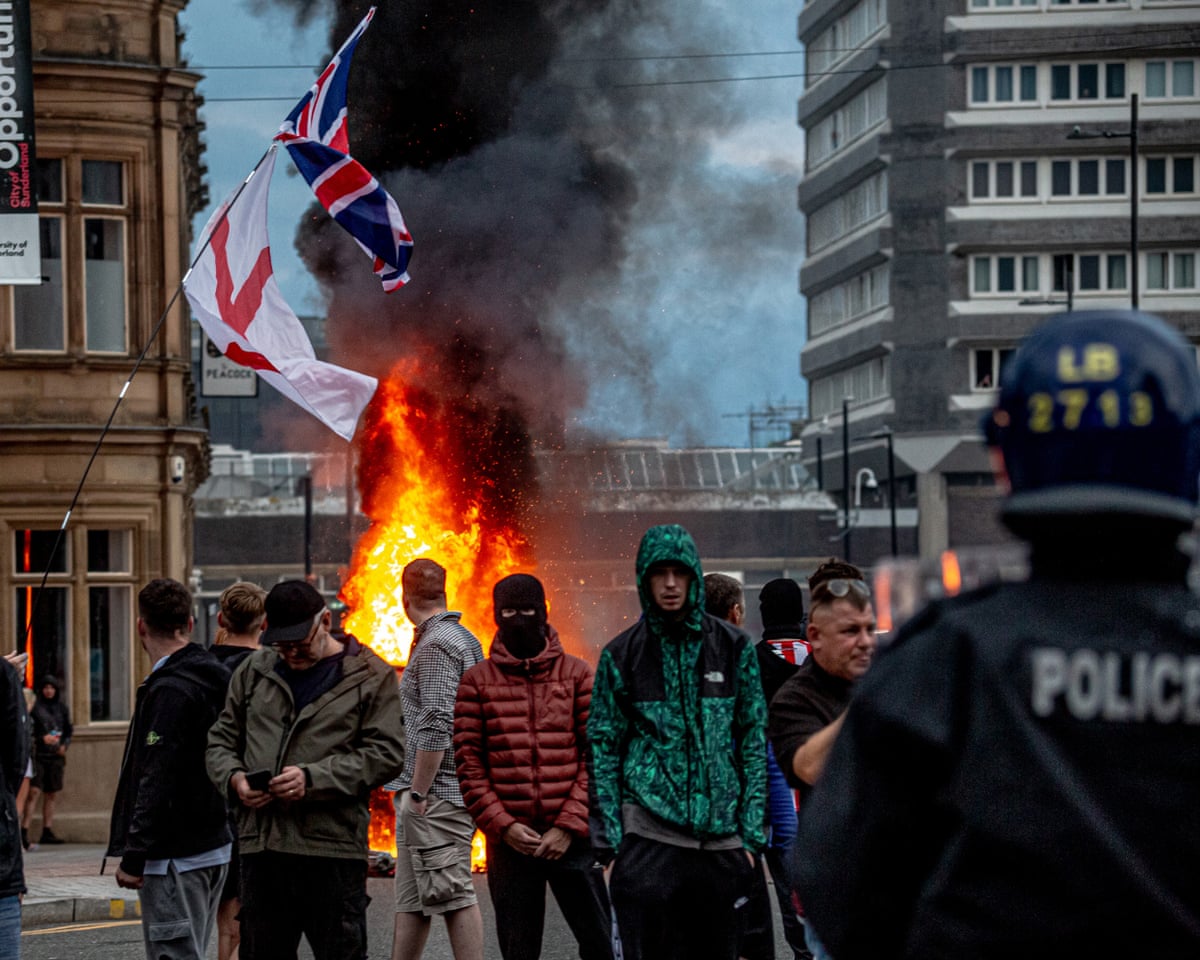
Violence erupted in parts of central England on Sunday evening after hundreds of masked demonstrators clashed with police outside hotels housing asylum seekers, prompting emergency reinforcements and renewed scrutiny of Britain’s strained migration system.

According to local authorities, groups of protesters gathered near migrant accommodation sites in Rotherham and Tamworth shortly after 5 p.m., before confrontations escalated into property damage and street disorder. Police said objects were thrown, windows were broken and several officers sustained minor injuries while attempting to disperse the crowd. No fatalities were reported, and officials did not confirm widely circulated claims about the precise number of participants.
Footage shared on social media showed chaotic scenes: fireworks ignited near building entrances, riot police forming defensive lines and protesters chanting slogans critical of the government’s immigration policies. Law enforcement units, including dog handlers, were deployed to restore order. By late evening, authorities said they had regained control of the immediate areas, though tensions remained high.
The unrest appears to have been fueled by mounting frustration among some local residents over the use of hotels to house newly arrived asylum seekers — a practice adopted by successive governments amid a backlog of immigration cases and limited long-term housing capacity. Britain has faced sustained pressure along its southern coast from small boat crossings across the English Channel, with thousands arriving annually to seek protection.
In a statement, a spokesperson for Prime Minister Keir Starmer condemned the violence and said peaceful protest would be protected, but “criminal damage and attacks on officers will not be tolerated.” The Home Office described the scenes as “deeply concerning” and pledged to review security arrangements at accommodation sites nationwide.

Local leaders urged calm. The leader of Rotherham Council said in a statement that while residents are entitled to express concerns about public services and community safety, “intimidation and destruction undermine the very values people claim to defend.” Community groups also warned that misinformation circulating online may have intensified fears and contributed to the scale of the confrontation.
Britain’s debate over migration has sharpened in recent years, cutting across party lines and fueling political realignment. Supporters of tighter border controls argue that the asylum system is overwhelmed, straining housing, health care and policing. Advocates for refugees counter that the United Kingdom remains bound by international humanitarian obligations and that asylum seekers represent a small fraction of overall migration.
Security analysts say the volatility reflects a broader pattern across Europe, where migration pressures intersect with economic anxiety and social media amplification. “When accommodation sites become symbolic flashpoints, they can attract individuals far beyond the immediate community,” said one London-based expert on political violence. “What begins as protest can quickly morph into disorder if policing lines are breached.”
As investigations continue, police are reviewing video evidence to identify those responsible for assaults and property damage. Officials indicated that arrests are expected in the coming days. Meanwhile, migrant residents inside the targeted hotels were relocated temporarily as a precaution, according to local reports.
The disturbances underscore the fragile balance facing British authorities: maintaining public order while addressing legitimate concerns over migration policy in a polarized climate. Whether Sunday’s violence proves an isolated episode or a sign of deeper unrest may depend less on policing tactics than on how the government manages the asylum backlog and communicates its strategy to communities that feel left behind.