🔥 BREAKING: DEFENSE TENSIONS RISE OVER FIGHTER JET DECISION — OTTAWA HOLDS FIRM 🇨🇦✈️🇺🇸
For decades, Canada’s replacement of its aging CF-18 fighter jets was expected to be a procedural matter — a technical procurement nested comfortably within one of the world’s closest defense partnerships. Instead, Ottawa’s review of alternatives to the American-made Lockheed Martin F-35 has exposed deeper tensions over sovereignty, interoperability and the future architecture of Western air power.
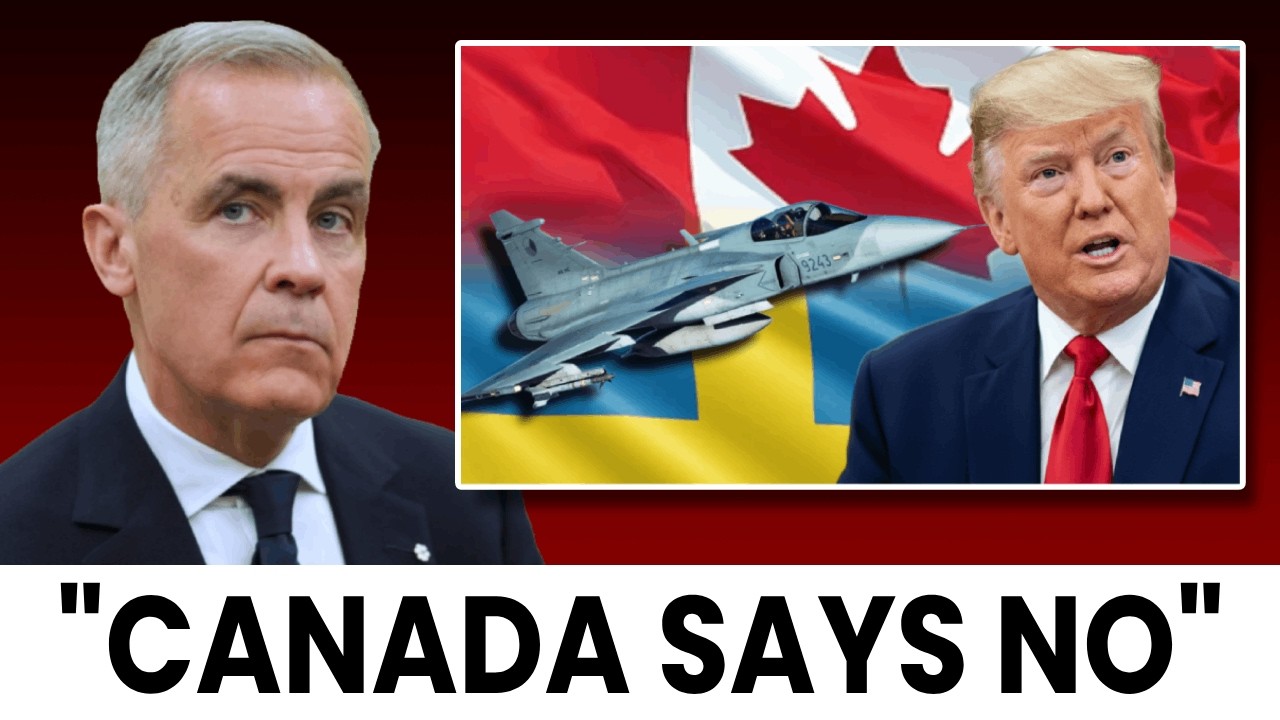
At the center of the debate is Sweden’s Saab and its JAS 39 Gripen fighter, which the company has pitched to Canada as more than an aircraft. Saab executives have proposed extensive technology transfer, domestic assembly and thousands of Canadian manufacturing and research jobs, in partnership with local industry.
Canadian officials began evaluating the Gripen as a serious alternative during a broader reassessment of defense spending. That review followed rising cost projections associated with the F-35 program and came amid political strains between Ottawa and Washington on trade and other matters.
What might once have remained a technical comparison of radar systems and lifecycle costs quickly became something more sensitive. According to defense analysts and former officials, as the Gripen gained traction in Ottawa, American representatives delivered pointed reminders — privately — about the implications for continental defense and alliance interoperability.
The United States and Canada jointly manage North American air defense through North American Aerospace Defense Command, or NORAD, a Cold War-era framework that allows both countries to monitor and, if necessary, intercept airborne threats across shared airspace. The F-35, widely adopted among NATO allies, is deeply integrated into American-managed logistics systems, software networks and intelligence-sharing platforms.
The Gripen, by contrast, was designed with a different philosophy. While fully interoperable with NATO systems, it allows operators greater control over mission data, software modifications and weapons integration. Sweden built the aircraft with dispersed operations in mind: the ability to land on highways, operate from austere bases and remain functional even if centralized infrastructure is disrupted.
For Canada, geography shapes the stakes. The country oversees the second-largest national airspace in the world, much of it stretching across sparsely populated Arctic regions. Russian bomber patrols near North American approaches have increased in recent years, and climate change is opening new polar routes of strategic consequence.
Operating reliably in extreme cold, with limited infrastructure and vast distances between runways, is not a theoretical requirement. It is a daily reality for the Royal Canadian Air Force. Supporters of the Gripen argue that its design — emphasizing resilience and lower operating costs — aligns naturally with those conditions.
Advocates of the F-35 counter that its stealth capabilities, sensor fusion and integration with allied forces provide unmatched advantages in high-end conflict. The aircraft’s ability to operate seamlessly within U.S.-led command networks, they argue, strengthens collective defense and ensures Canada remains fully synchronized with key partners.
The friction arises less from performance metrics than from structure. The F-35 program binds participating countries into a shared sustainment and upgrade ecosystem largely managed by the United States. Software updates, maintenance pipelines and mission data flow through centralized systems. Proponents describe this as efficient integration; skeptics see long-term dependence.
In recent remarks, American officials have suggested that any significant reduction in Canada’s planned F-35 purchase could require adjustments to NORAD operations. Though such comments stopped short of formal warnings, they underscored Washington’s view that force structure decisions on one side of the border inevitably affect the other.

Canadian leaders have framed their review not as a rejection of the United States but as an affirmation of national control. Prime Minister Mark Carney has ordered a reassessment of defense spending priorities in light of rising program costs and shifting geopolitical conditions. Officials insist that alliance commitments remain firm, even as procurement assumptions are reexamined.
Defense scholars note that the episode reflects broader questions facing NATO. Over the past three decades, joint weapons programs have served not only military functions but also political ones, knitting allies together through shared technology and infrastructure. Aircraft purchases, once signed, shape relationships for generations.
“If a country demonstrates it can retain greater operational autonomy while remaining interoperable, that sets a precedent,” said one European security analyst. “Others will pay attention.”
Several NATO members, including Finland and Norway, have committed to the F-35, reinforcing a common fleet across the alliance. A Canadian shift toward the Gripen would not dismantle that framework, but it could signal that alternatives remain viable — and that integration need not equate to uniformity.
For Ottawa, the choice now extends beyond aircraft specifications. It is a question of how to balance performance, cost, industrial policy and strategic independence within an alliance built on shared defense. Neither option offers a perfect solution. The F-35 promises unmatched capability but deepens reliance on American systems. The Gripen offers greater sovereign control but may complicate certain coalition operations.
What has unsettled Washington, analysts say, is not merely the prospect of losing a contract. It is the possibility that a close partner is challenging the assumptions that have quietly underpinned Western air power for decades.
In that sense, Canada’s deliberation has become a proxy for a larger debate: how much autonomy can a middle power preserve within a tightly integrated security architecture — and how alliances must evolve as technology increasingly defines who controls not just the skies, but the software that governs them.