In 2017, Donald Trump stood beside Justin Trudeau and praised the Gordie Howe International Bridge as a symbol of cooperation, commerce, and shared prosperity between two nations. He approved funding, placed the project on a national priority list, and sent his ambassador to break ground. Nearly a decade later, that same bridge has become the center of an explosive controversy after Trump abruptly declared he would never allow it to open—despite construction being complete and trade dependence higher than ever.

The reversal came with a timeline that immediately raised red flags in Ottawa. On February 9, 2026, a billionaire owner of the privately held Ambassador Bridge donated $1 million to Trump’s super PAC. Hours after a private meeting between that donor and the U.S. commerce secretary, Trump posted on Truth Social threatening to block the publicly funded Gordie Howe crossing. For Canada, this was not a policy dispute but a structural shock: the Windsor–Detroit corridor moves roughly $323 million in goods every single day, accounting for more than a quarter of total Canada–U.S. trade by value.
The economic stakes are enormous. Auto plants on both sides of the border rely on just-in-time supply chains, with parts crossing the river multiple times before a single vehicle is completed. When the Ambassador Bridge was briefly blocked in 2022, production losses approached $300 million within days. A prolonged delay—or permanent obstruction—of the new bridge would magnify that damage, hitting American factories and Michigan workers as hard as Canadian exporters.
What makes the dispute more consequential is ownership. Canada financed nearly the entire $6.4 billion project, assumed the construction risk, and delivered a six-lane, cable-stayed crossing with direct highway connections. The bridge is jointly owned by Canada and the state of Michigan, with toll revenues designed to repay costs and then generate long-term shared income. Claims that the United States “gets nothing” have been publicly disputed by economists and former officials, who note that Michigan gains both ownership and a critical second crossing that ends a century-long private monopoly.
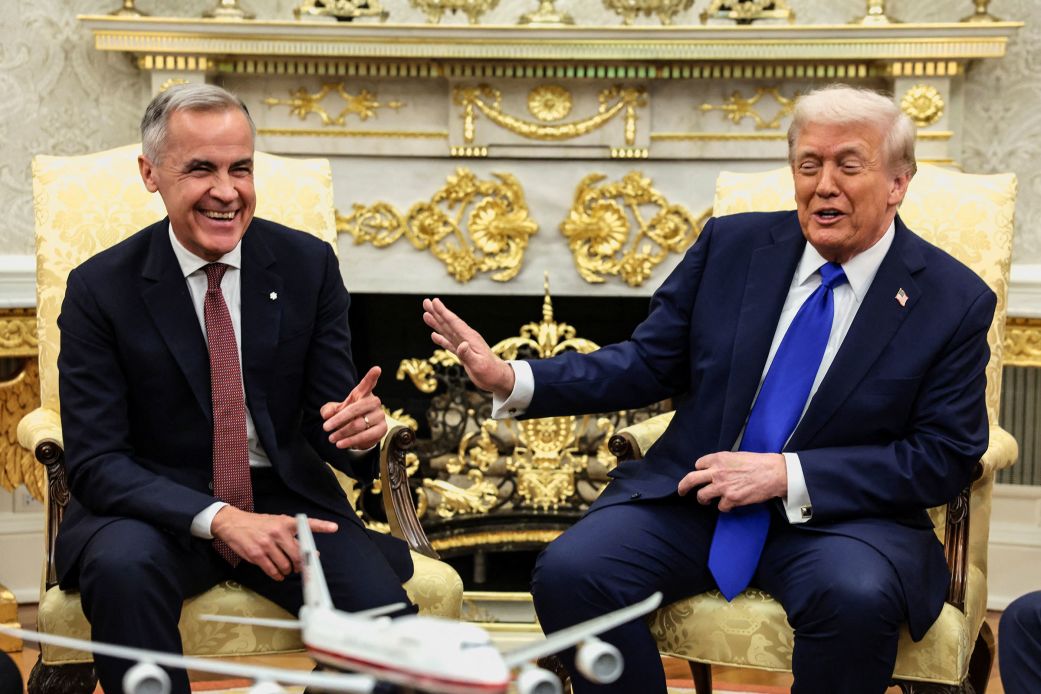
Prime Minister Mark Carney has responded without escalation. Rather than threaten retaliation, he emphasized the bridge as a cooperative achievement built with Canadian and American workers, steel, and capital. Privately, Ottawa has signaled it understands the nature of the pressure being applied and is monitoring it closely. Publicly, Carney has stayed disciplined, refusing to legitimize a precedent where political donations can dictate cross-border infrastructure outcomes.
Strategically, the episode reinforces why Canada is accelerating trade and infrastructure diversification beyond the United States. The Gordie Howe bridge was never just concrete and steel—it was proof that Canada could reduce choke points controlled by private interests. Trump’s threat turns that lesson into doctrine. Canada’s response has not been outrage, but insulation: more partners, more routes, and fewer single points of failure. The bridge will open because the economics demand it. The larger question is whether this moment marks the end of one-sided dependency—and the beginning of a more resilient Canadian trade strategy.