What began as a hardline trade posture meant to project confidence and leverage has quietly evolved into an uncomfortable reckoning for the United States. At the center of this shift is an unlikely symbol of economic power: Canadian potatoes. More specifically, frozen French fries — a product so embedded in everyday American life that its geopolitical significance went largely unnoticed until now. As tariff threats and trade uncertainty ripple through North American supply chains, Canada’s role as the backbone of U.S. fast-food operations has transformed from a background detail into a strategic pressure point, revealing vulnerabilities few policymakers publicly acknowledge.
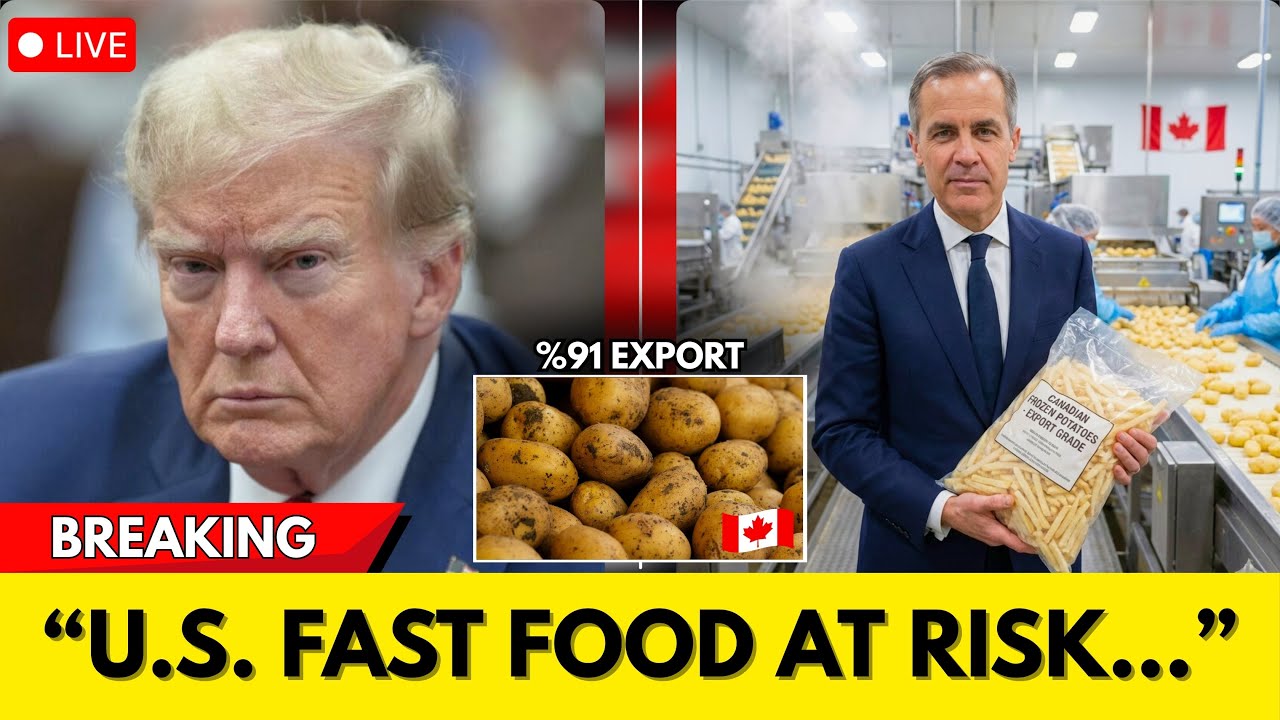
For years, Canada has been the dominant supplier of frozen potato products to the United States, accounting for the overwhelming majority of imported French fries used by major fast-food chains. McDonald’s, Wendy’s, Burger King, and countless regional franchises have built their menus, pricing models, and customer expectations on the assumption of a stable, predictable flow of Canadian supply. That assumption is now being tested. Proposed tariffs and erratic trade signals have forced Canadian processors to re-evaluate whether the U.S. market can still be treated as a reliable long-term partner, or whether diversification is no longer optional but necessary for survival.
The issue is not simply about price increases or short-term supply disruptions. It is about uncertainty. Food processing operates on thin margins and long planning horizons. When tariffs are floated, revised, or threatened without clear timelines, companies cannot confidently sign multi-year contracts or justify further investment tied to a single market. As a result, Canadian potato processors have reportedly begun adjusting production plans, reducing contracted volumes, and quietly exploring alternative export destinations, particularly in Asia, where demand for Western-style fast food continues to grow steadily.

This shift has not unfolded with dramatic announcements or official declarations. Instead, it has emerged through subtle signals: cautious language from industry groups, quieter contract negotiations, and a noticeable chill in political enthusiasm on Capitol Hill. Members of Congress, already sensitive to inflation and consumer backlash, have shown little appetite for escalating a trade fight that could raise fast-food prices — a politically dangerous outcome given how closely those prices track everyday cost-of-living concerns for millions of Americans. The lack of vocal support has itself become a form of institutional pushback.
What makes the situation more precarious is the deeply integrated nature of the U.S.–Canada potato supply chain. This is not a simple buyer-seller relationship but a cross-border system built over decades, where seed potatoes, fresh potatoes, and processed products flow in both directions. Canadian seed potatoes, in particular, play a crucial role in U.S. agricultural production, supplying disease-free, region-specific stock that American farmers rely on each planting season. Disruptions at this level would not only affect imports but could also constrain domestic U.S. production in future harvests, compounding the problem rather than solving it.

From a political perspective, the optics are increasingly awkward. A strategy intended to signal toughness is now being interpreted by critics as a self-inflicted stress test that the U.S. supply chain did not pass cleanly. Analysts note that while no immediate collapse has occurred, the narrative has shifted. Canada is no longer viewed solely as a dependable partner absorbing U.S. pressure, but as a rational actor weighing alternatives and quietly building leverage by doing nothing more dramatic than answering calls from Tokyo, Seoul, or Manila.
The fast-food industry, meanwhile, finds itself caught in the middle. Chains cannot easily replace Canadian supply without years of investment in new processing facilities, higher transportation costs from overseas suppliers, or painful menu adjustments. Even minor disruptions could translate into higher prices, portion controls, or limited availability — outcomes that would quickly be noticed by consumers and investors alike. The mere perception of instability is enough to unsettle procurement strategies and long-term planning.
Ultimately, this episode is less about potatoes than about power and predictability. Trade relationships function on trust as much as on tariffs. When that trust erodes, partners adapt — often quietly, incrementally, and permanently. Canada’s “potato card” was never a threat issued from a podium, but a structural reality embedded in supply chains that Americans took for granted. As those chains begin to bend under political pressure, the broader lesson is becoming harder to ignore: in an interconnected economy, leverage cuts both ways, and even the most ordinary products can become symbols of strategic vulnerability.