BREAKING: TRUMP TURNS UP THE PRESSURE ON CANADA — CARNEY’S CALM RESPONSE SENDS SHOCKWAVES THROUGH WASHINGTON
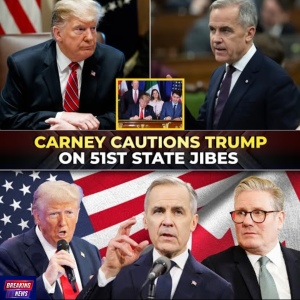
In an Oval Office meeting in May, Prime Minister Mark Carney offered a response that was at once understated and unyielding. Canada, he said, was “not for sale.” Seated across from President Donald Trump, who had once again mused publicly about Canada becoming the 51st state, Mr. Carney repeated the word “never” under his breath as cameras rolled.
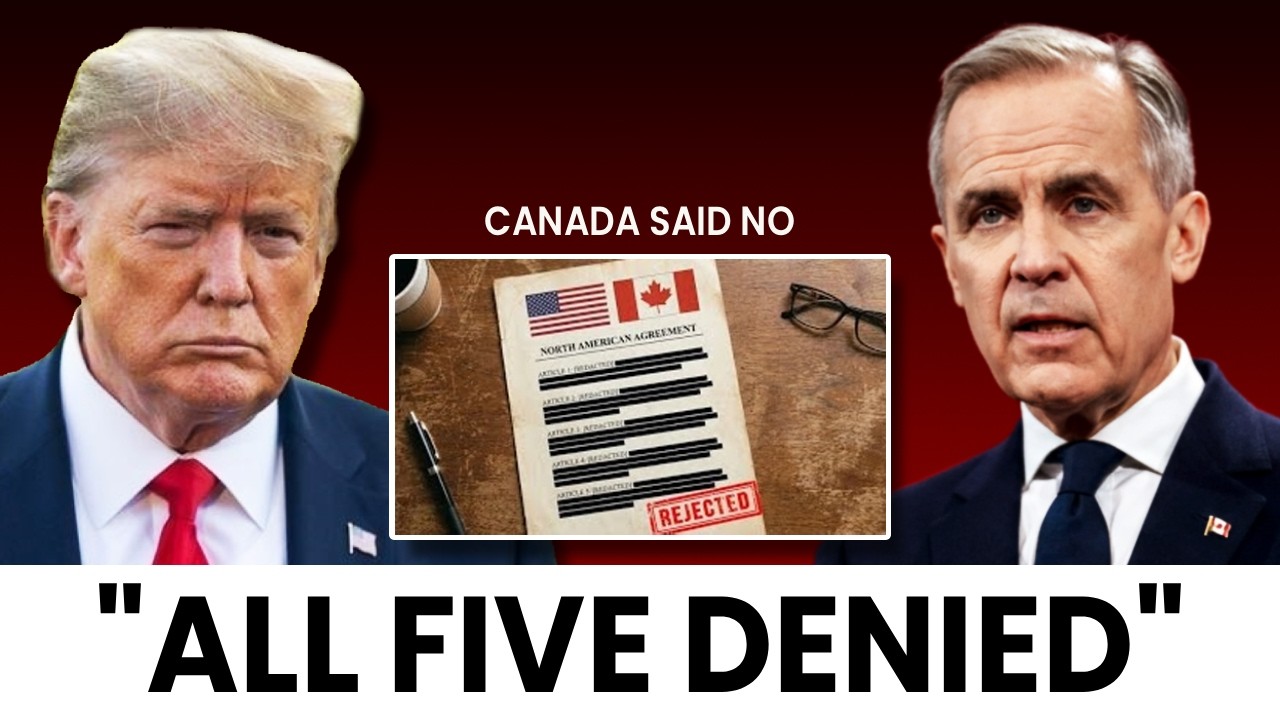
The exchange crystallized a months-long confrontation that has pushed North America’s economic architecture into its most serious test in decades.
Soon after returning to the White House in January 2025, Mr. Trump declared a national emergency under the International Emergency Economic Powers Act, citing concerns along the northern border. Within days, his administration imposed a 25 percent tariff on most Canadian imports and a 10 percent levy on Canadian energy exports. The stated rationale was fentanyl trafficking. Yet U.S. Customs and Border Protection data indicated that a tiny fraction of fentanyl seized at American borders originated in Canada, with the overwhelming majority entering from the south.
Despite the imbalance, the tariffs took effect in March and were increased to 35 percent by August. The message from Washington was clear: compliance would not necessarily yield relief.
Ottawa moved quickly to address the White House’s initial demands. The Canadian government announced a $1.3 billion border security plan, appointed a national fentanyl czar, designated several transnational criminal organizations as terrorist entities and launched a joint strike force to coordinate cross-border enforcement. Canadian officials privately argued that they had met — and in some cases exceeded — American requests.
But the tariffs remained.
For Mr. Carney, a former governor of both the Bank of Canada and the Bank of England, the dispute quickly appeared less about narcotics than about leverage. An economist by training who helped steer financial systems through the 2008 global crisis and the turbulence following Britain’s vote to leave the European Union, he has approached the standoff as a structural risk rather than a political skirmish.
A second American grievance centered on trade deficits. Mr. Trump has long portrayed bilateral deficits as evidence of exploitation. Economists across the ideological spectrum counter that such deficits reflect patterns of consumption, currency flows and comparative advantage in a high-income economy. The United States runs trade deficits with most major partners.
Nowhere are the complexities clearer than in the auto industry, where components can cross the border multiple times before final assembly. Decades of free trade agreements — most recently the United States-Mexico-Canada Agreement, or USMCA — treated North America as an integrated production platform. Tariffs on each crossing introduce friction into a system designed for fluidity, raising costs for manufacturers and consumers on both sides of the border.
Mr. Carney signaled openness to reviewing USMCA during its scheduled 2026 reassessment, while simultaneously launching an ambitious diversification drive. Within six months, Canada announced a dozen trade initiatives across Europe, Asia and other regions, aiming to reduce its reliance on a single export destination. Roughly three-quarters of Canadian exports currently go to the United States.
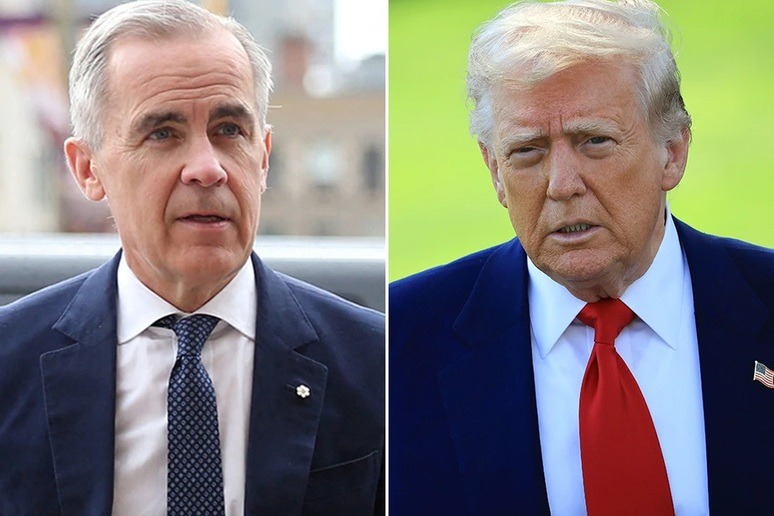
Tensions escalated further when Mr. Trump unveiled a proposal at the World Economic Forum in Davos for a new international body he called the “Board of Peace,” to be chaired by the United States and financed by billion-dollar contributions from permanent members. Canada received an invitation. Days later, in a speech that drew sustained applause, Mr. Carney warned that major powers were increasingly weaponizing economic interdependence — turning tariffs and financial infrastructure into tools of coercion. Mr. Trump soon withdrew the invitation, declaring that Canada’s prosperity depended on the United States.
Another flashpoint emerged over China. Seeking to cushion industries hit by American tariffs, Ottawa explored a limited, sector-specific arrangement with Beijing to reduce certain trade barriers. Washington signaled strong opposition, threatening 100 percent tariffs if Canada broadened its engagement. Mr. Carney clarified that any measures would remain narrow and compliant with USMCA commitments, emphasizing that diversification was a hedge, not a pivot.
At home, the economic strain has been real. Steel and aluminum producers have faced compressed margins; auto parts manufacturers have scrambled to reconfigure supply chains. Investment has slowed amid uncertainty, and currency volatility has added to the pressure.
To blunt the shock, the Canadian government introduced a $6 billion resilience package. It eliminated the employment insurance waiting period for displaced workers, suspended certain separation payment rules to accelerate aid and created a $10 billion loan facility for large employers affected by tariffs. An additional $450 million was directed toward retraining programs intended to move up to 50,000 workers into emerging sectors.
Critics have questioned whether Ottawa’s concessions — including dropping a planned digital services tax on large American technology companies and increasing military and border spending — dilute its assertive rhetoric. Mr. Carney’s framework appears to distinguish between peripheral compromises and core principles: sovereignty, equitable USMCA membership, the right to diversify trade and categorical rejection of annexation.
In Washington, signs of strain have also surfaced. The House of Representatives voted narrowly to terminate the national emergency underpinning the tariffs, though not by enough to override a promised presidential veto. The Tax Foundation estimated that the tariffs represented the largest average tax increase per U.S. household as a share of gross domestic product since 1993, with costs projected to rise.
All eyes now turn to the 2026 USMCA review. If negotiators can preserve integrated supply chains while addressing political grievances, the crisis may be remembered as a bruising recalibration. If not, North America’s tightly woven economic fabric could begin to unravel.
For now, the standoff has reshaped political narratives on both sides of the border. In Canada, appeals to sovereignty have buoyed Mr. Carney’s standing. In the United States, the debate over tariffs has exposed divisions within Mr. Trump’s coalition.
What replaces the pre-2025 order remains uncertain. But the assumption that economic interdependence guarantees stability has been decisively shaken — and neither side appears ready to blink.