A Party at the Crossroads: How J.D. Vance Is Redefining the Post-Trump Right
The most consequential shift in contemporary American politics may not be the volume of its arguments, but the boundaries it no longer insists on drawing. In recent years, ideas once confined to the political fringe have moved closer to the center of Republican discourse, not always through explicit endorsement, but through silence, reframing, and strategic tolerance. Nowhere was that evolution more visible than at Turning Point USA’s recent AmericaFest, where Vice President J.D. Vance emerged not merely as a successor to Donald Trump’s coalition, but as a figure reshaping its ideological contours.

Vance has long presented himself as a bridge — between populism and policy, grievance and governance, cultural reaction and institutional power. On stage, he framed his message as inclusive, urging conservatives to abandon what he described as self-defeating “purity tests” and instead welcome anyone who claims to love America. The rhetoric sounded conciliatory. Yet critics noted what was absent: a clear rejection of antisemitism, white nationalism, or racial exclusion. In a movement increasingly forced to confront the presence of extremist factions, Vance chose unity over boundaries.
That choice matters. White nationalist ideology is not a disagreement over marginal tax rates or trade policy. It is an exclusionary worldview that defines belonging by race, ancestry, or religion. To refuse to name it as incompatible with democratic pluralism is not neutrality. It is permission. History offers few examples in which extremist movements have been successfully absorbed without distorting the institutions that welcomed them.
Donald Trump, for all his incendiary rhetoric, often relied on ambiguity — statements that could be disavowed, reframed, or dismissed as exaggeration. Vance’s approach is different. Over the past several years, he has adopted a more coherent ideological framework, drawing on themes familiar to the far right but presented in polished, intellectual language. His favorable references to restrictive immigration laws of the 1920s, his arguments that Americans with deep ancestral roots possess a stronger claim to the nation, and his flirtation with the concept of “heritage Americans” echo long-standing white nationalist talking points, even when stripped of overt racial language.
These ideas rest on a fragile historical foundation. The United States has never been defined by a single ethnicity, and the constitutional amendments enacted after the Civil War explicitly rejected racial hierarchy as a basis for citizenship. Yet a growing movement on the right now seeks to revisit those assumptions, questioning birthright citizenship and the legitimacy of a multiracial democracy itself. Vance’s rhetoric aligns with that project, even as it is framed as a defense of tradition, Christianity, and national cohesion.
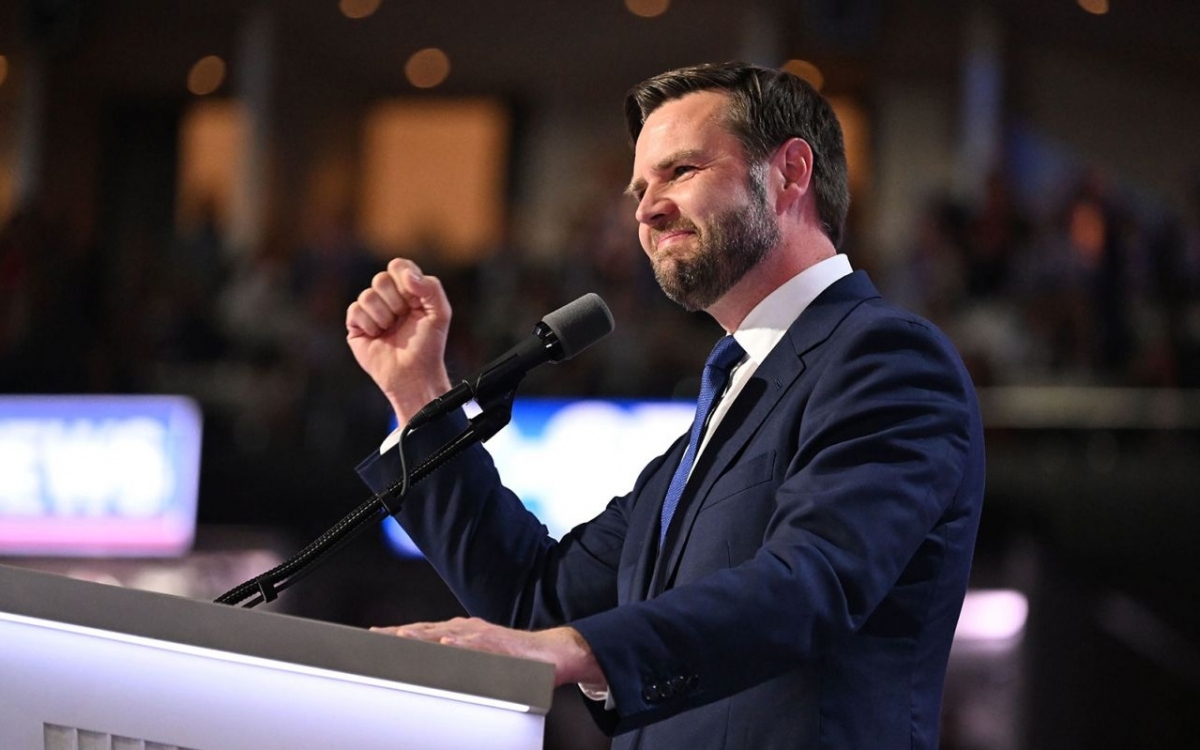
At AmericaFest, Vance declared that Americans no longer need to apologize for being white and asserted that the country “always will be a Christian nation.” Statements like these function as signals — reassurance to a base animated by cultural grievance that demographic and social change represents loss, and that loss demands resistance. Among younger conservatives, where admiration for authoritarian figures and ethnic nationalism is increasingly visible, that message resonates.
Organizations such as Turning Point USA have taken note. With its expansive network of college and high school chapters, the group provides an infrastructure uniquely suited to mobilizing an intensely loyal and ideologically disciplined base. Following a speech by its new leader publicly endorsing Vance as a future presidential candidate, the organization reported a surge in requests to form new chapters, underscoring the appeal of this vision among a rising generation of activists.
But intensity is not the same as breadth. American politics rewards coalition-building, not contraction. White nationalism, by definition, narrows the circle of belonging. Trump’s electoral success depended in part on persuading just enough voters — including some voters of color — that his most extreme rhetoric was theatrical rather than programmatic. Vance lacks that insulation. His worldview is more explicit, more internally consistent, and therefore more difficult to disown when consequences follow.
Even within pro-Trump spaces, resistance is emerging. Some conservative figures have argued that ranking Americans by ancestry or race violates foundational principles of the republic. Their objections have often been met with hostility or silence, revealing how far the internal consensus has shifted — and how fragile it has become.
Vance insists he is building a “big tent.” But white nationalism cannot coexist with genuine pluralism. It presents an ultimatum, not an invitation. Either a political party rejects racial hierarchy, or it becomes defined by it. Delaying that reckoning does not prevent it. It only ensures that when it arrives, the costs will be higher — for the party, for democratic institutions, and for the country itself.