When Late-Night Comedy Meets the Oval Office: Trump’s On-Camera Naps and the Unease Behind the Laughter
WASHINGTON — It began, as many political storms now do, not with a formal investigation or a leaked memo, but with a joke. On a recent night, Jimmy Kimmel devoted a segment of his late-night show to a series of clips showing President Donald J. Trump appearing to nod off during public meetings. The audience laughed. The clip went viral. And within hours, what might once have been dismissed as a trivial moment of fatigue hardened into a more unsettling question about power, perception, and the thin line between comedy and concern.

Mr. Kimmel’s monologue was sharp but familiar in tone, blending satire with incredulity. He replayed footage of Mr. Trump sitting motionless during cabinet sessions, his eyes closed for stretches long enough to spark speculation. “This isn’t a blink,” Kimmel quipped. “This is a REM cycle.” The crowd roared. Online, the clip exploded across platforms, shared not only by comedians and critics but by political operatives and foreign observers, all asking versions of the same question: was this just late-night fodder, or something more consequential?
Inside the White House, according to people familiar with internal discussions, the laughter landed with a thud. Several aides, speaking on the condition of anonymity, described a growing anxiety about how such moments are handled — or, more accurately, not handled. Unlike verbal slips or policy gaffes, an image of a president apparently asleep offers little room for rhetorical maneuvering. “You can’t spin silence,” one senior official said. “And you definitely can’t spin closed eyes.”
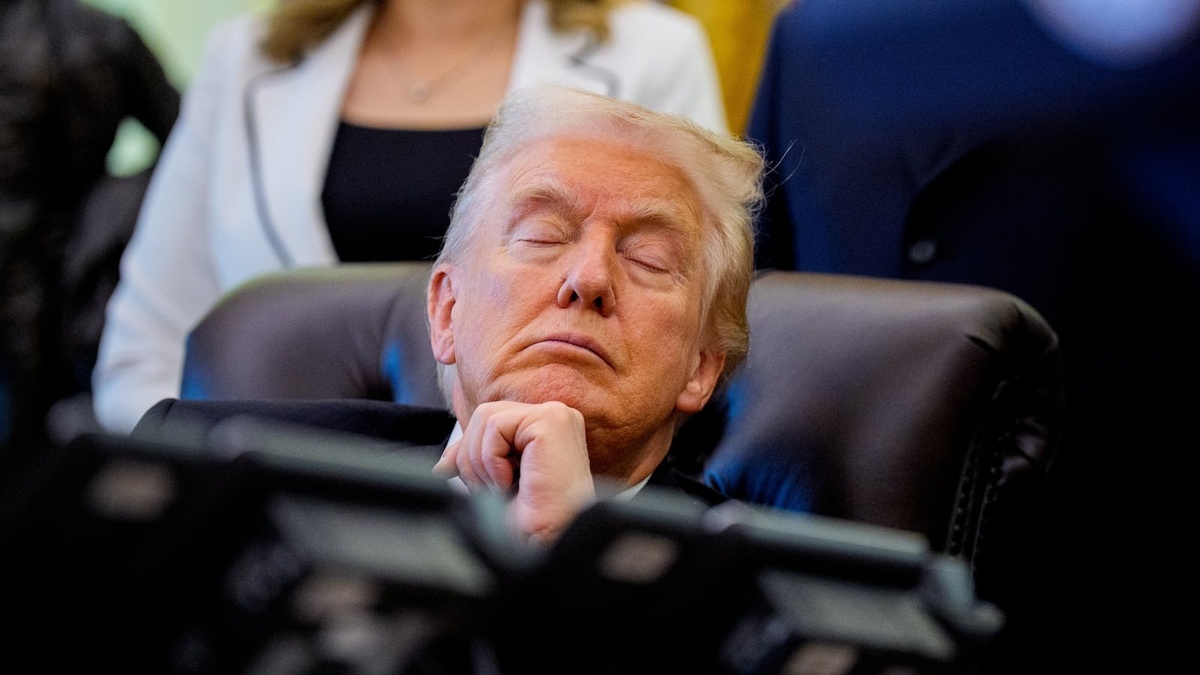
Publicly, allies of the president moved quickly to normalize the incidents. Commentators on conservative media suggested the president was “resting his eyes” or deeply focused. A Fox News medical contributor compared Mr. Trump’s brief lapses to the power naps of Thomas Edison, a comparison that was swiftly mocked online. Others argued that long meetings and relentless schedules would exhaust anyone, particularly a 79-year-old man carrying the burdens of the presidency.
Privately, however, the mood has been more fraught. According to two people briefed on the matter, staffers have quietly adjusted meeting lengths and presentation styles, hoping to maintain the president’s engagement during public sessions. One adviser described an unspoken rule: under no circumstances should anyone draw attention to the issue while cameras are rolling. “The fear,” the adviser said, “is not just embarrassment. It’s escalation.”

That escalation has been accelerated by the unusual source of scrutiny. Late-night comedians have long skewered presidents, but Mr. Kimmel’s commentary struck a nerve precisely because it intersected with broader political narratives. During the 2024 campaign, Mr. Trump repeatedly attacked President Joe Biden over age and stamina, portraying himself as uniquely energetic. Now, critics argue, those attacks have rebounded with a force sharpened by video evidence and punchlines.
The president himself has dismissed the controversy outright. At a recent rally in North Carolina, he denied falling asleep at all and pivoted quickly to a familiar refrain, calling for mandatory cognitive testing for sitting presidents. The timing was not lost on observers. “It was a remarkable moment,” said one veteran Republican strategist. “He was responding to a visual narrative by denying the premise and changing the subject — classic Trump. But the visuals don’t go away.”
What makes this episode resonate beyond partisan skirmishing is its symbolic weight. The presidency is not merely a job of speeches and ceremonies; it is a role defined by attention, judgment, and constant decision-making. Even fleeting images of disengagement can erode confidence, particularly in an era when every second of footage can be replayed endlessly, reframed by critics and comedians alike.
For Mr. Kimmel, the segment was another successful night of television, blending political critique with entertainment. For the White House, it was a reminder that power now competes with perception on an unforgiving stage. And for the public, the episode sits uneasily between humor and unease — funny enough to share, serious enough to linger.
As the clips continue to circulate and the jokes keep coming, aides are left managing not just a communications challenge, but a deeper vulnerability. In modern American politics, ridicule can be as destabilizing as opposition, especially when it crystallizes into a single, unforgettable image.
The laughter may fade. The questions, for now, have not.