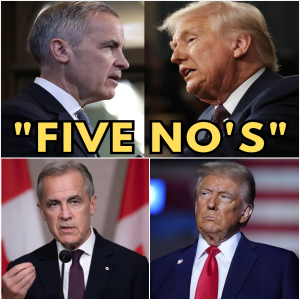
Trade Talks Between the U.S. and Canada Stall as Ottawa Signals a Strategic Pause

Washington — Trade negotiations between the United States and Canada hit a sudden impasse this week after Washington signaled the possible reimposition of targeted tariffs, prompting a swift and measured response from Prime Minister Mark Carney that effectively froze talks and sent ripples through diplomatic and business circles on both sides of the border.
The breakdown followed a series of increasingly blunt warnings from former President Donald J. Trump and his allies, who accused Canada of exploiting trade loopholes and threatened punitive duties on key Canadian exports. Canadian officials, while avoiding public escalation, moved quickly to suspend negotiations, citing legal uncertainty and what they described as an erosion of good-faith bargaining.
The result was a rare moment of visible friction between two of the world’s most economically integrated partners — and a reminder of how fragile even long-standing trade relationships can become under political pressure.
A Negotiation Unravels
According to officials familiar with the talks, negotiators had been working toward incremental updates to existing trade arrangements, focusing on industrial supply chains, energy exports and dispute-resolution mechanisms. Progress had been slow but steady until U.S. rhetoric shifted sharply in recent days, with Trump allies publicly reviving tariff threats tied to domestic political messaging.
Canadian officials viewed the move as destabilizing. Within hours, Ottawa signaled that negotiations would be paused pending clarification of Washington’s legal position and trade intentions.
“This was not a walkout,” said a senior Canadian official, speaking on the condition of anonymity to discuss sensitive talks. “It was a controlled stop.”
Carney’s Calculated Response

Mr. Carney, who has positioned himself as a steward of economic stability, refrained from direct confrontation. In public remarks, he emphasized “predictability, legality and mutual respect” — diplomatic language that nonetheless conveyed firmness.
Analysts said the response reflected a broader Canadian strategy: refusing to negotiate under threat while avoiding the appearance of escalation.
“Carney understands leverage,” said Meredith Collins, a trade economist at the Brookings Institution. “By pausing rather than protesting, Canada forces Washington to explain itself.”
Behind the scenes, Canadian trade lawyers reportedly began reviewing contingency measures, including potential challenges under international trade law should tariffs be imposed without due process.
Washington Reacts — Quietly

In Washington, the reaction was notably restrained. Administration officials declined to characterize the pause as a breakdown, insisting that “talks remain ongoing.” But privately, some acknowledged surprise at Canada’s decisiveness.
“There’s an assumption in Washington that Canada will absorb pressure and keep negotiating,” said a former U.S. trade official. “This time, they didn’t.”
Business groups were quick to voice concern. The U.S. Chamber of Commerce warned that renewed tariff uncertainty could disrupt cross-border supply chains that remain deeply intertwined, particularly in autos, agriculture and energy.
Legal and Economic Stakes
Trade experts noted that tariff threats raise immediate legal questions, especially if imposed without formal justification under existing agreements. Canada has historically been willing to litigate disputes — and often successfully.
“Canada plays the long game,” said Collins. “They rely on rules, not rhetoric.”
Markets reacted cautiously. While there was no immediate sell-off, analysts said uncertainty alone could delay investment decisions, particularly for firms dependent on predictable cross-border flows.
A Familiar Pattern, a New Tone

The episode echoes earlier periods of U.S.–Canada trade tension, particularly during Trump’s presidency, when tariffs on steel and aluminum strained relations. What differs now, analysts say, is Canada’s posture.
“Canada is less willing to negotiate from a defensive crouch,” said a senior European diplomat who follows North American trade closely. “Ottawa has options it didn’t emphasize before.”
Those options include deeper trade ties with Europe and Asia, where Canada has invested heavily in recent years.
Domestic Politics Shape the Moment
The impasse also reflects domestic political pressures in the United States. Tariff threats have long been a favored rhetorical tool in Trump-aligned politics, resonating with voters skeptical of globalization. Canada, by contrast, has sought to insulate trade policy from electoral cycles.
“That mismatch creates friction,” Collins said.
Mr. Trump has not commented directly on Canada’s decision to pause talks, but allies framed it as evidence that pressure was working — a claim Canadian officials flatly rejected.
What Comes Next
Both sides left the door open to resuming negotiations, but analysts said movement would likely require Washington to clarify its trade posture and de-escalate rhetoric.
For Canada, the pause sends a message not just to Washington, but to other partners: that it will not negotiate under threat, even with its closest ally.
For the United States, the moment raises a broader question about how allies respond to coercive trade tactics in an era of shifting power dynamics.
“Canada didn’t shout,” Collins said. “They stopped. And sometimes that’s louder.”
As trade officials wait for next steps, the episode underscores a quiet but consequential shift in North American economic diplomacy — one in which calm restraint may prove as disruptive as confrontation.
https://www.youtube.com/watch?v=-jVFQJ9-pUo