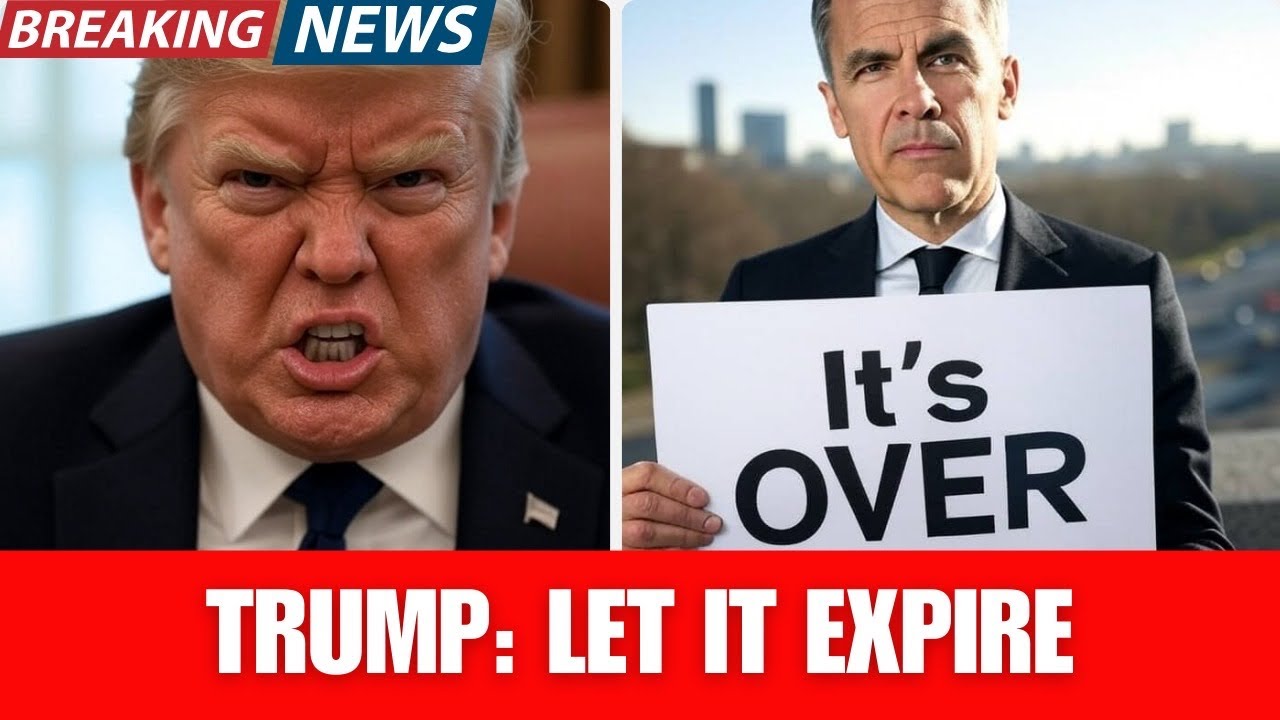
OTTAWA — A brief exchange in a low-profile trade hearing in Washington has prompted an unusually rapid and coordinated response inside Canada’s federal government, according to several senior officials, after former President Donald Trump suggested key bilateral trade provisions could be allowed to “expire.” The phrase, delivered almost in passing, has triggered far-reaching concerns in Ottawa about the stability of North America’s economic architecture and the vulnerability of Canadian industries built around predictable access to U.S. markets.
While the remark received little attention from American media, Canadian policymakers interpreted it as a potential sign that the next phase of U.S. economic policy — regardless of who wins in November — may move in a significantly more protectionist direction. By the end of the day, senior civil servants had begun convening a series of highly restricted strategy meetings, part of what officials described as contingency planning for scenarios that could reshape the country’s economic landscape.
The meetings, held across several secure locations in downtown Ottawa, were notable not only for their substance but for their secrecy. Multiple officials said some staff members became aware of the gatherings only because empty blocks appeared on ministers’ calendars, prompting speculation that something beyond ordinary preparation was underway. Those familiar with the discussions say the mood was “focused, concerned and highly technical,” with analysts modeling the effects of potential disruptions to automotive supply chains, agricultural exports, cross-border energy flows and the broader North American manufacturing ecosystem.
At the center of the deliberations is the possibility — still hypothetical, but no longer dismissed internally — that parts of the Canada-United States-Mexico Agreement could be reopened, weakened or simply left unresolved if Washington shifts its approach to shared industrial policy. The unpredictability surrounding future American trade strategy, combined with pre-existing strains over electric vehicle incentives and critical minerals, has reinforced a sense that the rules governing North American commerce may be entering a period of volatility.
“Canada cannot afford to be surprised,” said one senior official briefed on the meetings. “Even ambiguous signals from Washington require us to evaluate how exposed we are — and we are exposed across almost every major sector.”
Industry groups have been informed only in general terms, but economists say the risks are not abstract. Canada’s automotive sector remains deeply intertwined with U.S. production lines; even modest changes to rules of origin could disrupt investment decisions across Ontario’s manufacturing corridor. On the Prairies, grain shippers worry that expanding American skepticism toward import reliance could upend export expectations. And in British Columbia, where lumber disputes have flared repeatedly, the prospect of renewed tariff confrontations could affect thousands of jobs.
Complicating matters is that several of the contingency plans under review — including expanding European market access, accelerating Indo-Pacific supply diversification and exploring new domestic industrial incentives — signal a potential shift toward greater economic autonomy. Such moves would not indicate a break from the United States, officials stressed, but rather an acknowledgment that Canada may need broader options if the bilateral relationship becomes less predictable.
As the internal deliberations expanded through the week, political reaction remained measured. Government spokespeople declined to comment on what they described as “routine planning,” and opposition parties offered little more than targeted criticism that the federal government had not communicated clearly with the public. The lack of visible alarm has done little to quiet speculation, however, particularly among analysts who say Ottawa’s sensitivity suggests more than simple prudence.

“The fact that contingency work is happening at this scale tells us officials believe the trade environment could deteriorate quickly,” said a trade scholar at the University of Toronto. “This is not about panic — it is about the realization that Canada’s long-standing assumptions about U.S. stability may no longer hold.”
Diplomats, meanwhile, have begun quietly sounding out counterparts in Europe and Asia about market access and regulatory cooperation, a sign that Canada is not limiting its preparations to North America alone. Several allies expressed surprise at how seriously Ottawa responded to Trump’s remark, but officials insist the reaction reflects structural realities: Canada’s economy, more than most advanced economies, is deeply dependent on predictable cross-border flows.
Still, the central question remains unanswered: does Ottawa know more than it is prepared to say publicly? Those closest to the planning insist the government is responding not to classified intelligence but to uncertainty — and to a political climate in Washington that makes long-term commitments increasingly difficult to secure. Yet the intensity of the meetings suggests a recognition that Canada may soon face choices it has not confronted in decades.
As one senior adviser put it, “We are preparing for possibilities we hope never materialize. But hope is not the basis for strategy.”
For now, the planning continues behind closed doors, and Canadians are left to interpret the silence — a reminder that even a few words uttered in Washington can reverberate across Ottawa with lasting economic consequences.