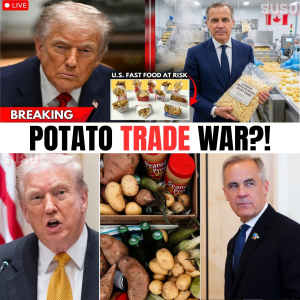
What began as a familiar political provocation has now escalated into a high-stakes confrontation over resources, trade leverage, and North America’s agricultural future.
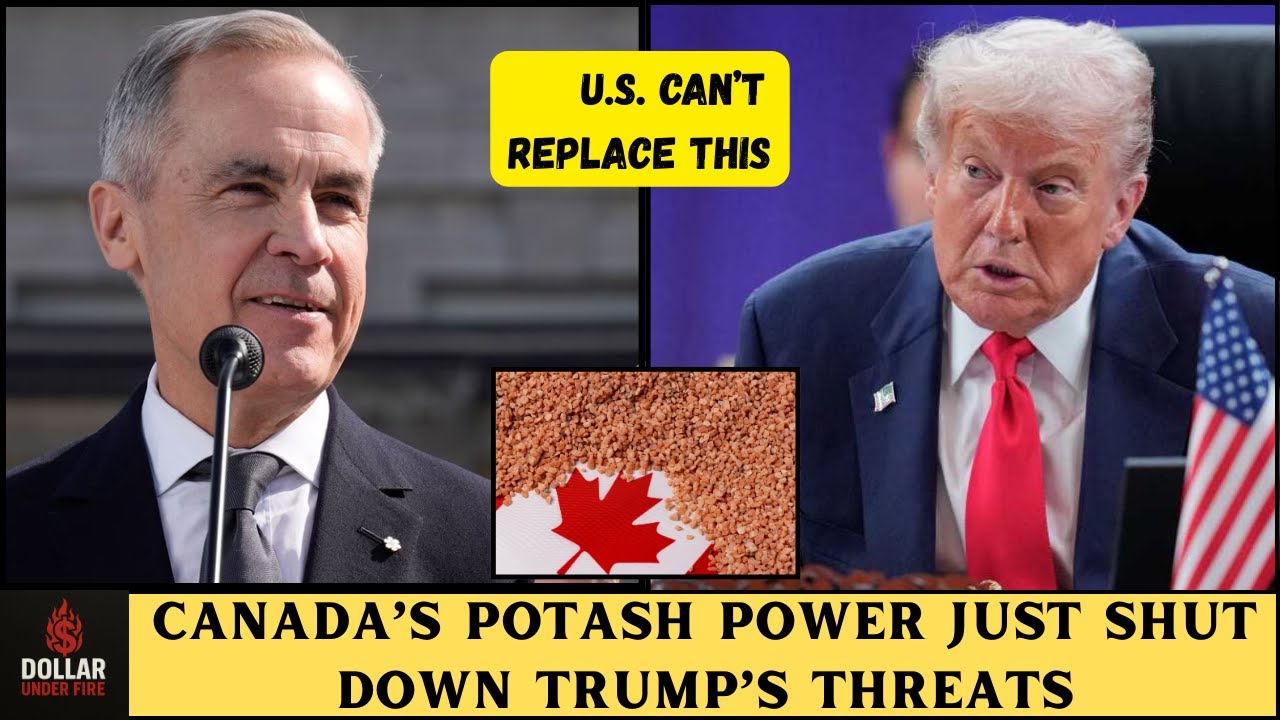 The chain reaction started when former President Donald Trump signaled that he was considering heavy tariffs on potash — the critical mineral that underpins the entire U.S. agricultural system. No executive order was issued and no policy was formally drafted, yet the mere threat instantly triggered panic in the global fertilizer market. Potash prices jumped, production forecasts shifted, and American farmers were hit with rising input costs before spring planting even began.
While U.S. markets reacted in real time, Canada — the world’s largest and most stable supplier of potash, responsible for nearly one-third of global output — responded with complete silence. No press conferences. No counter-threats. No public diplomacy. Ottawa’s calm, almost calculated lack of reaction became a story in itself, raising alarm among analysts who understand the fragile dependency between the two countries. The truth is stark: the United States relies on Canada for up to 90% of its potash imports, and with supply from Russia and Belarus constrained by geopolitical conflict, Canada effectively holds North America’s agricultural lifeline.

The impact on American farmers was immediate. Potash is the second-largest operating cost for major U.S. crops like corn, soybeans, and wheat. A spike in fertilizer prices can disrupt planting decisions, reduce yields, and squeeze profit margins across the Midwest — the heart of America’s food production. Agricultural groups warned that the sudden cost increases could destabilize local economies and force the federal government to consider multi-billion-dollar emergency subsidies just to offset a price surge caused by political posturing rather than market fundamentals.
While U.S. stakeholders scrambled, Canada used the moment to strengthen its global position. Major Canadian producers began expanding partnerships across Europe and emerging markets, subtly reinforcing the message that Canada is the world’s most reliable potash supplier. Ottawa did not need aggressive rhetoric; its geological advantage speaks for itself. When Washington attempted to use potash as a pressure point, Canada merely held steady — allowing the markets to reveal which side truly holds leverage.
At the center of the crisis is a simple structural reality: the United States cannot quickly or easily replace Canadian potash. The U.S. has no major potash deposits capable of commercial-scale production. Developing new mines would require decades of permitting, billions in investment, and complex infrastructure that does not currently exist. This leaves American agriculture deeply dependent on Canada in a way that cannot be resolved with tariffs or tough political language.
The balance of power is shifting in a way many Americans did not anticipate. Canada, often perceived as the quieter partner in North American geopolitics, now sits atop one of the most strategically important resources in the world. Without potash, crop yields collapse, food prices rise, and supply chains fracture. And as the world navigates inflation, climate disruptions, and global conflict, reliable access to fertilizer is not simply an economic issue — it is a matter of national security.
Trump’s tariff threat, intended to pressure Canada, inadvertently exposed the United States’ own vulnerabilities. The move demonstrated that political leverage means little when a nation is structurally dependent on the resource it seeks to weaponize. Rather than forcing Ottawa into concessions, the threat magnified Canada’s strength and highlighted America’s lack of alternatives.
Ultimately, the potash standoff is more than a dispute over trade policy. It is a revealing case study in how modern power is distributed — not just in legislatures or military alliances, but deep underground, in the minerals and materials that sustain global food systems. The episode underscores a new geopolitical truth: in a world defined by supply chain shocks and resource scarcity, quiet stability can be more powerful than loud threats. And in this moment, Canada has proven that silence can be a strategic advantage.