A Late-Night Takedown Reverberates in Washington as Kimmel and Senator Kelly Confront Trump On-Air
In an age when political conflict often unfolds on social media or in closed-door briefings, it was a moment of unmistakable cultural crossover: a late-night television monologue that drifted into the territory of a Senate hearing. Jimmy Kimmel, long accustomed to shaping public opinion with comedic barbs, invited Senator Mark Kelly to join him for a segment that, within hours, had transformed into a national flashpoint. Their discussion—part humor, part sober critique—offered a pointed assessment of former President Donald Trump’s behavior, prompting a reaction that ricocheted from studio audiences to political circles throughout Washington.
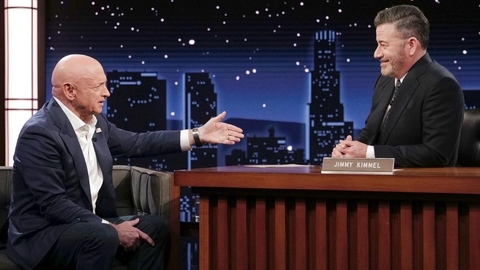
The segment began in familiar territory. Kimmel delivered a monologue laced with jokes, audience banter and the usual rhythms of late-night television. But the tone shifted as Senator Kelly stepped onto the stage. Known for his measured style and background as a former astronaut and Navy captain, Kelly began with an understated analysis of what he described as “patterns of instability” in the former president’s conduct, particularly in recent months. The language was calm, almost clinical, but the implications were unmistakable. Kimmel’s role throughout the exchange was to punctuate Kelly’s statements with comedic interpretation—an exchange that allowed the senator to project seriousness while the host began to underscore those observations with punchlines.
What electrified the moment was the fusion of formats: political critique delivered within a comedic frame, resulting in commentary that spread rapidly across digital platforms. Viewers shared clips of Kelly’s remarks, particularly a moment in which he noted that “leadership is not merely a performance of strength, but a discipline of stability,” a line that would later be replayed on cable news panels. Kimmel responded with a joke suggesting that Trump had “mastered turbulence, not governance,” a quip that landed easily yet drew attention to the underlying critique.
According to aides familiar with the matter, Trump watched the segment live from Mar-a-Lago. Several people who later described the scene characterized his response as “agitated,” noting that he paced while directing remarks toward the television. One person briefed on the moment said he chastised Kelly as “a grandstanding ex-astronaut” and complained that Kimmel was “trying to interfere in politics,” though the individual spoke on the condition of anonymity to describe private behavior.
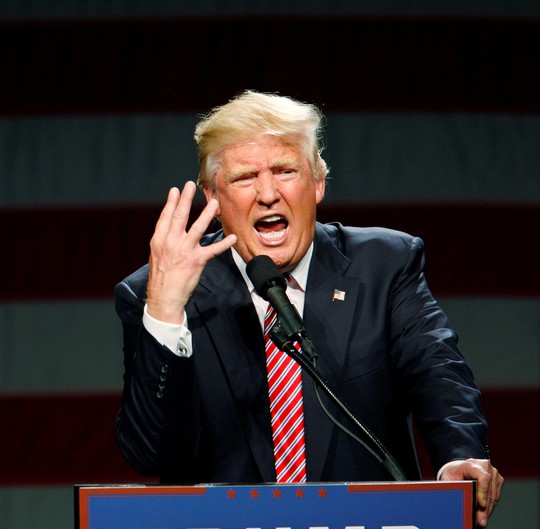
Long after the cameras stopped rolling, the conversation continued in Washington. Some Republican lawmakers dismissed the segment as political theater, while others privately acknowledged that the senator’s remarks reflected concerns they had heard circulating among colleagues. Democrats, meanwhile, seized on the moment as evidence of growing alignment between public sentiment and institutional unease about the former president’s conduct.
The White House, for its part, refrained from direct comment, but several administration officials appeared keenly aware of the clip’s reach. A senior official, speaking privately, described the segment as “the kind of cultural moment that shapes voter impressions more strongly than a press release ever could.” The remark was less an endorsement of the content and more an acknowledgment of the political reality: entertainment platforms can serve as megaphones for political messaging, and their influence is often unpredictable.
Media analysts noted that while late-night hosts have long used their platforms to criticize elected officials, the combination of Kimmel and a sitting senator lent the segment a degree of gravitas that set it apart from typical satire. The dynamic echoed moments from earlier eras when entertainers and public officials intersected in ways that reflected—rather than drove—sentiment in the electorate. In this case, the collaboration seemed to crystallize broader questions about the former president’s temperament and the role it may play in ongoing political debates.
By the next morning, the clip had been viewed millions of times across multiple platforms. News outlets framed the exchange as everything from an “on-air rebuke” to “a cultural reality check” for a political figure known for dominating media cycles. Conservative commentators criticized the segment as partisan messaging disguised as comedy, while progressive analysts praised Kelly for bringing “adult language” to public conversations about leadership standards.

What remained clear, however, was the degree to which the episode highlighted enduring tensions in American politics: the conflict between public performance and private governance, the friction between entertainment and political discourse, and the persistent question of how leaders respond when confronted in an arena they cannot fully control.
Whether the moment ultimately alters any political trajectory remains uncertain. But in a fragmented media landscape—one where voters consume news through comedy, commentary and curated clips—the Kimmel-Kelly segment provided a snapshot of how cultural and political forces continue to blur. It was not just a monologue or a senatorial interview; it was a public reckoning staged in a format familiar to millions, reflecting anxieties that continue to define the national conversation.