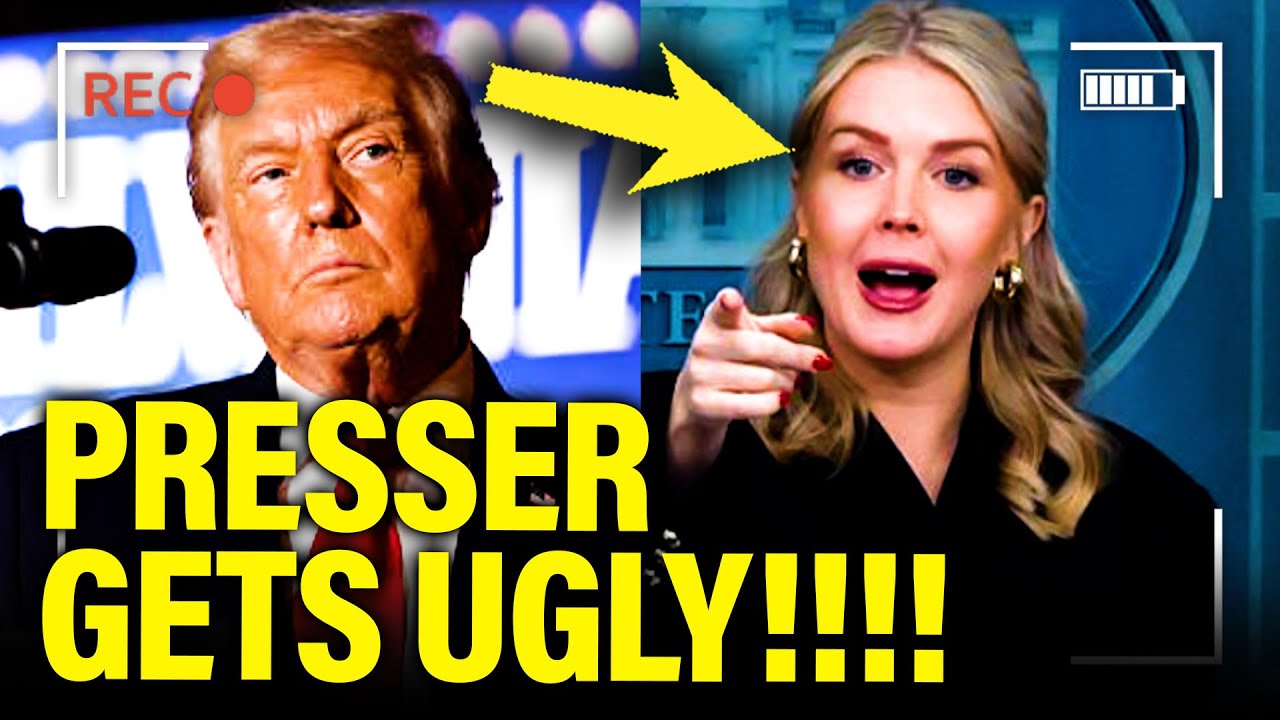
In one of the most contentious press briefings of the year, White House Press Secretary Karoline Leavitt faced an increasingly assertive press corps as she attempted to defend President Donald Trump’s recent statements on inflation, national security, and economic policy. What began as routine questioning quickly escalated into a sustained series of fact-checks, challenges, and pointed exchanges that highlighted the widening disconnect between the administration’s messaging and publicly available data.
From the outset, the briefing was tense. A reporter opened by pressing Leavitt on why the president had repeatedly appeared in public wearing bandages on his hands—a minor but persistent observation that fueled speculation. Leavitt attributed the bandages to excessive handshaking and aspirin-related bruising, a response that drew raised eyebrows in the briefing room. Though seemingly trivial, the moment foreshadowed the larger credibility battles that would define the remainder of the session.
The first significant clash came when Leavitt reiterated the administration’s claim that inflation had fallen to 2.5 percent. A reporter immediately corrected her, noting that the most recent Consumer Price Index data placed inflation at 3 percent. Leavitt doubled down, citing internal figures and framing the administration’s narrative as fact-based despite contradictions with publicly accessible metrics. The exchange underscored a recurring tension: the administration’s effort to reframe economic conditions in more favorable terms, often at odds with independent data.
This friction intensified when CNN’s Kaitlan Collins questioned why the president, if convinced of a strong economy, had recently urged parents to buy only “two or three dolls” for their children during the holiday season. Leavitt responded with a defense of the administration’s tariffs and a broader argument for purchasing American-made goods. Yet the attempt to recast the president’s remarks as an appeal to patriotism rather than economic caution sparked further scrutiny about the administration’s messaging strategy—and whether it aligned with the lived experiences of American families confronting rising prices.
A similar dynamic played out when reporters pressed Leavitt on the administration’s decision to allow certain high-end Nvidia semiconductor chips to be shipped to China under specific conditions. The H200 series chips, considered among the most advanced in the world, represent a significant technological advantage for the United States. Leavitt insisted the administration was upholding strict security protocols, but her explanation did little to resolve concerns about the strategic implications of the policy.
Throughout the briefing, Leavitt repeatedly invoked average inflation trends, rising wages, and declining gas prices as evidence that the administration had stabilized the economy after inheriting what she described as a “historic economic hole.” Yet reporters challenged these claims with consistent counterpoints—highlighting grocery costs, housing affordability, and discrepancies in the administration’s framing of inherited economic conditions. The back-and-forth revealed not only policy disagreements but also competing versions of economic reality.
Tensions escalated further when Leavitt criticized CNN’s ratings in response to questions about the president’s stated desire to condition any future Warner Bros. merger on selling the network. The moment drew murmurs in the room, raising concerns about potential political interference in the media landscape and reinforcing perceptions of adversarial relations between the administration and major news outlets.
Foreign policy proved no less contentious. Asked about Venezuela and the recent seizure of a Venezuelan oil tanker, Leavitt confirmed that the United States intended to seize the oil on board pending legal proceedings, positioning the action as a measure that could eventually support affordability in domestic markets. In another exchange, she defended the president’s foreign policy record, asserting that he had “solved nine conflicts” and was deserving of the Nobel Peace Prize—a characterization that stands in stark contrast with ongoing global conflicts and geopolitical tensions.
The briefing concluded with pointed questions about health-care subsidies scheduled to expire within weeks. Reporters asked whether the administration was prepared for millions of Americans to face higher health-care costs. Leavitt attributed the looming expiration to Democratic legislation and emphasized that Republicans were developing “creative solutions,” though she did not offer specifics—leaving a number of critical questions unanswered.
By the end of the briefing, one theme was unmistakable: the White House is facing a growing challenge in maintaining message discipline in the face of rigorous questioning and conflicting public data. Leavitt’s unwavering defense of the administration did little to bridge the divide. Instead, the briefing laid bare the broader turbulence surrounding the administration’s policy positions, communication approach, and relationship with the press.
As the election season intensifies and scrutiny mounts, the White House may find it increasingly difficult to reconcile its internal narrative with the external realities journalists continue to bring to light. The latest briefing offers a glimpse into what could become a defining dynamic of the months ahead: a combative White House, a skeptical press corps, and a public caught between competing claims of what the truth really is.