The Northern Pivot: How Washington’s Pressure Campaign Created a New Competitor
OTTAWA — For nearly a century, the geopolitical relationship between the United States and Canada was defined by a comfortable, if lopsided, predictability. Washington set the tempo, and Ottawa, for the most part, hummed along. But as the winter of 2026 takes hold, that rhythmic symmetry has been replaced by a jarring dissonance. What began as a series of aggressive U.S. trade demands and provocative rhetoric—ranging from threats to dissolve the USMCA to the explosive, if informal, suggestion of Canada as a “51st state”—has backfired in a way few in the West Wing anticipated. Instead of a neighbor cowed into submission, the United States is finding itself facing a strategically autonomous, economically defiant North American competitor.
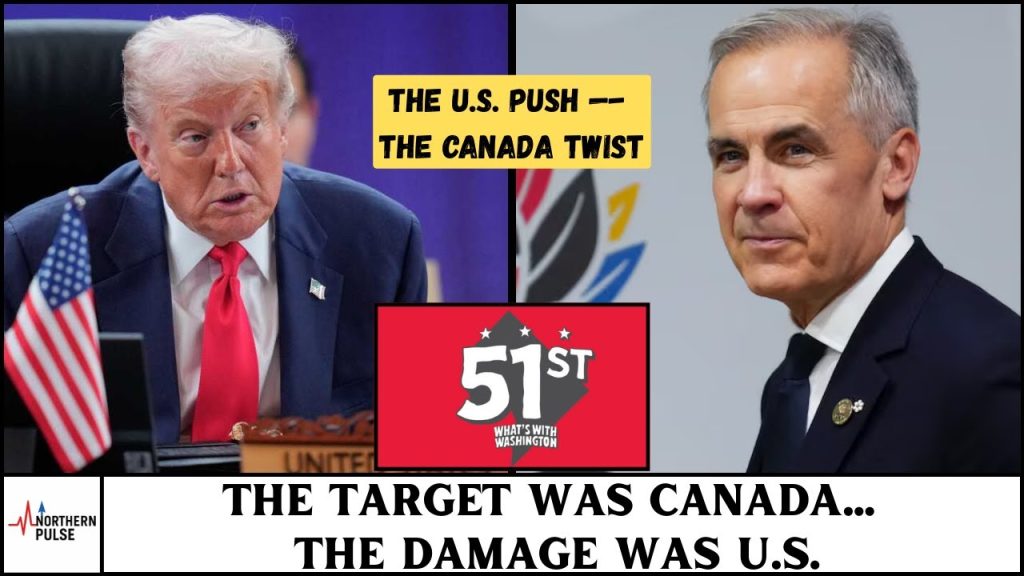
The fracture reached a boiling point following comments from U.S. Trade Representative Jameson Greer, whose recent skepticism regarding the longevity of the USMCA sent immediate tremors through the Canadian capital. When combined with President Trump’s renewed tariff threats and a series of late-night social media posts questioning Canadian provincial integrity, the message to Ottawa was clear: the old rules of engagement were no longer in effect. However, the “America First” strategy, designed to extract concessions through sheer leverage, seems to have missed a fundamental shift in the global landscape. Canada, led by a technocratic government that views economic stability as its primary weapon, decided to stop waiting for American permission and started building its own exit ramp.
The moment Canada realized the traditional relationship was over did not come during a grand summit, but in the quiet realization that American volatility was now a permanent feature, not a bug. Canadian policymakers, long accustomed to being the junior partner, have undergone a psychological decoupling. Rather than engaging in a tit-for-tat tariff war that would bleed both economies, Ottawa flipped the script. They recalibrated their capital attraction strategy, positioning Canada not as an adjunct to the U.S. market, but as a “safe-haven” for global firms seeking the one thing Washington currently lacks: predictability.
This strategic pivot is already yielding tangible, and for some U.S. analysts, alarming results. There has been a measurable surge in global investment flowing into Toronto, Montreal, and Vancouver—capital that was previously earmarked for U.S. expansion. European and Asian conglomerates, wary of the shifting regulatory sands and “cooperation metrics” emerging from Washington, are increasingly viewing Canada’s robust legal framework and its new “Alternative Security Partnership” as a more reliable bet. In the cold language of the markets, Canada is being re-rated as a low-risk alternative to an increasingly high-risk United States.

The economic boomerang of this pressure campaign is now hitting U.S. manufacturing hubs with unexpected force. Because the two nations’ supply chains are so deeply intertwined, any friction at the border acts as a tax on American producers. From the automotive plants in Michigan to the aerospace clusters in Washington State, the cost of uncertainty is rising. U.S. consumers, too, are feeling the pinch as the reliability of cheap Canadian energy and raw materials is called into question. By threatening the USMCA, the United States has inadvertently forced its largest supplier to begin looking west to the Pacific and east to the Atlantic for more stable, long-term contracts.
Perhaps the most significant miscalculation by Washington was the assumption that Canada lacked alternatives. In reality, the 2026 landscape is vastly different from that of the 1990s. Canada’s aggressive pursuit of trade agreements with Japan, South Korea, and the European Union has provided it with a diversified portfolio that dilutes American leverage. As Ottawa moves forward with independent security frameworks and energy diversification, it is effectively dismantling the “continental energy security” model that has benefited American industry for decades. The U.S. may have intended to bring a partner to heel; instead, it has catalyzed the birth of a rival.
Inside the White House, the reaction to Canada’s resilience has been a mix of disbelief and internal finger-pointing. Sources close to the administration suggest that officials are struggling to comprehend how a nation they viewed as a “subordinate” could successfully navigate such an aggressive pressure campaign. The “51st state” rhetoric, intended to signal dominance, has instead served as a powerful unifying force for Canadians across the political spectrum, providing Prime Minister Mark Carney with the domestic mandate needed to pursue a policy of “Total Sovereignty.”

As the continent enters the second quarter of 2026, the question is no longer whether the U.S.-Canada relationship can be restored, but what will replace it. The parallel North Americas model is no longer a theoretical exercise; it is a developing reality. One North America is defined by a populist, inward-looking United States, and the other by a globalist, diversified Canada that is increasingly looking beyond its southern border for its future. The “Huge Mistake” that analysts are now whispering about is the realization that in trying to squeeze Canada, the United States may have permanently pushed it away.
The lesson of the last few months is one of diminishing returns. In a globalized world, leverage is often an illusion if the target has the will and the wisdom to walk away. As Canada continues to secure its independent future, the United States is left to grapple with the unintended consequences of its own strength. The border that was once the world’s longest undefended line is becoming a mirror, reflecting two very different visions of what it means to be a power in the 21st century.