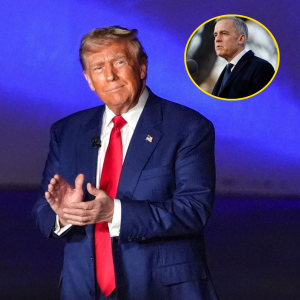
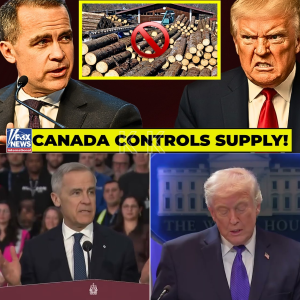
A Shocking Escalation in North American Trade Relations

In a stunning economic and political rupture that has sent shockwaves across borders, President Donald J. Trump has erupted with a blistering threat to impose 100 percent tariffs on all Canadian imports, effectively doubling the cost of goods flowing into the United States overnight. The move, announced amid rising fury over Canadian Prime Minister Mark Carney’s deepening ties with Beijing, has plunged the long-stable U.S.-Canada economic partnership into crisis. What began as a targeted adjustment in tariffs has ballooned into a full-blown confrontation, with billions in daily cross-border trade hanging in the balance and industries on both sides bracing for paralysis.
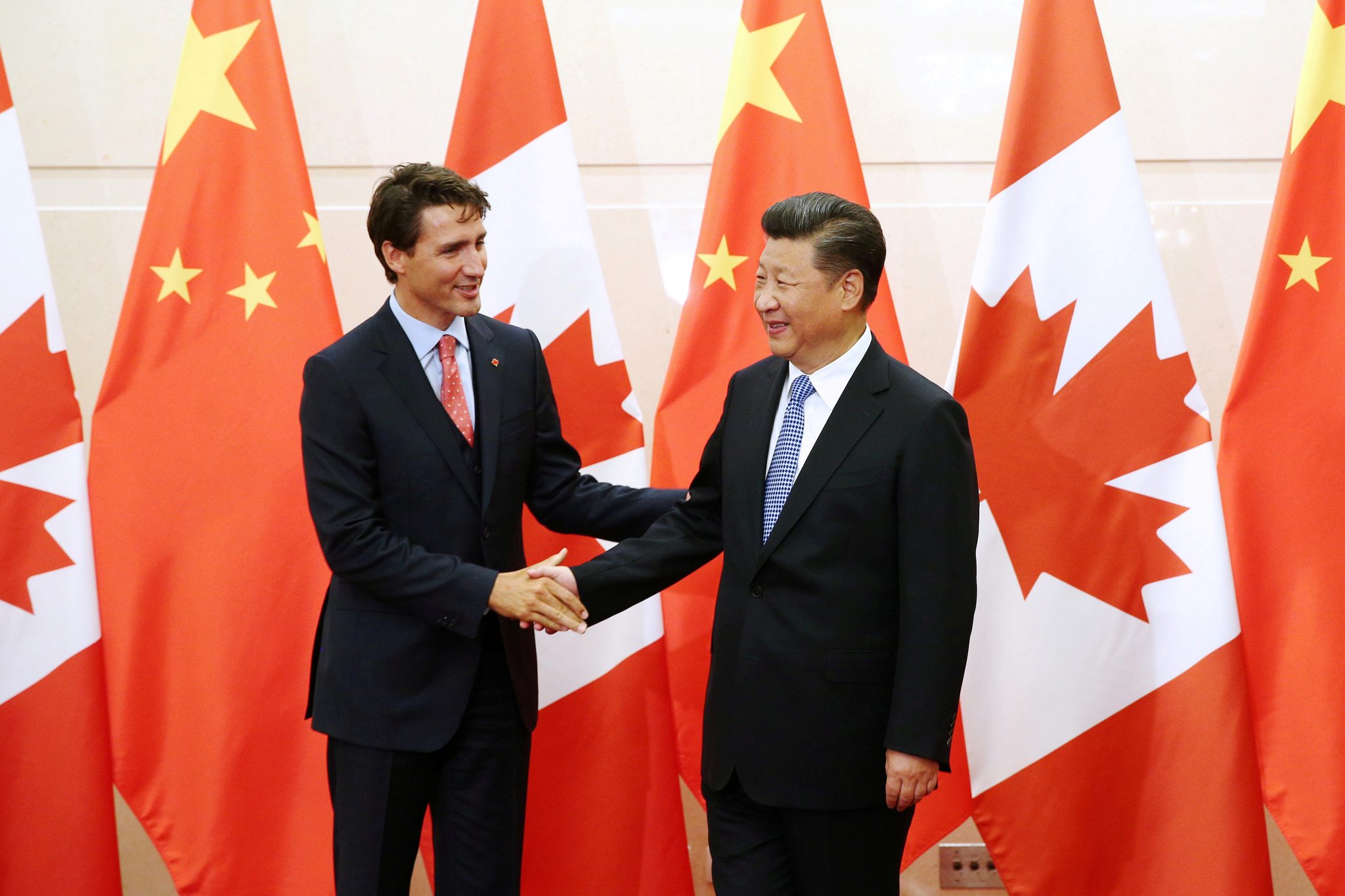
The crisis ignited suddenly last week when Carney, fresh from his first high-profile visit to Beijing in years, emerged with a landmark agreement that slashes barriers on key sectors. Under the deal, Canada will permit an annual quota of 49,000 Chinese electric vehicles to enter its market at a dramatically reduced tariff of just 6.1 percent — a sharp reversal from the previous 100 percent duties that mirrored U.S. policy. In return, China has slashed tariffs on Canadian canola from 85 percent to 15 percent and eliminated them entirely on lobster, crab, and other seafood products. For prairie farmers in Saskatchewan and Manitoba, the pact promises a lifeline after years of retaliatory pain. Atlantic seafood exporters cheer the reopening of lucrative channels.
Yet in Ontario’s auto heartland, where hundreds of thousands rely on manufacturing jobs, the reaction has been one of outrage. Premier Doug Ford has decried the influx of what he calls potential “spy cars,” warning that the agreement risks infuriating Washington. His fears proved prescient. Just days after the Beijing signing, Carney took the stage at the World Economic Forum in Davos, delivering a thunderous address that many interpreted as a direct rebuke of Trump’s aggressive trade tactics. Declaring the old order of North American integration “over,” Carney spoke of middle powers banding together against coercion by great powers, earning a rare standing ovation from a global elite weary of unilateral threats.
Trump, speaking the following day, struck back with characteristic force. He dismissed Carney personally, mocked foreign leaders, and reiterated demands on unrelated issues like Greenland. The personal barbs escalated quickly: social media broadsides, the withdrawal of a symbolic invitation to a Trump-led initiative, and then the bombshell tariff threat. If Canada proceeds with the China pact, Trump declared, every Canadian good entering the U.S. would face 100 percent duties — a move that would devastate intertwined supply chains.
The Deeper Stakes: USMCA Review Looms as Existential Battle
At the heart of this explosive standoff lies the impending mandatory review of the United States-Mexico-Canada Agreement (USMCA), set for July 2026. The pact, which Trump himself renegotiated to replace NAFTA, underpins roughly $2 trillion in annual trilateral trade. With the review approaching, Washington has grown increasingly alarmed by what it sees as China exploiting Canada and Mexico as back doors to evade American tariffs. Chinese investments in North American manufacturing have surged in recent years, particularly in sectors like electronics and autos, raising fears of transshipment — where goods receive minimal processing to qualify for duty-free entry.

Trump’s administration views Carney’s EV quota as the thin edge of a dangerous wedge. While the vehicles are capped and intended primarily for the Canadian market — and do not automatically qualify for U.S. entry without meeting strict 75 percent North American content rules — critics argue it signals a broader shift. If Chinese firms establish assembly plants in Canada, they could eventually route production southward tariff-free, undermining Washington’s decoupling strategy from Beijing.
Carney, however, frames the deal not as alignment with China but as prudent diversification. With 75 percent of Canadian exports flowing to the U.S., reliance on a single partner has become untenable amid repeated threats of tariffs, annexation rhetoric, and unpredictable policy swings. In Davos, he signaled a deliberate pivot: boosting exports to China by 50 percent by 2030, alongside deeper ties with Europe, India, and Indonesia. Canada, he insists, thrives on its own values and sovereignty, not as an appendage of American power.
Economic Catastrophe on the Horizon
The potential fallout is catastrophic for both nations. Nearly $3 billion in goods and services cross the border daily. Canada supplies 60 percent of U.S. crude oil imports, vast amounts of electricity, steel, aluminum, and uranium. A 100 percent tariff would trigger immediate price shocks: higher costs for American refineries, auto plants, construction firms, and households already burdened by existing duties. Economic models suggest the average U.S. family could face thousands in added annual expenses, risking recession, factory shutdowns, and widespread layoffs. On the Canadian side, exporters would face ruin, with ripple effects crippling industries built around seamless integration.
Yet Trump appears convinced the pain will force concessions. He seeks tighter rules of origin, explicit anti-transshipment provisions, and alignment of Canadian and Mexican China policies with Washington’s. Carney, by contrast, demands stability and respect for sovereignty. Neither side shows signs of blinking.
This confrontation exposes fractures in the post-World War II order: the erosion of trust among allies, the fragility of rules-based trade when power trumps predictability. As negotiations intensify ahead of the USMCA review, the next six months will determine whether North America’s economic fortress endures or crumbles under the weight of rivalry and resentment. The stakes extend far beyond tariffs — they touch the very nature of partnership in an era of great-power competition.