World Cup 2026 on the Brink: Boycott Threats, Military Shockwaves and the Political Storm Swallowing FIFA
With five months to go before kickoff, the 2026 FIFA World Cup — designed to be the largest tournament in football history — is no longer defined by tactics, star forwards or stadium architecture. Instead, it is shadowed by petitions, parliamentary debates, visa anxieties and a geopolitical shock that has transformed the event into something far larger than sport.
Set to span the United States, Canada and Mexico with 48 teams and 104 matches, the tournament was projected to generate nearly $10 billion in revenue and create more than 290,000 jobs in the United States alone. But as the calendar narrows toward June 11, 2026, the competition is increasingly framed as a referendum on politics, power and the limits of FIFA’s neutrality.

Public pressure first surged in the Netherlands, where more than 150,000 citizens signed a petition urging their national team to boycott the tournament. The appeal argued that participation could be interpreted as tacit endorsement of Washington’s recent political and military decisions. While the Royal Dutch Football Association stopped short of supporting withdrawal, the scale of civic mobilization signaled that the debate had escaped sports pages and entered the public square.
Germany soon faced a similar reckoning. CDU parliamentarian Jürgen Hardt suggested Berlin reconsider participation under certain geopolitical circumstances. A national survey indicated that nearly half of respondents would support a boycott if the United States were to annex Greenland — a scenario raised repeatedly by President Donald Trump in recent months. Though the German Football Association has rejected the idea of withdrawal for now, unease lingers within European federations.
In the United Kingdom, members of Parliament have publicly floated boycott discussions. In France, lawmaker Eric Coquerel proposed relocating hosting duties to Canada and Mexico. Even former FIFA president Sepp Blatter — largely absent from the spotlight since leaving office — voiced support for reconsidering fan travel to the United States.
The tipping point for many observers came on January 3, 2026, when the United States launched “Operation Absolute Resolve” in Venezuela. According to official statements, more than 150 U.S. aircraft participated in an operation that led to the capture of Venezuelan President Nicolás Maduro, who was transported to New York for trial. The United States subsequently announced it would administer Venezuela, a move that polarized global reaction and intensified scrutiny of the World Cup’s political backdrop.
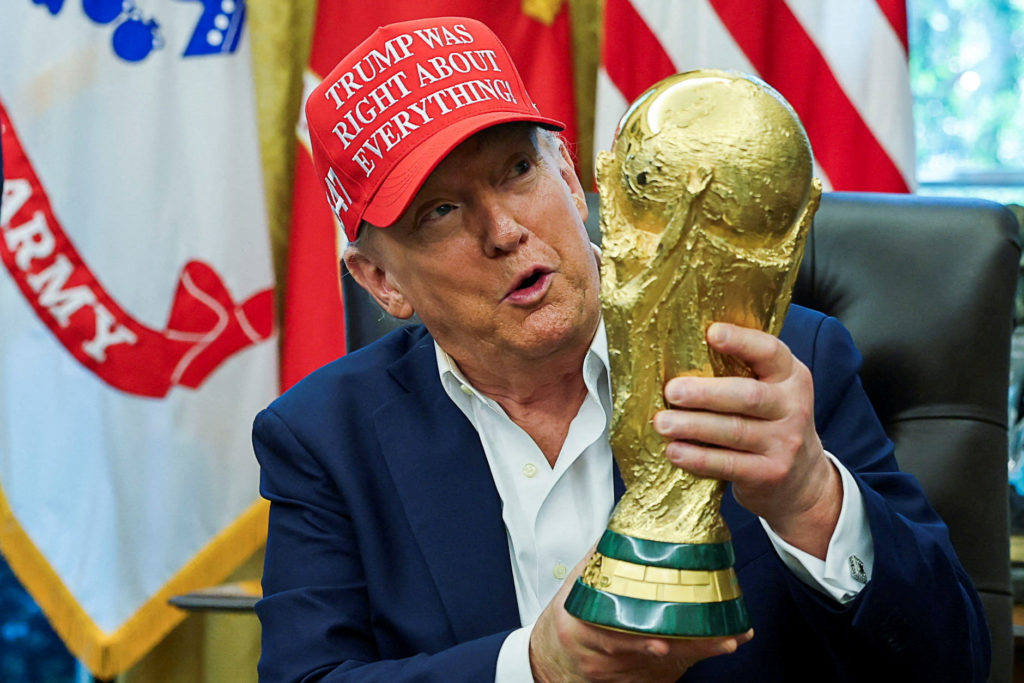
The tournament’s institutional optics have compounded the controversy. In March 2025, the White House established a task force for the World Cup chaired by President Trump, with Vice President J.D. Vance serving as vice chair. FIFA President Gianni Infantino has appeared alongside administration officials repeatedly, reinforcing perceptions of close coordination.
Symbolism reached a crescendo during the 2025 Club World Cup final, when Trump remained on stage as Chelsea celebrated victory. Days later, during the World Cup draw, Infantino presented the president with FIFA’s inaugural “Peace Prize,” citing diplomatic efforts abroad. FIFA later confirmed that Trump will personally present the World Cup trophy on July 19, 2026.
For critics, these gestures blur the line between sport and statecraft. Human rights organizations, including Human Rights Watch and the American Civil Liberties Union, have warned that large-scale tournaments risk becoming platforms for political messaging — whether intentional or not.
Immigration enforcement has emerged as another flashpoint. Reports of stricter visa scrutiny and entry complications during preparations for the 2025 Club World Cup have fueled anxiety among federations from Africa, Asia and the Middle East. Asylum-related detentions near host stadiums added to concerns about how visiting supporters may be treated.
Supporters of the tournament argue that isolating 2026 would be inconsistent with past precedents. The 1978 World Cup proceeded in Argentina under military dictatorship. The 2018 tournament unfolded in Russia following the annexation of Crimea. Qatar hosted in 2022 despite sustained criticism over labor conditions. From this perspective, singling out 2026 risks selective outrage.
Yet the scale of the upcoming competition amplifies every gesture. With 78 matches scheduled in U.S. cities and 13 each in Canada and Mexico, the event’s continental footprint is unprecedented. The economic momentum is formidable; contracts are signed, infrastructure projects are underway, sponsors are deeply invested.
Still, the debate now extends beyond financial projections. It revolves around whether participation equals endorsement — and whether absence would meaningfully alter policy or merely punish athletes who have trained for decades for this moment.
History suggests alternatives to outright boycott. In 1978, Dutch players publicly expressed solidarity with victims of Argentina’s regime. During the 2022 World Cup, German players covered their mouths in protest of FIFA’s ban on the “One Love” armband. Presence did not preclude expression.
As kickoff approaches, football federations face a dilemma without precedent in modern tournament cycles. Competing while making a visible stand could harness the global stage for principled messaging. Refusing to participate could send a sharper signal — but at enormous sporting and financial cost.
Between June 11 and July 19, 2026, billions will watch. They will see goals, celebrations and trophy lifts. But they will also see leaders, ceremonies and gestures heavy with implication.
The question is no longer whether politics will intersect with World Cup 2026. It already has. The real test is whether the tournament can prevent that intersection from widening into a divide that reshapes international sport for a generation.