By XAMXAM
DAVOS, Switzerland — Standing ovations are rare at the World Economic Forum. The annual gathering is designed for caution: calibrated language, hedged statements, and the careful avoidance of confrontation. That is why the reaction to Prime Minister Mark Carney’s speech this week caught so many delegates off guard. What Carney delivered was not a provocation or a theatrical rebuke. It was something far more unsettling for Washington: a clear, public diagnosis of how President Donald Trump’s use of pressure is reshaping the global system — and why Canada will no longer pretend otherwise.
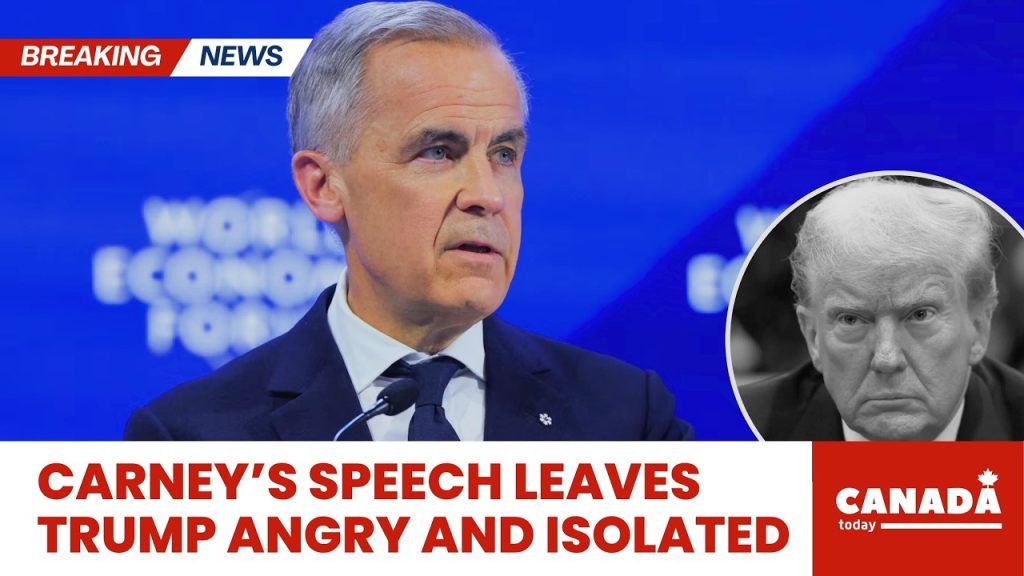
Carney’s address cut against the grain of Davos tradition. Rather than praising resilience or calling for dialogue in abstract terms, he argued that the world is no longer in a period of transition, but in the midst of a rupture. Over decades, he said, global integration had been sold as mutually beneficial. Today, that same integration is increasingly being weaponized: tariffs used as leverage, supply chains treated as vulnerabilities, and economic dependence turned into a tool of coercion.
The implication was unmistakable. Without naming Trump directly at every turn, Carney dismantled the logic that has defined the former president’s approach to trade and alliances. Pressure, he argued, does not create strength. It creates fear. And once fear replaces trust, systems built on cooperation begin to fracture.
For years, many countries responded to that dynamic by staying quiet. Leaders grumbled in private while hoping the pressure would ease or shift elsewhere. Carney made clear that Canada no longer believes silence is neutral. “We are taking the sign out of the window,” he said — a phrase that landed heavily in the hall. The old order, he argued, is not coming back, and nostalgia is not a strategy. Pretending that threats and tariffs are normal diplomacy only accelerates the damage.
The speech moved from theory to specifics when Carney addressed Greenland. Trump’s repeated threats to acquire the territory — backed by the possibility of tariffs on Denmark and other European allies — were not, Carney said, jokes or negotiating flourishes. They crossed a line. Greenland is not for sale. Tariffs are not diplomacy. And NATO, he added pointedly, is not a menu from which powerful members can pick and choose.
That framing marked a shift in Canada’s posture. For decades, Ottawa has been careful to avoid public confrontation with Washington, mindful of deep economic integration and political sensitivity. At Davos, Carney signaled that those constraints no longer dictate Canada’s response when sovereignty and alliance norms are challenged.

The applause that followed was telling. It was not the reaction of a crowd entertained by defiance. It was recognition. Many leaders in the room have faced similar pressures, often without the political space to address them openly. Carney articulated what others have avoided saying: that adapting quietly to coercion carries its own costs, and that the erosion of rules does not stop at any single border.
Carney anticipated the obvious question. Isn’t Canada uniquely vulnerable to U.S. pressure, given the scale of bilateral trade? His answer rejected the premise. Canada, he said, has already withstood significant pressure — and learned a lesson from it. Sovereignty in the modern world is not just about borders. It is the ability to absorb shocks, diversify relationships, and act without waiting for permission.
To underline the point, Carney pointed to actions rather than rhetoric. Canada has concluded or accelerated trade and strategic partnerships across multiple regions, including Asia and the Gulf. It has increased investments in Arctic security, working with Nordic and European allies to reinforce NATO’s northern flank. These moves are not anti-American, he stressed. They are anti-chaos.
That distinction matters. Carney did not frame Canada as a rebel or a victim. He framed it as a stabilizer — a country preparing for the world as it is, not the one it wishes still existed. In doing so, he challenged a central assumption of Trump’s strategy: that dependence guarantees compliance. When alternatives are built, pressure loses its edge.
What happens next will test that claim. Trump rarely backs down when challenged. He may escalate further, converting threats into action. Or he may recalibrate, wary of confirming the charge that economic coercion has become his default tool. Either outcome carries risks for Washington. Escalation could accelerate allied coordination. Retreat could signal that pressure no longer works as reliably as it once did.
The deeper significance of Carney’s speech lies beyond any single policy dispute. It suggests that a growing number of U.S. allies are reassessing how much silence costs them — and how much resilience they can build by acting openly. Power, after all, often depends less on force than on assumption. When those assumptions change, the system shifts.
At Davos, the applause marked that realization. Not that confrontation is desirable, but that pretending everything is fine no longer is.