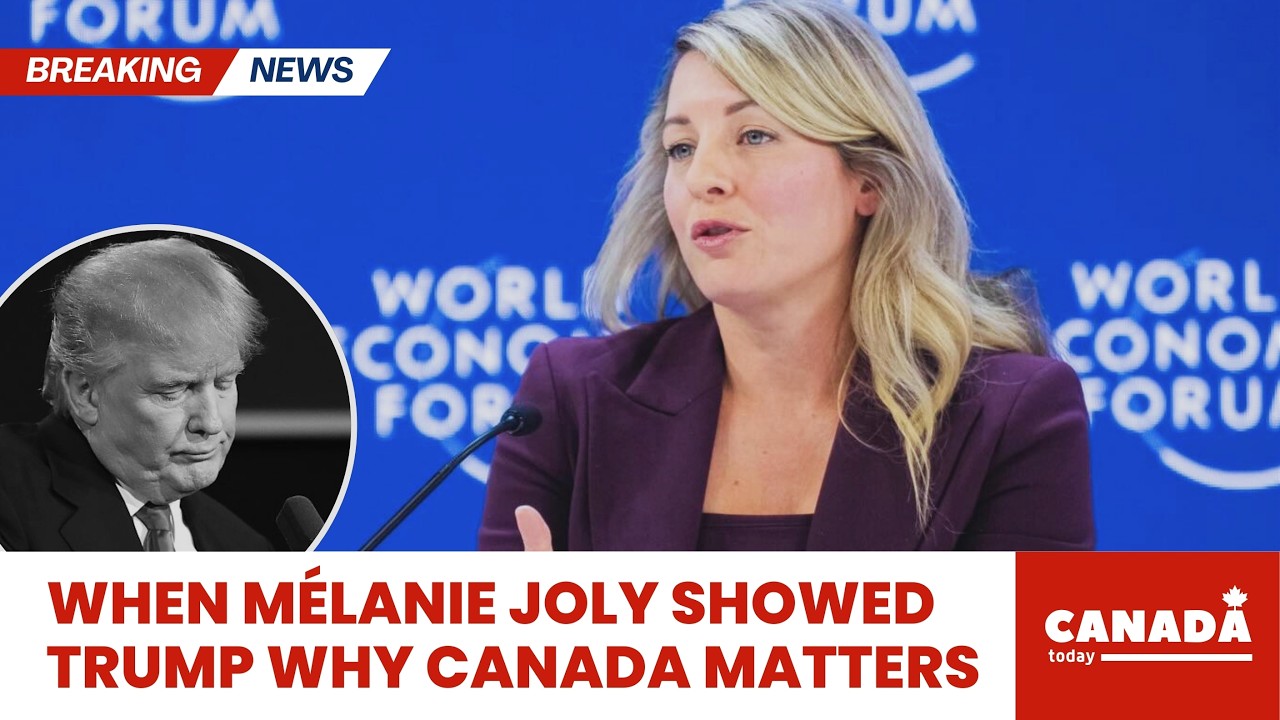
When Canada’s industry minister Melanie Joly stepped onto the stage at the World Economic Forum in Davos, she wasn’t there to offer polite reassurances or diplomatic filler. She was there to deliver a signal — not just to global investors and policymakers, but directly to Washington.
From her opening remarks, Joly made one thing unmistakably clear: Canada has stopped building its economic future around the hope of U.S. stability.
Years of trade threats, tariff battles, and political unpredictability under Donald Trump’s presidency forced Ottawa to confront an uncomfortable reality. The economic relationship Canada once treated as immovable had become volatile. Instead of denying that reality, Canada adapted to it.
What Joly presented in Davos was not a reaction. It was the outline of a strategy already in motion.
Trump’s Trade Pressure Became Canada’s Wake-Up Call
Joly spoke candidly about how U.S. trade actions — particularly during the Trump years — shook Canada’s assumptions about economic security. The trade war was painful. It disrupted industries, strained supply chains, and tested political nerves.
But Canada did not retreat.
“We can’t control what happens in Washington,” Joly explained. “But we can control who we do business with.”
That idea now sits at the center of Canada’s industrial and trade policy.
Rather than doubling down on dependence, Ottawa pursued diversification aggressively. Canada expanded and leveraged free trade agreements with Europe, stabilized its relationship with China, and strengthened partnerships across the Middle East, including Qatar and the UAE. Today, Canada has preferential market access to roughly 1.5 billion consumers worldwide — a statistic Joly emphasized repeatedly.
The message was subtle but unmistakable: Canada is no longer hostage to American political cycles.
An Industrial Policy Built for a Chaotic World
Joly’s remarks went far beyond trade diplomacy. She laid out a comprehensive industrial policy designed for a world defined by fragmentation, technological disruption, and geopolitical risk.
Canada’s approach, she explained, rests on three pillars: protect, create, attract.
First, protection. Ottawa has committed to shielding workers and industries affected by tariffs and external shocks, acknowledging that open trade must be matched with domestic resilience.
Second, creation. Canada is investing heavily in next-generation manufacturing, particularly electric vehicles, autonomous transportation, aerospace, and advanced automotive production. Joly pointed out that Canada already hosts some of the most productive auto plants in the Americas — an advantage Ottawa intends to expand, not surrender.
Third, attraction. Capital, talent, and major infrastructure projects are central to the plan. Ports, mining, renewable and conventional energy, and large-scale industrial projects are being fast-tracked to ensure Canada remains competitive in an increasingly protectionist global economy.
Perhaps most striking was Joly’s announcement that Canada will invest $81 billion over the next five years in a new defense industrial strategy — covering aircraft, drones, artificial intelligence, and advanced military technologies. In a world where security and industrial capacity are increasingly intertwined, Canada is positioning itself as both a reliable ally and a serious industrial player.
Artificial Intelligence, Sovereignty, and Social Trust
Joly also addressed one of the most sensitive issues facing modern democracies: the relationship between governments, technology, and public trust.
Artificial intelligence, she argued, cannot be treated as a purely market-driven phenomenon. Questions of sovereignty, regulation, and social responsibility are unavoidable — especially when AI systems shape information flows, public opinion, and democratic processes.
Canada’s approach, Joly insisted, rejects the false choice between innovation and regulation.
“We believe in AI,” she said. “But when companies operate in our digital space, there are norms they must follow. Ultimately, it’s about protecting people.”
Canada is investing heavily in AI adoption while simultaneously asserting regulatory authority to protect children, vulnerable populations, and democratic institutions. Joly highlighted Cohere, a Canadian AI firm, as an example of domestic innovation Ottawa intends to scale globally.
Crucially, she emphasized that public buy-in — what she called “social license” — is essential. AI must deliver tangible benefits people can feel: faster healthcare services, improved cancer detection, more efficient public administration. Without that connection, fear and resistance will dominate.
The Hidden Risk: Affordability and Energy
One of Joly’s most revealing moments came when she shifted the conversation to energy and affordability — an issue often sidelined in tech-heavy discussions.
The expansion of data centers and AI infrastructure, she warned, places enormous strain on electricity grids. Without parallel investment in energy capacity, AI-driven growth could drive power prices sharply higher.
“If people open their electricity bill and it’s twice what it used to be,” Joly said, “there will be a backlash — not just against AI, but against government.”
Canada, she noted, has a long-standing social compact built around affordable electricity. Preserving that stability is not a technical detail; it is a democratic necessity. In this sense, industrial policy is inseparable from social policy.
Leadership Without Theatrics
What made Joly’s Davos appearance stand out was not rhetoric, but tone.
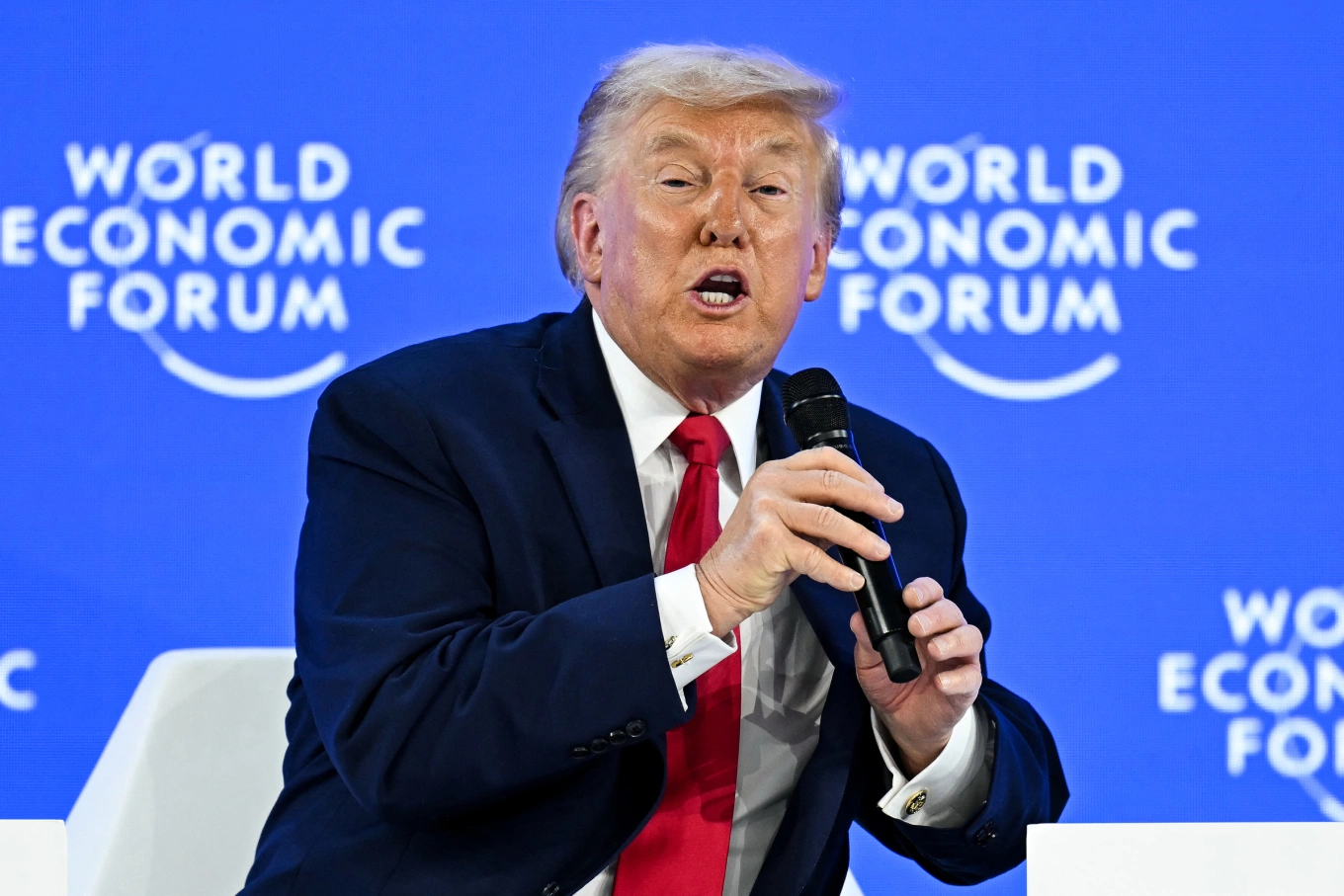
While Donald Trump’s political brand relies on confrontation, volatility, and spectacle, Canada’s message was calm, deliberate, and grounded in policy execution. There were no grand gestures, no attacks — just a clear articulation of priorities backed by investment, planning, and institutional capacity.
Joly framed Canada’s challenge not as outmaneuvering rivals, but as restoring a sense of control in an anxious world. People, she argued, are deeply concerned about cost of living, job security, and the feeling that global forces are overpowering democratic choice.
Governments, she said, must show — concretely — that they have a plan.
Canada’s Strategic Shift Is Already Underway
The most important takeaway from Davos was this: Canada is no longer waiting for the United States to stabilize before acting.
It has accepted global uncertainty as a permanent condition and built systems designed to absorb it. Diversification, industrial resilience, AI governance, energy security, and social cohesion are no longer abstract goals — they are operating principles.
In contrast to political noise elsewhere, Canada is betting on preparation over provocation.
Melanie Joly’s performance was not about headlines. It was about credibility. And in a fractured global economy, credibility may be the most valuable currency of all.