Canada’s $70 Billion Gulf Deal Signals a Turning Point in the Global Economy—and a Blow to Trump’s Trade Strategy
By late November 2025, as the sun set over Abu Dhabi, a quiet signing ceremony marked one of the most consequential economic shifts of the Trump era—one that unfolded far from Washington but landed squarely at its doorstep.
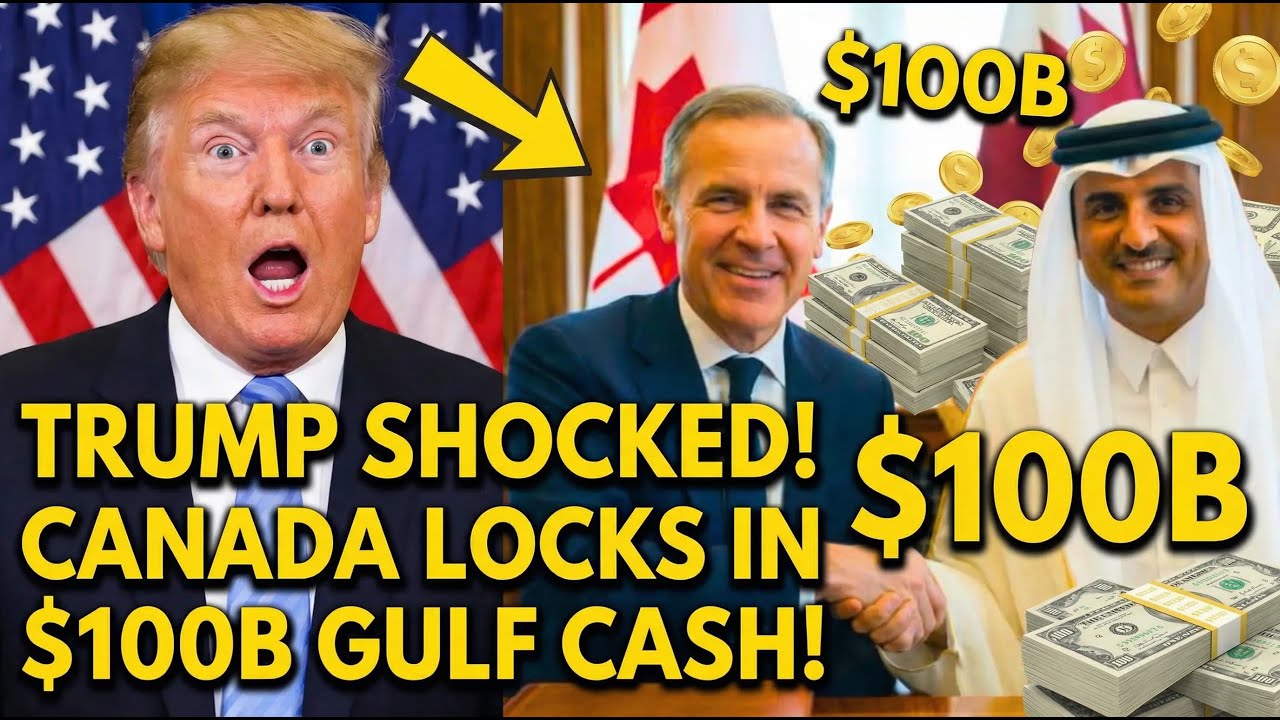
On November 21, Canada’s newly elected prime minister, Mark Carney, concluded a visit to the United Arab Emirates with an announcement that reverberated through global markets: the UAE would commit approximately $70 billion in investment into the Canadian economy, targeting infrastructure, clean energy, artificial intelligence, advanced manufacturing, and critical minerals processing.
The deal, one of the largest foreign investment commitments in Canadian history, carried significance far beyond its size. It signaled a strategic recalibration by a close U.S. ally—and underscored the unintended consequences of President Donald Trump’s aggressive trade posture toward partners long considered economically inseparable from the United States.
A Break with the Past
For decades, Canada’s economic model rested on a simple premise: deep integration with the American market. Nearly 80 percent of Canadian exports flowed south, sustained by free-trade agreements and political predictability.
That assumption began to unravel in early 2025, when President Trump—weeks into his second term—imposed sweeping tariffs on Canadian goods. The measures included a 25 percent levy on most imports and additional penalties on energy and automobiles, even those compliant with the U.S.–Mexico–Canada Agreement (USMCA), the very pact Trump had negotiated during his first term.
Ottawa responded with retaliatory tariffs, but the deeper shift was psychological. In his final address before leaving office, then–Prime Minister Justin Trudeau warned that the era of unquestioned American economic leadership had ended. His successor, Mark Carney, built an election campaign around that premise—and won a decisive mandate.
Carney, a former governor of both the Bank of Canada and the Bank of England, entered office with a message rarely heard in Canadian politics: the old economic relationship with the United States was no longer reliable, and Canada needed alternatives.
Why Abu Dhabi Mattered
The UAE deal did not materialize overnight. During Carney’s November visit, Canada and the Emirates signed a Foreign Investment Promotion and Protection Agreement, establishing legal guarantees required by sovereign wealth funds. Negotiations also began on a comprehensive economic partnership agreement, a free-trade framework aimed at doubling bilateral trade within a decade.
Then came the headline figure: $70 billion in committed Emirati investment, equivalent to nearly $100 billion Canadian.
The funds are expected to flow into strategic sectors that define 21st-century competitiveness—clean energy, logistics, artificial intelligence, and most critically, the processing of critical minerals.
For the UAE, whose sovereign wealth funds manage hundreds of billions of dollars globally, the decision reflected cold calculation rather than political symbolism. In a world increasingly shaped by supply-chain risk, Canada offered what the United States under Trump increasingly did not: regulatory stability, predictable governance, and long-term policy continuity.

The Critical Minerals Factor
At the heart of the agreement lies a geopolitical reality reshaping global trade: control over critical minerals.
China dominates roughly 70 percent of global refining capacity for rare earths and battery materials—an advantage it has leveraged through export restrictions in recent years. The United States has sought to reshore production, but faces high costs, environmental opposition, and years-long timelines.
Canada, by contrast, possesses vast reserves of lithium, cobalt, nickel, graphite, and rare earth elements—alongside abundant clean energy and advanced research infrastructure. The UAE deal includes over $1 billion specifically earmarked for expanding Canada’s minerals processing capacity, potentially creating a Western-aligned supply chain independent of both China and the United States.
For Europe, Japan, and South Korea, the implications are profound. For Washington, they are uncomfortable.
A Verdict on American Reliability
The timing of the deal was not lost on observers. Throughout 2025, the Trump administration imposed or threatened tariffs on allies, canceled negotiations over political grievances, and signaled willingness to upend existing agreements with little notice.
For sophisticated investors, size matters less than predictability. The UAE’s move suggested that American markets—once viewed as the global default—now carried political risk that could not easily be hedged.
Canada’s response was not capitulation, but diversification. Pension funds managing more than $2 trillion are now exploring co-investment with Gulf partners. Trade delegations are targeting Europe, Asia, and the Middle East. At the 2026 G7 summit, hosted by Canada, critical minerals coordination has emerged as a central agenda item.
Consequences for Trump’s Trade Strategy
President Trump launched his tariff campaign claiming it would restore American dominance and force allies to comply. The opposite appears to be unfolding.
Rather than isolating partners, the strategy has accelerated efforts to build economic architectures around the United States. Canada’s deal with the UAE offers a proof of concept: major economies can attract capital, secure supply chains, and negotiate trade outside Washington’s orbit.
The precedent matters. If Canada can reduce its reliance on U.S. markets from 80 percent to closer to 60 percent over the coming years, its leverage in future negotiations changes fundamentally. Other allies are watching closely.
A System in Transition
None of this suggests that the United States is suddenly irrelevant. American markets remain enormous, its financial system central. But the assumption that allies have no alternative is eroding.
The $70 billion agreement signed in Abu Dhabi represents more than an investment. It is a judgment—on risk, reliability, and the future shape of global trade.
For Canada, it is an adaptation to a harsher, more fragmented world. For the UAE, a strategic hedge. For the United States, it is a warning that economic power, once taken for granted, depends not only on size—but on trust.
And trust, once broken, is not easily rebuilt.