Canada’s $500 Million Food Shock Exposes the Collapse of Trump’s Tariff Strategy
Donald Trump expected pressure to work again.
For years, tariffs, threats, and public intimidation have been his preferred tools for forcing allies into submission. Create uncertainty, escalate loudly, and wait for the other side to blink. That strategy has delivered results before — but this time, it ran straight into a wall Canada had already built.
That wall is a $500 million food security plan.
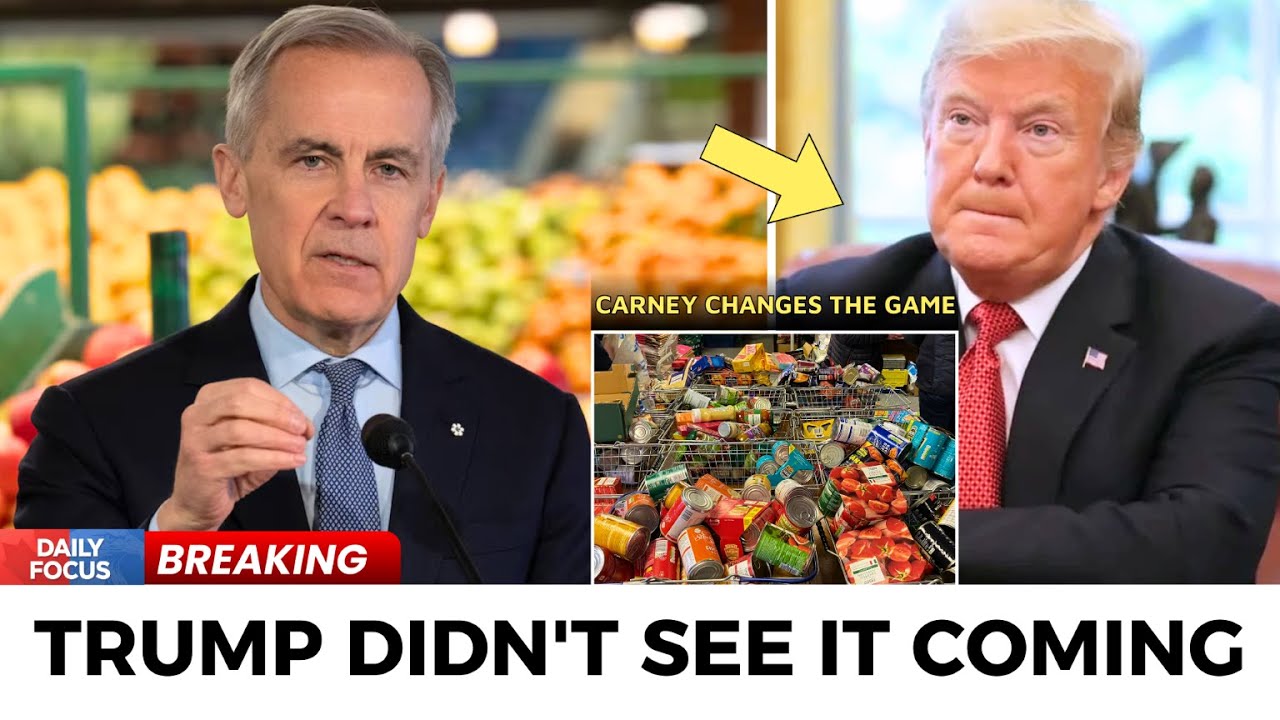
This week, Prime Minister Mark Carney unveiled a sweeping investment designed to harden Canada’s domestic food system against global shocks, supply chain disruptions, and — most pointedly — weaponized trade policy from the United States. The announcement landed just as Trump renewed tariff threats, mocked Canada’s leadership, and signaled that the 2026 USMCA review would be handled with maximum pressure.
Instead of responding with outrage, Carney responded with infrastructure.
The result stunned Washington.
A Curveball the White House Didn’t See Coming
The commitment allocates $500 million to expand food production, processing, and supply capacity across Canada. The goal is not short-term relief but structural resilience: more greenhouses, more processing facilities, stronger domestic supply chains, and reduced reliance on foreign imports.
Carney tied the plan directly to rising grocery prices, climate instability, and aggressive tariff policies abroad. His message was unmistakable: Canada can no longer afford to depend on external supply chains — especially when its closest neighbor treats trade as a weapon.
For the White House, the timing was a shock.
Trump had just floated 100% tariffs on Canadian goods, threatened retaliation over Canada’s global partnerships, and openly belittled Carney. The expectation was familiar: create fear, force concessions, and regain leverage.
Instead, Ottawa quietly removed the leverage.
Why Tariffs Lost Their Power Overnight
Trump’s tariff strategy depends on vulnerability. It works only when the targeted country cannot absorb disruption. Canada’s response short-circuited that logic.
By investing heavily in domestic food capacity, Canada is insulating itself from future tariff shocks before they materialize. This is not symbolism. It is an operational shift that reduces exposure across agriculture, logistics, and processing — sectors Trump has historically targeted.
In simple terms: you cannot threaten supply chains that no longer depend on you.
That is why insiders say the White House was caught off guard. What was meant to force compliance instead strengthened Canada’s position and accelerated its independence.
A Broader Strategic Shift
The food plan is not an isolated policy. It is part of a wider transformation underway in Canada’s economic and geopolitical posture.
Over the past six months, Ottawa has:
-
Diversified trade partnerships across Europe and Asia
-
Expanded energy export routes beyond the United States
-
Accelerated critical mineral processing at home
-
Strengthened Arctic and Nordic cooperation
-
Reduced long-term reliance on U.S. political stability
Carney’s government is responding to a hard reality: American policy now swings sharply with each election cycle. Dependence is no longer a strength — it is a risk.
Rather than waiting to react to Washington’s next move, Canada is embedding resilience directly into its infrastructure.
The Pressure Campaign That Backfired
Trump’s approach was designed to intimidate. Instead, it triggered recalibration.
Tariffs on steel, autos, clean energy components, and lumber were supposed to weaken Canada. Instead, they justified a full-scale industrial pivot. Canada used the disruption to accelerate diversification faster than at any point in four decades.
Even tourism became part of the shift.
In 2025, Canadian travel to the United States collapsed by more than 30%, marking the steepest sustained decline since 9/11. Canadians cited hostile rhetoric, invasive border rules, and disrespect as primary reasons for staying away.
Ottawa didn’t fight the trend. It embraced it.
Domestic tourism surged. Billions in spending stayed inside Canada. Border towns in the U.S., meanwhile, reported empty hotels, canceled events, and mounting losses. Estimates suggest America could lose nearly $6 billion in tourism revenue this year alone.
Trump tried to pressure Canada. Canada redirected the money.
When Allies Start Choosing Sides
Perhaps the most revealing moment came not from Ottawa, but from Stockholm.
During a high-profile visit to Canada, Sweden’s deputy prime minister delivered a blunt message on Canadian television: “You need to choose your friends wisely — and Sweden is choosing Canada.”
The statement landed as Washington pressured Ottawa over defense procurement and hinted that NORAD cooperation could be affected if Canada considered alternatives to U.S. military hardware.
Sweden’s response was the opposite of coercion. It offered partnership, production on Canadian soil, and long-term industrial cooperation — without threats.
The contrast was impossible to miss.
Across Europe, unease with Trump’s unpredictability is growing. Canada, under Carney, is increasingly viewed as the stable anchor in a turbulent Western alliance.
The Leverage Is Gone
Trump believed Canada had no choice.
Carney proved otherwise.
With a diversified export strategy, a strengthened energy platform, controlled mineral supply chains, a revitalized research ecosystem, and now a fortified food system, Canada is no longer operating from dependency.
Tariffs can pressure a vulnerable country.
They cannot control a self-sufficient one.
That is the miscalculation now dawning in Washington.
The $500 million food plan is not just about groceries. It is about sovereignty. It is about neutralizing intimidation before it works. And it is about preparing for a future where stability must be built at home, not borrowed from abroad.
Trump wanted a submissive partner.
Carney is building a resilient one.
And as Canada quietly locks in its independence, the real question for Washington is no longer how to pressure Ottawa — but what happens when pressure stops working altogether.