Canada’s $109 Billion LNG Pivot to Asia Reshapes Global Energy—and Leaves the U.S. on the Sidelines
BEIJING — When Canada’s energy minister, Tim Hodgson, spoke to reporters in Beijing on January 15, 2026, his remarks were precise, technical, and quietly consequential.
“We produce the lowest carbon-intensity LNG in the world,” Hodgson said. “China is an investor in our first LNG project. They will be an investor in our second LNG project. And they are a major user of our conventional oil and gas.”
Those sentences, delivered after the signing of a memorandum of understanding on energy cooperation between Canada and China, marked a turning point. Behind them lies a sweeping realignment of global energy flows—one that bypasses the United States entirely and permanently alters Canada’s economic orientation.
The agreement opens the door to as much as $109 billion in Canadian liquefied natural gas investment, with projected export capacity of 50 million metric tons annually by 2030, all destined for Asian markets. Not a single ton is intended for the United States.
For decades, Canadian natural gas flowed almost exclusively south. Geography, pipelines, and habit made the U.S. Canada’s default customer. That assumption no longer holds.
A Pacific Turn, Years in the Making
At a press conference in Beijing on January 16, Prime Minister Mark Carney confirmed what energy markets had begun to anticipate: Canada is scaling up LNG exports with a complete Pacific orientation.
Fifty million tons a year is not a marginal increase. Asia imported roughly 270 million tons of LNG in 2025. By 2030, demand is projected to reach 350 million tons, driven primarily by China and India. Canada’s planned capacity would represent nearly one-fifth of the Asian LNG market, a dramatic shift for a country that until recently had virtually no LNG exports at all.
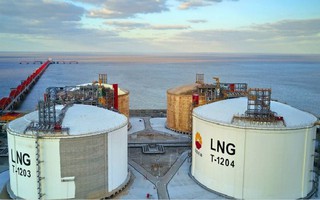
Canada’s first major LNG export facility, LNG Canada in Kitimat, British Columbia, began shipping cargoes in 2025. The $40 billion project is owned by an international consortium led by Shell, with equity stakes held by Malaysia’s Petronas, China’s PetroChina, Mitsubishi, and Korea Gas Corporation. It is designed to export 14 million tons annually, with expansion plans that could nearly double that figure.
Six additional LNG export projects are now in development along Canada’s Pacific coast, all scheduled to come online between 2027 and 2030. Together, they form the largest energy infrastructure buildout in Canadian history.
Why China Is Investing, Not Just Buying
China’s role goes beyond long-term purchase agreements. Chinese firms are taking equity stakes in Canadian LNG facilities, embedding themselves directly in production.
The rationale is strategic. Ownership provides security of supply regardless of global market volatility or geopolitical tension. Once liquefaction plants are built—assets designed to operate for 30 to 40 years—their output cannot be easily redirected. Facilities on Canada’s Pacific coast are structurally locked into Asian trade routes.
For Beijing, this means stable access to cleaner-burning fuel at a time when China is aggressively replacing coal in power generation, industrial heating, and urban residential use. Natural gas emits roughly half the carbon dioxide of coal, and Canada’s LNG carries an additional advantage.
British Columbia’s liquefaction facilities are powered largely by hydroelectric electricity, not gas-fired turbines. That reduces carbon intensity to roughly 15 tons of CO₂ equivalent per ton of LNG produced, compared with a global average ranging from 26 to 35 tons. For a country committed to carbon neutrality by 2060, that difference matters.
Japan and South Korea, both heavily dependent on imported energy, have adopted the same logic. Their national energy firms are also equity partners in Canadian projects, seeking long-term supply stability rather than spot-market exposure.

Geography and Economics Favor Canada
Canada enjoys a geographic advantage that U.S. LNG exporters cannot match. Ships departing British Columbia reach Asian ports directly across the Pacific. By contrast, American LNG from the Gulf Coast must pass through the Panama Canal or take longer routes around South America, adding cost and delay.
As Asian demand surges, these logistics increasingly favor Canadian supply.
At the same time, Canada’s Pacific energy infrastructure has expanded rapidly. The Trans Mountain pipeline, completed in 2024, enabled crude oil exports to Asia for the first time. In 2025, Canadian petroleum exports to China increased by 240 percent, reaching an estimated $8 billion annually.
LNG represents the longer-term transformation. Unlike oil, which uses existing pipelines, LNG requires entirely new infrastructure. Once built, it creates what economists call path dependency: long-term contracts, fixed shipping routes, and industrial ecosystems that endure for generations.
The United States Left Out
The most striking feature of Canada’s LNG expansion is not its scale, but its destination. The United States is excluded by design.
Prime Minister Carney stated plainly that Canada’s LNG exports will be “for Asian markets,” not American ones. All new terminals face the Pacific. No comparable infrastructure exists on Canada’s Atlantic coast, and none is planned at scale.
The reason is not economic—it is political.
Repeated tariff threats, trade disputes, and rhetoric questioning Canada’s sovereignty during Donald Trump’s presidency convinced Canadian policymakers and energy executives that the U.S. market carried unacceptable political risk. LNG infrastructure requires decades-long certainty. A partner that weaponizes trade cannot provide it.
Asia, by contrast, offers long-term contracts, capital investment, and diplomatic stability—without threats of coercion.
A Permanent Shift
The Canada-China energy memorandum formalizes this new alignment. It establishes a five-year framework for cooperation in LNG, oil, emissions reduction, and even renewable energy technologies. It also expands collaboration in uranium, another area where Canada is a critical supplier as China rapidly builds nuclear reactors.
What emerges is not a single deal, but a structural realignment.
By 2030, Canada is expected to ship 50 million tons of LNG annually to Asia, supported by $109 billion in capital investment, much of it Asian. Chinese, Japanese, and Korean firms will own portions of the production. Long-term contracts will lock in supply. The facilities will operate into the 2070s.
No future U.S. administration can reverse that reality.
Consequences Beyond Energy
For Canada, the shift represents strategic autonomy—freedom from dependence on a single market. For China, it provides secure access to lower-carbon energy from a politically stable democracy. For the United States, it marks a quiet but profound loss of leverage.
Energy infrastructure shapes geopolitics for generations. Pipelines, ports, and liquefaction plants outlast leaders and administrations. In seeking to exert pressure on Canada, Washington accelerated a process that neutralized that pressure entirely.
By the end of this decade, Canada’s energy map will face west.
And the United States will be watching from the sidelines.