Sydney — Canadian Prime Minister Mark Carney began a three-day official visit to Australia on Tuesday, with discussions expected to span economic cooperation, Indo-Pacific strategy, and the implications of recent military developments in the Middle East.
The visit, originally framed around deepening trade links, investment flows, and middle-power coordination, has acquired additional layers of significance following the US-Israeli strikes on selected Iranian nuclear and military infrastructure sites. Both Canada and Australia have publicly articulated positions of qualified support for the operations, marking a point of notable convergence between the two countries.

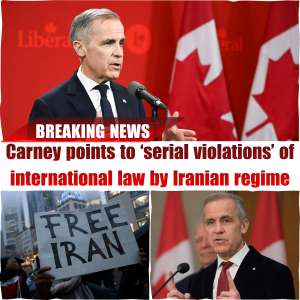
Canadian officials, including Prime Minister Carney, have described the strikes as a necessary and proportionate response to credible intelligence indicating an imminent advancement in Iran’s nuclear weapons program. In statements issued shortly after the operations, Ottawa emphasized that the actions were aimed at degrading specific capabilities that posed a direct threat to regional and international security, rather than constituting a broader campaign against the Iranian state. The Canadian government underscored its long-standing commitment to preventing nuclear proliferation in the Middle East and reiterated calls for renewed diplomatic engagement to address underlying tensions.
Australia adopted a similarly measured tone. Prime Minister Anthony Albanese and Foreign Minister Penny Wong expressed understanding of the security rationale behind the strikes, while stressing the importance of avoiding wider escalation and protecting civilian populations. Canberra highlighted its consistent policy of opposing the acquisition of nuclear weapons by Iran and supporting international non-proliferation regimes, including the Joint Comprehensive Plan of Action framework when it was in effect.

Analysts point to several factors explaining the alignment. Both nations are non-nuclear-weapon states with strong records of advocating multilateral arms control. They share membership in key Western-aligned groupings—the G7 for Canada and close US alliance structures for Australia—that have repeatedly identified Iran’s nuclear activities as a priority concern. Neither country maintains military forces in the region capable of independent power projection, which allows their positions to remain declarative rather than operational.
The shared stance also reflects parallel domestic considerations. In Canada, public opinion has historically been sensitive to proliferation risks, with successive governments maintaining firm opposition to nuclear breakout scenarios in volatile regions. Australia’s position aligns with its long-term security posture in the Indo-Pacific, where credibility in supporting allies on global non-proliferation issues is viewed as reinforcing deterrence more broadly.
Despite the convergence, nuances remain. Canadian commentary has placed greater emphasis on the legal and procedural dimensions of the strikes, noting ongoing debates over authorization under international law and the absence of an explicit UN Security Council mandate. Australian statements have tended to focus more on strategic outcomes, framing the operations within the context of preserving stability in energy transit routes and preventing a nuclear arms race in the Middle East.
The issue is expected to feature in bilateral talks, particularly during Carney’s meetings with Australian business leaders in Sydney and his address to federal parliament in Canberra. Observers anticipate that the prime minister will elaborate on Canada’s view that selective, intelligence-driven actions—when paired with robust diplomatic follow-up—can serve as limited instruments to uphold non-proliferation norms without triggering uncontrolled escalation.

Beyond the Middle East dimension, the visit retains its core economic focus. Carney has repeatedly highlighted the potential for greater cross-investment between Canadian and Australian institutional capital, including superannuation and pension funds. Discussions are likely to explore joint opportunities in critical minerals processing, renewable energy infrastructure, and supply-chain resilience—sectors where both countries possess comparative advantages and face similar vulnerabilities to global market disruptions.
Carney’s broader strategic narrative, articulated most prominently in his Davos address earlier this year, will also inform the agenda. He has argued that the post-Cold War rules-based order has undergone irreversible change, requiring middle powers to construct new networks of cooperation to safeguard shared interests in open trade, democratic norms, and collective security. Australia, while sharing much of this diagnosis, has maintained a more restrained public posture toward great-power frictions, particularly in its relationship with the United States.
The visit therefore offers a platform to explore the extent of convergence—and divergence—between two countries navigating a similar structural environment from different geographic and alliance vantage points. Joint work on Indo-Pacific maritime security, artificial intelligence governance standards, and climate finance mechanisms is expected to feature prominently alongside any discussion of Middle East developments.
As the program unfolds, the Middle East component is likely to remain an important but not dominant element. Both sides have signaled that practical cooperation on economic resilience and regional stability will continue to anchor the relationship, even as they coordinate messaging on global security challenges.
The visit underscores a recurring theme in contemporary diplomacy: middle powers seeking pragmatic alignment on specific issues while preserving flexibility in their broader strategic postures. For Canada and Australia, the current convergence on the Iran-related strikes illustrates how shared assessments of proliferation threats can produce quiet but meaningful policy harmony amid wider global uncertainty.