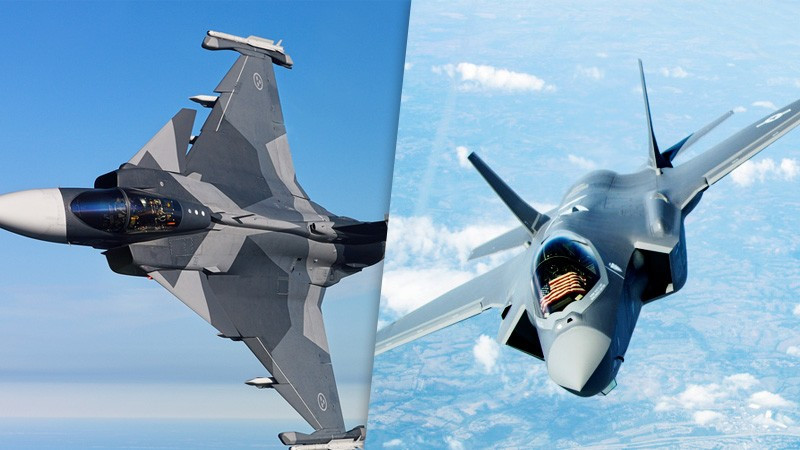
Canada’s decision to select Sweden’s Gripen fighter over the American-led F-35 program has landed in Washington with an impact that goes far beyond aircraft specifications. On the surface, it is a procurement choice by a close ally. Beneath that surface, it is a challenge to a set of assumptions that have quietly governed Western defense cooperation for a generation: that interoperability requires uniformity, that advanced capability must come bundled with centralized control, and that allies will accept dependence as the price of protection.
For American audiences, the surprise is not that Canada modernized its air force. It is that Ottawa stepped away from a system that has become a symbol of alliance cohesion itself. The F-35 is more than a jet; it is an ecosystem, a digital architecture tying air forces together through shared software, logistics, and data pipelines largely managed by U.S. contractors. Participation delivers formidable capability, but it also limits national discretion in ways that have become harder to ignore as warfare turns increasingly software-driven.

Canada’s move suggests that the tradeoff between capability and autonomy is no longer being taken for granted, even among Washington’s closest partners.
The Gripen choice reflects a different philosophy of air power. Where the F-35 emphasizes stealth, centralized updates, and deep integration into a U.S.-managed network, the Gripen is built around operator control. Under the agreement described by Canadian officials, Ottawa gains access to software, upgrade authority, and domestic sustainment. Assembly, maintenance, and future modifications take place on Canadian soil. The distinction is not cosmetic. In an era where code determines combat effectiveness, authority over software is authority over force.
For the United States, this raises uncomfortable questions. American planners have long argued that common platforms simplify coalition warfare. Shared aircraft mean shared training, shared logistics, and fewer surprises in joint operations. That logic remains sound. But it assumes that allies are willing to cede a degree of sovereignty over how their systems evolve, when they are updated, and how they are deployed in sensitive scenarios.
Canada’s calculation suggests that assumption is fraying.
Geography helps explain why. Defending the Arctic is not a theoretical exercise. It involves extreme cold, vast distances, limited infrastructure, and the need to operate far from major bases. Canadian planners have argued that an aircraft optimized for dispersed operations, short runways, and rapid turnaround better suits northern realities than one designed around large, heavily supported installations. The Gripen’s ability to operate from austere locations and be maintained by small teams aligns with that logic, even if it challenges conventional procurement wisdom.

This is not an argument against the F-35’s performance. It is an argument about resilience. Concentration of assets can be efficient in peacetime and vulnerable in crisis. Dispersal complicates adversary targeting and keeps aircraft flying when bases are threatened. For Canada, whose territory stretches across the high north, that flexibility carries strategic weight.
Washington’s unease is not really about Canada’s air defense. It is about precedent. If a founding NORAD partner can step outside the F-35 ecosystem while remaining fully committed to NATO, others may ask why their own requirements must be identical. Questions about long-term costs, maintenance dependency, and industrial participation are already circulating quietly among allied defense ministries. Diversification, once seen as fragmentation, is being reframed as insurance.
Importantly, Canada’s decision does not signal withdrawal from alliance obligations. The Gripen integrates with NATO data links, weapons, and command structures. Interoperability is preserved, even if standardization is not absolute. That distinction matters. Alliances are not weakened when members assert capability; they are weakened when trust erodes. Canada’s move argues that trust can coexist with autonomy.
There is also an industrial dimension Americans should not overlook. Defense spending is not only about deterrence; it is about where skills, jobs, and innovation accumulate. By insisting on domestic assembly and sustainment, Canada is rebuilding aerospace capacity that once defined its economy. Engineers train at home. Universities gain access to advanced avionics research. Supply chains embed locally. Over time, that translates into political durability for defense commitments — a factor often underestimated in Washington debates.

From a U.S. perspective, the lesson is not that allies are rejecting American leadership. It is that leadership based on indispensability faces limits when technology concentrates control too tightly. Software-defined warfare amplifies this tension. When updates, diagnostics, and permissions flow through a single gatekeeper, allies begin to weigh capability against independence in new ways.
The Gripen decision does not mean the F-35 model is broken. It does mean it is no longer unquestioned. Allies are signaling that partnership must allow room for national choice, especially as defense systems become inseparable from digital sovereignty.
For Washington, the challenge is strategic rather than transactional. The United States can respond by warning about interoperability risks and alliance cohesion. Or it can ask why autonomy is becoming a priority even among its closest friends. The answer lies not in betrayal or defiance, but in a changing definition of security itself.
Canada’s move is best understood not as a rebuke, but as a data point. It suggests that the future of alliances will be less about uniform platforms and more about shared outcomes — deterrence, resilience, and credibility — achieved through diverse means. For American policymakers, recognizing that shift early may matter more than winning any single contract.