Canada Defies U.S. Threats With Historic China Trade Deal: A High-Risk Bet on Economic Independence
Ottawa / Beijing — What would you do if your country’s largest trading partner, closest military ally, and economic lifeline looked you in the eye and said: Don’t make that deal, or we’ll blow up our entire trade relationship?
For Canada, that question stopped being hypothetical last week.
Despite an explicit public threat from former U.S. President Donald Trump to impose a 100% tariff on all Canadian exports, Prime Minister Mark Carney flew to Beijing and signed Canada’s first high-level economic pact with China. The reaction from Washington was immediate, hostile, and unmistakable.
So why would Canada take a risk that could endanger a trade relationship worth more than $1 trillion a year?
The answer lies in a calculated gamble about the future of Canada’s economy — one built on saving a struggling traditional industry while making a controversial bet on next-generation technology. This deal is not just about trade. It is about economic sovereignty.

The Seed of the Deal: Canola and a Broken Relationship
At the heart of the agreement lies canola, one of Canada’s most important agricultural exports. This is not a niche crop. Canola supports tens of thousands of farmers, entire rural communities across the Prairies, and a multibillion-dollar export ecosystem.
For years, China was Canada’s largest canola customer, importing nearly $4 billion annually. Then the relationship collapsed during a diplomatic freeze. Beijing imposed combined tariffs of up to 84%, effectively shutting Canada out of its most valuable market overnight.
This was not a tax. It was a signal: stay out.
Farmers were stranded, political negotiations stalled, and the dispute became a symbol of how vulnerable Canada’s export-dependent economy had become.
The new deal changes that.
Beginning March 1, 2026, China’s tariff on Canadian canola will drop to roughly 15% through a phased reduction. The direction matters as much as the number. For Prairie farming communities, it means immediate relief and long-term stability.
For Carney, it delivers a tangible win — proof that re-engaging China produces real results.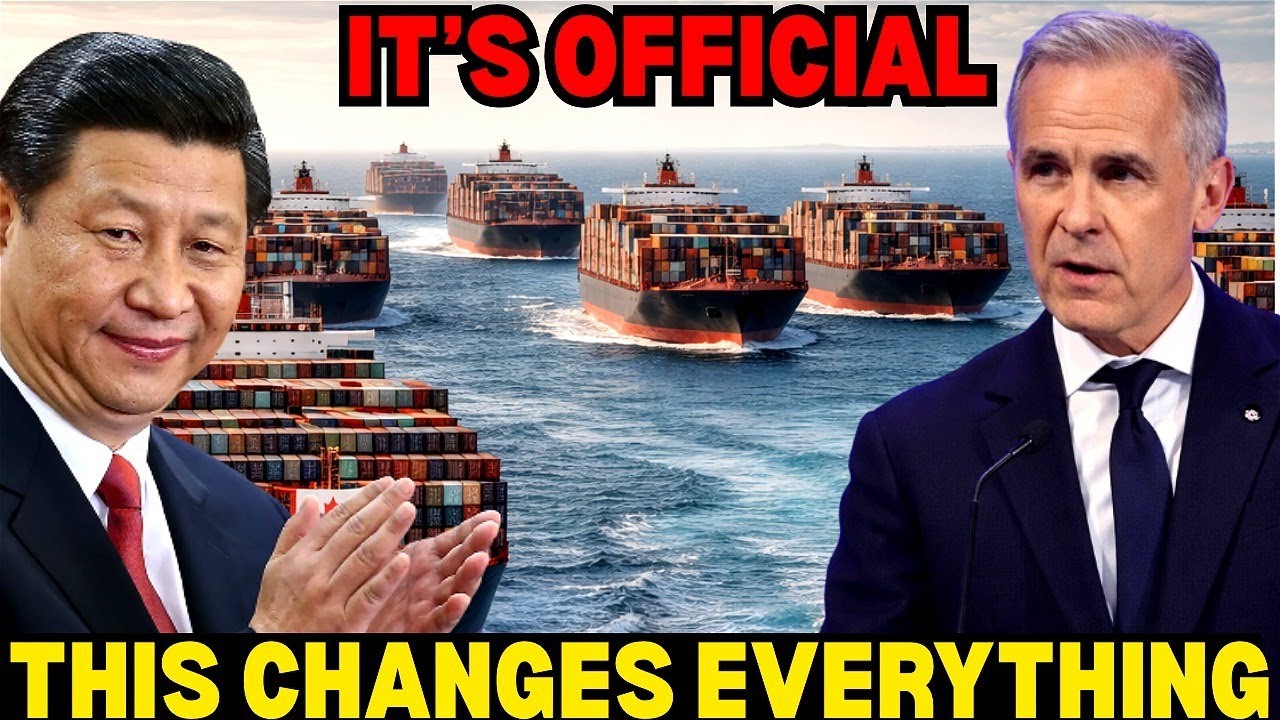
The Price of the Deal: Chinese Electric Vehicles
But high-stakes trade agreements are never one-sided.
To reopen the canola door, Canada made a controversial concession: allowing up to 49,000 Chinese-made electric vehicles (EVs) into the country each year at a 6.1% tariff, down from the 100% tariff imposed only months earlier.
This decision shocked Washington and divided opinion at home.
While the United States and Europe are moving aggressively to block Chinese EVs, Canada is opening a narrow, controlled channel. Critics call it a Trojan horse — a way for Chinese manufacturers to undercut domestic automakers before building a single factory in Canada.
The government calls it leverage.
A $30 Billion Gamble on the EV Future
Ottawa’s argument is strategic. The EV quota is not a giveaway — it is bait.
The message to Chinese automakers like BYD is simple: if you want predictable, low-tariff access to the North American market, you must build in Canada.
The prize is enormous. The federal government estimates the EV supply chain investment at stake could exceed $30 billion, bringing battery plants, assembly lines, and advanced manufacturing jobs to Ontario and Quebec.
If it works, Canada becomes a hub for EV production rather than just a consumer market.
If it fails, Canada risks becoming a showroom instead of a workshop.
The U.S. Threat Canada Chose to Ignore
The danger was never hidden.
In the weeks before the deal, Donald Trump publicly warned that any new Canada–China trade agreement would trigger a 100% tariff on all Canadian exports — not just cars, but oil, lumber, beef, agriculture, and manufactured goods.
When Carney signed the deal, he crossed a clearly marked line.
The rhetoric was personal as well as political. Trump referred to him as “Governor Carney,” reviving the long-standing insult that Canada lacks real independence and exists merely as a junior partner to the United States.
The accusation was blunt: Canada would become a backdoor for Chinese goods into America.
Why Canada Took the Risk Anyway
To understand the decision, you have to understand one number: 70%.
That is the share of Canadian exports that go to the United States.
No serious business would tolerate a single customer controlling 70% of its revenue. For Canada, that dependency has shaped policy for decades — and increasingly, it has become an existential risk.
Carney’s stated goal is to double Canada’s non-U.S. exports by 2030. This China deal is the first major step toward that objective.
The logic is simple: build multiple trade doors so no single partner can hold the only key.
In a world where U.S. politics can swing from cooperation to coercion overnight, Canada is betting that diversification is no longer optional — it is survival.
What This Means for Canadians at Home
This may feel like high-level geopolitics, but the consequences will reach Main Street.
First, food and fuel stability. Reviving the canola sector strengthens rural economies, stabilizes supply chains, and reduces pressure on food prices.
Second, cheaper electric vehicles. The 49,000-vehicle quota is designed to ignite a price war. Chinese EVs are significantly cheaper, forcing competitors to lower prices or innovate faster. Consumers win on cost and choice — but domestic auto workers face disruption.
Third, long-term economic resilience. If diversification succeeds, Canada becomes less vulnerable to U.S. economic downturns. If it fails and U.S. tariffs hit, prices across the economy could rise sharply.
The Quiet Power Move: Visa-Free Travel
Buried in the agreement is a move with outsized impact: visa-free travel for Canadians to China.
This is not about tourism alone. It is about rebuilding trust at the human level — entrepreneurs, students, investors, and researchers moving freely again.
Trade agreements only work if people believe in them. By removing visa barriers, China is reopening channels for influence, cooperation, and long-term engagement.
For Canada, it costs nothing — and potentially unlocks enormous opportunity.
The Countdown to 2030
The year 2030 looms over every part of this strategy.
It is Canada’s deadline to double non-U.S. exports — and likely the outer edge of Carney’s first term. Within four years, he must prove that this gamble delivers factories, jobs, and new markets.
If Chinese EV plants rise on Canadian soil and canola exports surge, Carney secures a historic legacy.
If the U.S. retaliates or China fails to invest, the strategy collapses.
Canada Is Not Alone — And That Matters
Here is what should worry Washington most: Canada is not acting in isolation.
Mexico has been quietly deepening trade and manufacturing ties with China for years — while remaining inside the North American trade framework. Canada is now openly following the same playbook.
This undermines the idea of a united North American front against Chinese economic influence. Goods may still be “made in North America,” but with Chinese technology, capital, and components.
For Canada, Mexico’s path provides political cover. This is not rebellion. It is a continental shift.
The Bottom Line
In the short term, Canadian farmers and Chinese automakers win. In the medium term, uncertainty dominates. In the long term, everything depends on investment.
If factories are built, Canada gains real independence.
If not, Canada risks becoming a market without leverage.
This deal is not the finish line. It is the opening move.
And the outcome will shape not just trade, but what kind of country Canada becomes for a generation.