Canada’s $500 Million Food Sovereignty Plan: How Trump’s Tariff Threats Backfired
Canada Moves to Protect Its Food Supply Amid Trade Turmoil
At a time when global supply chain disruptions are pushing grocery prices higher, Canada has decided not to wait, negotiate, or panic. Instead, it is building resilience. Standing inside a grocery store in Ottawa this morning, Prime Minister Mark Carney announced a $500 million investment aimed at protecting Canada’s food supply chains from the growing threat of U.S. tariffs under Donald Trump.
This was not a defensive maneuver or emergency spending triggered by fear. It was a declaration. Canada is preparing to feed itself regardless of what happens at the American border.
For decades, Canada and the United States functioned as a single, deeply integrated food system. Canadian farmers exported beef, pork, and grains south. American produce flowed north. Food products crossed the border multiple times before landing on grocery store shelves. The system relied on one assumption above all others: free trade would continue.
That assumption collapsed when Trump launched his tariff war.
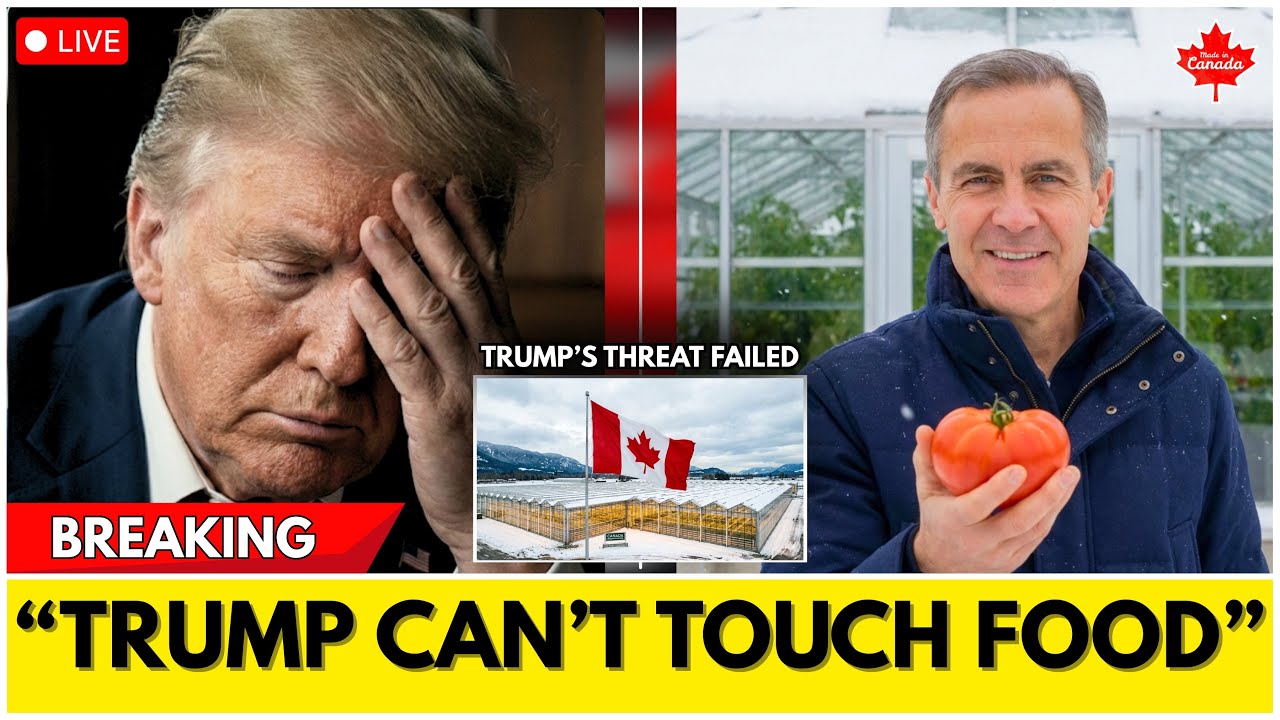
How Trump Turned Food Into a Political Weapon
Trump’s trade policy shattered the foundations of North American food integration. Tariffs of 25% on Canadian steel, 35% on non–trade agreement goods, and repeated threats of 100% tariffs if Canada deepened ties with China transformed trade from cooperation into coercion.
Suddenly, food supply chains became leverage.
Canadian farmers felt the impact immediately. Beef prices fell by 22%. Pork exports dropped 8%. Canola shipments to the United States declined sharply. At the same time, Canadian consumers were hit with rising grocery prices, which climbed 6.2% year over year as fractured supply chains passed higher costs down the line.
Trump appeared to believe that economic pain would force Canada to accept American demands. Instead, he handed Mark Carney the political justification to do what Canada should have done decades ago: invest in food sovereignty.
The $500 Million Strategy: Infrastructure, Not Subsidies
The centerpiece of Carney’s announcement is $500 million from the Strategic Response Fund, targeted specifically at helping food businesses absorb supply chain disruption costs without passing them on to consumers.
This is not a subsidy program. It is infrastructure investment.
Canadian food companies can apply for funding to expand processing capacity, upgrade cold storage, modernize distribution networks, and eliminate bottlenecks that currently force Canadian products to be processed in the United States before being sold back to Canadians at higher prices.
Meat processing is the clearest example. Canada produces vast amounts of beef and pork but lacks sufficient domestic slaughter and processing capacity. As a result, Canadian cattle are often shipped to U.S. facilities, processed there, and re-imported as finished products. Trump’s tariffs made this system economically irrational. The new funding aims to bring the entire process home.

Greenhouses and the Push for Year-Round Food Independence
In addition to the main fund, Carney announced $150 million dedicated to food security for small and medium-sized businesses, with a strong focus on greenhouse expansion and local production.
Canada currently imports massive quantities of fresh vegetables from California and Mexico due to limited domestic capacity. That dependence becomes a strategic vulnerability when trade relations deteriorate.
To accelerate change, the government introduced an immediate expensing provision for greenhouse buildings. Any company that brings a greenhouse into operation before 2030 can write off the full cost instantly. This creates powerful incentives to build now, not later.
Canada already has a growing greenhouse sector, particularly in Ontario, British Columbia, and Quebec, producing tomatoes, peppers, cucumbers, and lettuce year-round. With modern LED lighting, climate control, and hydroponics, greenhouse production is increasingly competitive once transportation costs and tariffs are factored in.
Within five years, Canada could be largely self-sufficient in greenhouse vegetables, eliminating billions of dollars in imports from the United States.
Food Security, Politics, and Public Support
Carney also allocated $20 million to food banks through the Local Food Infrastructure Fund. While this supports families in need, it also strengthens local demand for Canadian-produced food, reinforcing domestic supply chains from the community level upward.
Politically, the strategy is precise. Canadians are angry about food prices, and grocery inflation is among the most sensitive economic issues any government can face. By framing the investment as protection from Trump’s tariffs, Carney neutralizes opposition while justifying large-scale government intervention.
Opposition parties cannot easily attack the spending without appearing to side with Trump against Canadian consumers.
A Permanent Shift, Not a Temporary Response
What makes this plan strategically powerful is its permanence. Once Canada builds meat processing plants, greenhouse operations, and domestic distribution networks, they do not disappear when tariffs are lifted.
These investments reshape the economy.
Farmers gain access to domestic markets without relying on U.S. exports. Greenhouse operators lock in year-round production. Supply chains become shorter, cheaper, and more resilient. American leverage evaporates.
This is economic judo. The harder Trump pushes, the faster Canada reduces its vulnerability.
Why U.S. Agricultural Exporters Are Alarmed
Canada is one of the largest export markets for U.S. agricultural products, including produce, processed foods, and meat. Much of that trade exists because Canada historically lacked domestic capacity in key areas.
Trump’s tariffs gave Canada both the motivation and political cover to build that capacity itself.
Every new Canadian greenhouse means fewer California vegetables sold north of the border. Every domestic meat processing plant means fewer American slaughterhouse jobs. These losses are permanent, not cyclical.
American agricultural groups warned about this outcome, but their concerns were ignored in favor of short-term political leverage.
The Bigger Picture: Canada Reduces U.S. Dependence
The food sovereignty plan is part of a broader strategy. Canada is redirecting $70 billion in procurement toward domestic suppliers, investing in Arctic infrastructure to expand trade routes to Europe and Asia, and diversifying exports through new trade agreements, including China.
Together, these moves systematically reduce Canada’s dependence on the United States across multiple sectors.
By the time greenhouse construction booms ahead of the 2030 tax deadline and new processing facilities come online, Trump’s tariffs will no longer matter. Canadian producers will be serving Canadian markets.
Conclusion: A Strategic Failure for Trump
Trump believed tariffs would give him leverage over Canada. Instead, they triggered a structural transformation that permanently weakens American influence over Canadian food systems.
The $500 million food plan is not the end of this shift. It is the beginning.
Canada has turned a trade threat into an opportunity for independence, stability, and long-term economic security. And American exporters are only just beginning to understand what they have lost.