Ottawa — It was not framed as a turning point. There were no slogans, no overt warnings to allies or rivals, no language of rupture. And yet, for those listening closely, a recent address to Canadian service members marked something consequential: a subtle but unmistakable signal that Canada is rethinking the assumptions that have guided its security and economic posture for decades.
For much of the postwar period, Canada operated under a stable premise. Geography, alliances and predictability reduced the need for urgency. Defense spending lagged behind that of comparable allies, procurement flowed largely south, and strategic planning assumed that core guarantees would hold. That framework, officials now suggest, no longer reflects the world as it is.
What has changed is not Canada’s commitment to alliances, but its view of dependence. In recent months, government actions — particularly in budgets and procurement — point to a deliberate effort to reduce structural reliance on any single partner and to rebuild capacity at home. The shift has unfolded incrementally, almost quietly, but its implications are significant.
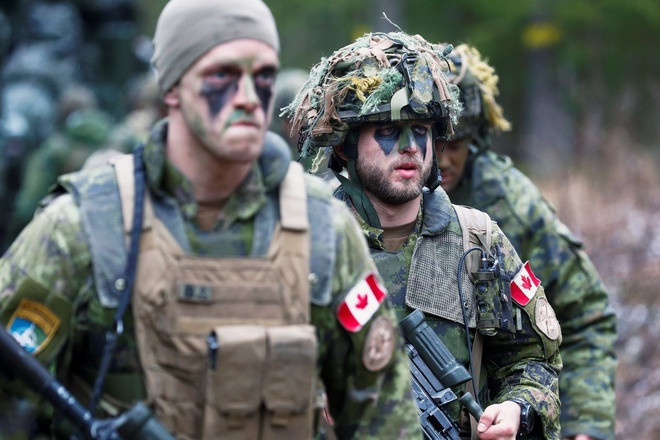
Defense spending sits at the center of that recalibration. After years of falling short of NATO’s benchmark, Canada has committed to meeting the alliance’s two-percent target sooner than previously planned, with additional increases outlined over the coming decade. Officials emphasize that the spending is not symbolic. Recruitment incentives have been expanded, training pipelines widened and retention bonuses restored for deployments in demanding regions.
Senior defense officials describe the changes less as militarization than as credibility. Capability, they argue, shapes how a country is treated long before force is contemplated. Prepared states are harder to pressure; unprepared ones are easier to ignore.
The geographic focus of the new posture is equally revealing. Canada’s Arctic, once treated primarily as distance and deterrent by climate, has become a strategic priority. Melting ice has transformed isolation into access, drawing the attention of Russia and China alike. For years, Canada’s presence in the region lagged its claims. That gap is now being addressed with investments in surveillance, logistics and sustained operational capacity.
“Sovereignty isn’t theoretical,” said one former defense official. “It exists where you can enforce it.”
Perhaps the most consequential change, however, is economic rather than geographic. For decades, a majority of Canada’s military procurement dollars flowed to American firms. The arrangement was efficient and familiar, but it carried a cost: leverage. When procurement is externalized, timelines, maintenance and upgrades are subject to another country’s priorities.

That pattern is now being reexamined. While Canada has not severed procurement ties — and has proceeded with some U.S.-built systems — future purchases are increasingly subject to review rather than assumption. Contracts now place greater emphasis on domestic manufacturing, servicing and long-term sustainment inside Canada.
The logic is straightforward. When a country builds and maintains its own systems, it controls readiness. When its workforce depends on domestic capability, pressure from outside loses force. Defense spending, in this framing, doubles as industrial policy — anchoring skills, supply chains and leverage at home.
Nowhere is that approach clearer than in maritime planning. Canada’s push to modernize its submarine fleet is being described by officials as generational. The proposal for a dozen new conventional submarines would provide persistent surveillance and denial capability across vast waters, particularly in the Arctic and Pacific approaches.
Submarines are not showpieces. They operate quietly and continuously, shaping outcomes by their presence alone. Their value lies less in confrontation than in certainty — the assurance that access can be monitored and controlled without reliance on others.
The long time horizons attached to such programs matter. Manufacturing, maintenance and training would lock in domestic expertise for decades. Once established, those capabilities are not easily reversed, regardless of political shifts elsewhere.
Air power presents a similar recalibration. Canada has committed to a limited number of U.S.-built fighter jets, but officials say future acquisitions are no longer automatic. Evaluations are underway, not cancellations. Even that pause carries meaning. When procurement slows, leverage shifts. Negotiation replaces assumption.
Officials are careful to stress that this is not disengagement. Canada remains committed to NATO and to cooperation with the United States. What is changing is the structure of the relationship. Partnership, in this view, works best when it is balanced — when cooperation is chosen, not compelled.
The shift reflects lessons drawn from recent years. Trade disputes, tariff threats and rhetoric that blurred partnership with possession shook long-standing assumptions. When economic tools are weaponized, dependence becomes vulnerability. And when vulnerability is exposed, governments face a choice: compromise or adapt.
Canada appears to have chosen adaptation.
The approach has been methodical rather than reactive. Investments preceded speeches. Contracts followed strategy. Officials avoided framing the changes as responses to any one country, preferring instead to speak in terms of resilience and permanence.
Markets noticed. Allies noticed. So did rivals.
Meeting NATO targets early was read as a signal that Canada intends to contribute capacity, not just goodwill. Commitments extending decades into the future suggest that the changes are not temporary corrections, but a new baseline.
Political analysts note that the absence of bombast may be the point. Quiet shifts in structure are harder to reverse than loud declarations. Once domestic supply chains are rebuilt and skills embedded, dependence does not quietly return. It becomes economically and politically untenable.
The recalibration also has domestic implications. For Canadians accustomed to seeing sovereignty discussed in abstract terms, the changes make it tangible — visible in infrastructure, training and readiness. Defense policy becomes measurable rather than symbolic.
Critics caution that increased spending carries opportunity costs and risks escalation if misunderstood. Government officials counter that preparedness reduces risk by removing uncertainty. States that can defend themselves are less likely to be tested.
What is clear is that Canada is repositioning itself in a world it now views as less predictable. Alliances remain essential, but assumptions have narrowed. Stability is no longer taken as given; it is treated as something to be maintained.
The shift did not begin with a speech, and it is unlikely to end with one. It is unfolding through budgets, procurement decisions and long-term planning that will outlast current leaders.
In the past, Canada was often described as reliable, cooperative and quietly dependent. That perception is changing — not through confrontation, but through capacity. Prepared countries do not need to announce independence; they demonstrate it.
As one senior official put it privately, “We are not rejecting partners. We are rejecting fragility.”
In an era when trust between allies can strain and power redistributes quickly, Canada’s recalibration suggests a broader lesson: sovereignty is not declared. It is built — slowly, deliberately and with consequences that endure long after the headlines fade.