For months, the pattern seemed almost ritualistic.
A new threat would emerge from Washington — tariffs, certification challenges, border accusations, rhetorical jabs about sovereignty. Within days, sometimes within hours, Ottawa would respond. Not always loudly. Not always publicly dramatic. But consistently.
The result was an unusual stretch in the modern history of the U.S.-Canada relationship: a period defined less by quiet diplomacy and more by visible friction between President Donald Trump and Prime Minister Mark Carney.
At first glance, the episodes appeared disconnected — fentanyl-linked tariffs, remarks describing Canada as a “51st state,” threats to block infrastructure projects, warnings over aircraft certification and trade deals with China. But taken together, they formed a recognizable pressure campaign, one aimed at recalibrating the terms under which Canada supplies energy, minerals and market access to its largest trading partner.
Carney’s counterstrategy was built on a simple premise: diversification reduces vulnerability.
The fentanyl justification was the opening salvo. Citing concerns about drug flows across the northern border, Washington invoked emergency authorities to impose tariffs on Canadian goods. Yet federal data showed that the overwhelming majority of fentanyl entering the United States came through the southern border, not the northern one. Ottawa responded with targeted retaliatory tariffs, calibrated to affect politically sensitive U.S. exports without triggering uncontrolled escalation.
Canadian officials avoided rhetorical theatrics. Instead, they framed each measure as reciprocal and proportionate. The message was consistent: every action would be matched.

The rhetorical escalation that followed — repeated references to Canada as a potential “51st state” — was intended, by many analysts’ accounts, to signal dominance rather than literal annexation. Yet it had a measurable domestic effect north of the border. Public opinion polls showed a spike in Canadian nationalism and a surge in support for economic independence initiatives. Consumer boycotts of American goods gained traction, and travel to the United States dipped.
Rather than retreat, Carney incorporated the rhetoric into his political argument. Sovereignty, he suggested, was not symbolic. It was economic. If a country relies overwhelmingly on a single export market, it risks losing leverage in moments of dispute.
The strategy unfolded in stages.
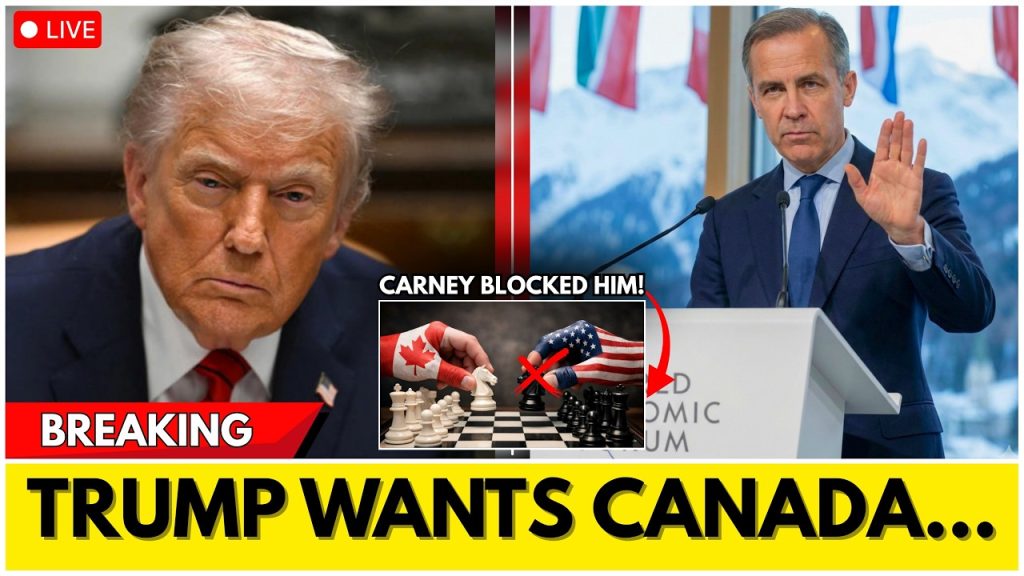
At the World Economic Forum in Davos earlier this year, Carney delivered a speech warning that economic interdependence was increasingly being used as a geopolitical weapon. Without naming the United States directly, he described a global order in which “stronger countries use tariffs as leverage and supply chains as vulnerabilities.” The implication was clear: middle powers must build alternatives.
Shortly afterward, Canada finalized expanded trade arrangements with China that lowered tariffs on select agricultural and electric vehicle exports. The deal, negotiated quietly, was announced only after its terms were secure. Washington responded with warnings of potential countermeasures, but by then, the agreements were operational.
The aircraft certification dispute offered another example of structural limits on executive threats. A proposal to decertify certain Canadian-built aircraft ran into regulatory constraints within the Federal Aviation Administration and the practical reality that American carriers already operate hundreds of such planes. The threat generated headlines; the implementation stalled.
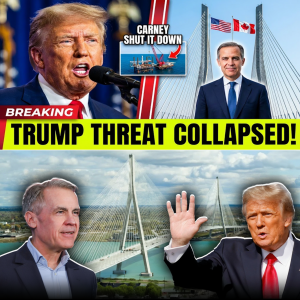
Infrastructure proved similarly resistant to unilateral pressure. When the president suggested blocking the opening of the Gordie Howe International Bridge linking Detroit and Windsor, Michigan officials — including Republicans — publicly corrected factual inaccuracies and emphasized the bridge’s economic importance to U.S. industry. The project moved forward.
In each case, the friction revealed a mutual dependency that complicated escalation. American refineries process Canadian crude. U.S. automakers rely on cross-border supply chains. Canadian producers depend heavily on the U.S. market, but American industries also depend on Canadian inputs.
That interdependence is the central tension.
Roughly two-thirds of Canadian exports still go to the United States. Geography makes that unlikely to change dramatically. But even incremental diversification can alter negotiating dynamics. Canadian trade officials have accelerated outreach to Europe, India and emerging markets in Latin America. Provincial governments have promoted domestic procurement policies and alternative supply chains.
None of this eliminates risk. Economists note that Canada cannot fully insulate itself from the gravitational pull of the American economy. The asymmetry remains real. But trajectory matters. A country moving toward diversified partnerships is different from one moving deeper into single-market reliance.
What makes this episode unusual is not that trade disputes occurred — they have punctuated the bilateral relationship for decades — but that the pressure was so personalized and so frequent. Weekly threats, even if inconsistently implemented, shape investor expectations and political narratives.
Carney’s response has been to lower the temperature publicly while adjusting the architecture underneath. Fewer counterpunches, more contracts. Fewer headlines, more memorandums of understanding. The approach reflects his background in central banking and risk management: reduce volatility, expand optionality.
The next test looms in the scheduled review of the United States-Mexico-Canada Agreement. American negotiators may assume that sustained pressure has weakened Ottawa’s position. Canadian officials appear to believe the opposite — that a year of friction has clarified vulnerabilities and accelerated alternatives.
Neither side can afford rupture. The United States and Canada share the world’s largest bilateral trading relationship, deeply integrated defense arrangements and extensive energy ties. But the terms of engagement remain fluid.
In the end, the contest has been less about theatrics than about leverage. Trump’s strategy sought to test how far economic pressure could bend a close ally. Carney’s has been to ensure that bending does not become dependence.
The outcome is not yet final. But one lesson has emerged clearly: in a relationship defined by proximity and necessity, threats often reveal as much about the issuer’s constraints as the target’s vulnerabilities.