🔥 BREAKING: Donald Trump RAMPS UP PRESSURE — Mark Carney RESPONDS WITH $500M FOOD STRATEGY 🌾🇨🇦
Prime Minister Mark Carney on Tuesday outlined a $500 million initiative aimed at strengthening Canada’s domestic food production, framing the plan as both a response to rising grocery prices and a safeguard against escalating trade tensions with the United States.
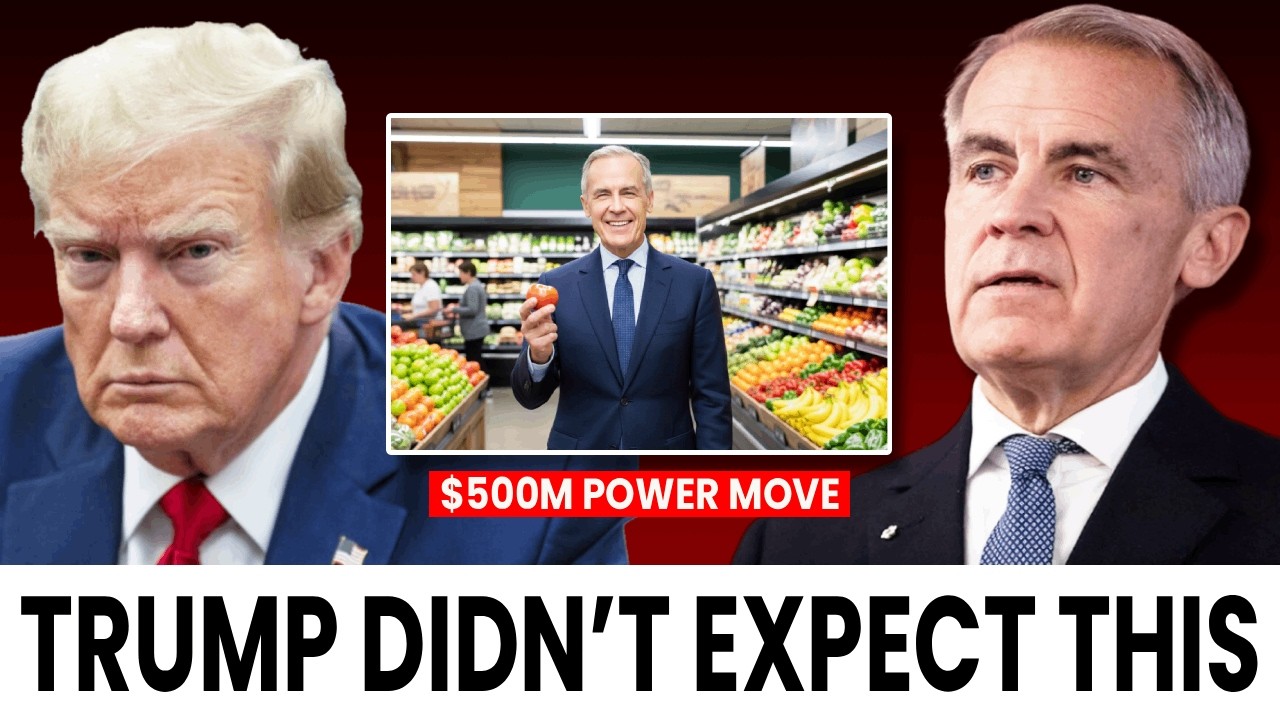
Speaking at a grocery store in Ottawa, Mr. Carney said the funds would be directed toward capital investments that expand food-processing capacity, modernize distribution systems and accelerate greenhouse development across the country. The proposal, part of a broader affordability agenda expected in the upcoming federal budget, comes amid renewed tariff disputes with Washington under President Donald Trump.
“We are committing $500 million from this fund to support capital investments to help food businesses expand capacity, increase productivity and strengthen our food supply for the future,” Mr. Carney said.
While the announcement focused on affordability — grocery prices in Canada have risen 6.2 percent over the past year, according to Statistics Canada — its broader significance lies in a strategic recalibration of Canada’s food system. For decades, agricultural trade between Canada and the United States operated with few visible frictions. Livestock, grains and produce frequently crossed the border multiple times before reaching consumers.
That system, dependent on predictable tariffs and stable political relations, has come under strain. In recent months, U.S. tariffs on Canadian steel and aluminum have climbed as high as 25 percent, with some non-agreement goods facing even higher levies. Though agriculture has not been the central focus of the dispute, Canadian producers say the climate of uncertainty has rippled across supply chains.
Beef cattle prices have fallen sharply amid market disruptions, and pork exports have weakened. At the same time, higher transportation and compliance costs have contributed to rising retail food prices at home. The result has been a renewed debate in Ottawa about the vulnerability created by deep cross-border integration.
The new investment package seeks to address longstanding structural gaps. A significant portion of Canadian livestock, for example, is sent to U.S. facilities for slaughter and processing before being sold back into Canadian markets as packaged meat. Industry leaders have long argued that insufficient domestic processing capacity forces producers to accept lower margins and exposes them to trade disruptions.
Under the plan, food companies will be eligible for financing to expand processing plants, build cold-storage infrastructure and develop domestic distribution networks. The aim, officials say, is to reduce reliance on U.S.-based facilities and keep more of the value chain within Canada.
A separate $150 million food security fund will focus on smaller businesses, particularly greenhouse operators. Canada imports substantial volumes of fresh vegetables during winter months, much of it from California and Mexico. Advances in greenhouse technology — including climate control systems and energy-efficient lighting — have made year-round domestic production more viable, especially in provinces such as Ontario, British Columbia and Quebec.
To accelerate expansion, the government is offering tax incentives that allow companies to immediately expense the full cost of greenhouse facilities brought online before 2030. The measure is designed to encourage rapid construction and reduce dependence on imported produce.
Ontario already leads North America in greenhouse vegetable production, but Canada continues to import billions of dollars’ worth of fresh produce annually. Officials say narrowing that gap would enhance food security while creating skilled jobs in rural and peri-urban communities.

Beyond industrial capacity, the government has pledged $20 million through a local food infrastructure program to support food banks and community organizations. The funding is intended to strengthen local supply chains and ensure that vulnerable households have access to nutritious, domestically produced food.
The strategy reflects a broader shift in Canada’s economic posture. In recent months, Ottawa has emphasized procurement policies favoring domestic suppliers and explored expanded trade relationships beyond North America. A recently finalized agreement with China, for example, is expected to increase Canadian canola exports.
Supporters of the food initiative argue that tariffs and trade volatility have exposed the risks of overdependence on a single market. Rather than pursuing immediate concessions to restore prior trade flows, Mr. Carney’s government appears to be betting that long-term resilience will prove more valuable.
Critics, however, question whether self-sufficiency is achievable in all categories. Canada’s climate limits traditional growing seasons, and greenhouse expansion requires significant energy inputs. Meat processing facilities entail complex regulatory approvals and high capital costs. Some economists caution that domestic production may not always match the efficiencies of integrated North American supply chains.
Still, the political appeal of the plan is clear. Food affordability is a sensitive issue for voters, and framing the initiative as protection against external shocks broadens its support. By emphasizing investment rather than retaliation, the government has sought to position its response as pragmatic rather than confrontational.
Whether the shift marks a permanent transformation of Canada’s food system remains uncertain. Infrastructure projects, once completed, tend to endure beyond the trade disputes that may have prompted them. If domestic capacity expands as envisioned, Canadian producers could become less reliant on American processing and seasonal imports.
For now, the $500 million commitment signals an intention to treat food not merely as a commodity but as a strategic asset — one intertwined with economic sovereignty, political stability and the everyday cost of living.