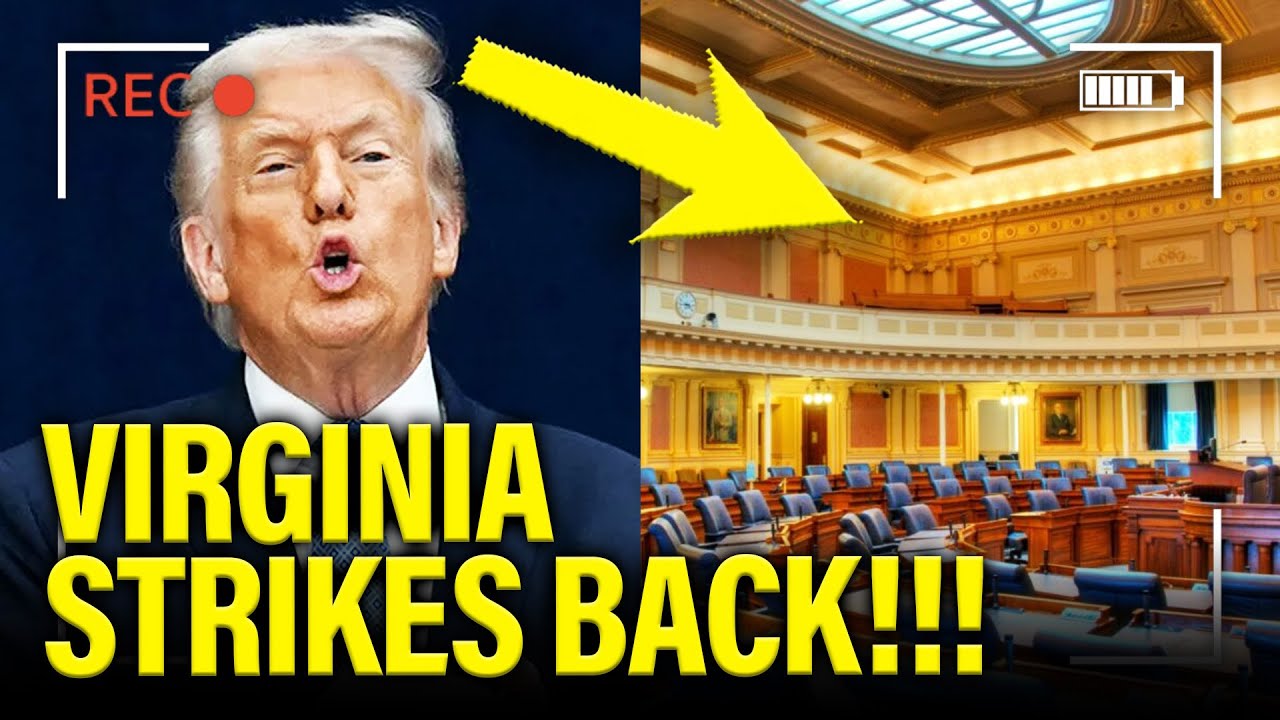
RICHMOND, Va. — The Supreme Court’s decision this week to allow Texas to proceed with a sharply partisan congressional map has triggered an unexpected political tremor hundreds of miles away, where Virginia Democrats are openly weighing whether to mount a sweeping redistricting counteroffensive of their own. Party leaders in Richmond, frustrated by the Court’s 6–3 ruling and convinced that the national playing field has tilted decisively toward Republican-drawn maps, have suggested they may pursue an aggressively Democratic map in response — one that some early estimates say could produce a 10–1 advantage for their party in the state’s congressional delegation.
The reaction unfolded in real time. Within hours of the Supreme Court’s ruling, Virginia’s Speaker of the House, Don Scott, told reporters that the state “would not sit back” while what he described as “one-sided redistricting tactics” reshaped the balance of power heading into the 2026 midterms. Louise Lucas, president pro tempore of the Virginia Senate, amplified that message on social media, posting a brief but pointed “10–1” message that quickly went viral and appeared to confirm that Democratic leaders were exploring a legally aggressive strategy of their own.
According to two officials familiar with internal discussions, who requested anonymity to describe deliberations still in progress, Democratic strategists began reviewing potential constitutional and statutory pathways “within minutes” of the Court’s decision. The officials emphasized that no final legislative proposal has been drafted, but said the party is examining whether recent case law — including the very reasoning used by the Court to uphold Texas’s map — could be invoked to justify a more favorable Democratic configuration.
A New Redistricting Climate
The events of the past week highlight a growing national uncertainty about the future of congressional mapmaking, long governed by a combination of state statutes, federal protections, and judicial oversight. But several Supreme Court decisions in recent years, including the 2019 ruling that limited federal courts’ ability to police partisan gerrymandering, have effectively shifted much of the authority back to individual states. The Texas ruling — in which the Court declined to block a map widely criticized by voting-rights advocates — appears to have reinforced that trajectory.
For Virginia Democrats, the ruling underscores what they view as an increasingly uneven legal and political environment. “The sense inside the caucus is that the rules have changed,” said Rachel Denning, a political scientist at the College of William & Mary. “If each state is being left to determine how aggressively it wants to shape its delegation, then political actors in Virginia will feel pressure to respond to what they perceive as more assertive moves elsewhere.”
Republicans in the state reacted sharply to the Democrats’ early signals. State GOP chair Rich Anderson accused Democratic leaders of embracing “the very same partisan map manipulation they claim to oppose.” He argued that such a plan, if pursued, would face legal and political scrutiny and could alienate voters who have supported Virginia’s decade-long experiment with independent redistricting commissions.
Legal and Practical Hurdles
Any move to advance a dramatically lopsided congressional map would face procedural and legal complexities. Since 2021, Virginia’s maps have been drawn by a court-appointed pair of experts after the state’s bipartisan redistricting commission failed to reach agreement. Altering that structure would likely require new legislation or a constitutional amendment, both of which would trigger lengthy legal reviews and political debate.
Still, Democratic strategists say that the Court’s willingness to defer to state authority on partisan maps has intensified conversations about whether the party should continue to rely on independent processes while other states adopt increasingly partisan strategies. “There is a real question now about asymmetry,” said one senior Democratic aide in Richmond. “If other states act unilaterally, and the Court upholds those actions, what incentive does Virginia have to keep playing by different rules?”
Some analysts caution that adopting a map designed to produce a 10–1 delegation could risk political backlash or litigation. But they note that the Supreme Court’s recent jurisprudence, particularly its reluctance to intervene in partisan-gerrymandering disputes, may embolden more states to test the limits of the law.
National Implications
The possibility of a Virginia countermove has already drawn national attention. Redistricting experts say that if Democratic leaders pursue a map resembling the one suggested on social media, it would mark one of the most consequential shifts in the post-2020 redistricting landscape — a sign that both parties now see the decennial process less as a neutral administrative function and more as a central battleground for congressional control.
“It would signal that the era of unilateral restraint is over,” said Nicholas Carmichael, a redistricting researcher at Princeton University. “Even states that have historically emphasized independence may feel compelled to react to the national environment.”
By Thursday evening, the clip of Lucas’s “10–1” remark had been viewed millions of times across platforms, accompanied by intense debate over whether Virginia Democrats were issuing a genuine policy signal or a symbolic protest against the Supreme Court’s ruling.
What remains unclear is whether the state’s leadership will move beyond rhetoric and attempt to reshape its map before the 2026 elections. But the speed and intensity of the response suggest a broader truth: the national fight over redistricting, once a cyclical and largely bureaucratic process, has become an open-ended political conflict — and Virginia may soon find itself at its center.