Trump Warns Canada Over Gripen Jet Deal as Carney’s Defiance Sends Shockwaves Through Washington
OTTAWA — President Donald Trump has issued pointed warnings to Canadian Prime Minister Mark Carney over Ottawa’s reconsideration of its $19 billion purchase of American F-35 fighter jets, raising the stakes in a defense debate that now threatens the deepest foundations of North American security cooperation. Canada’s exploration of Sweden’s Saab Gripen as an alternative has provoked unusually direct pressure from Washington, exposing long-simmering tensions over sovereignty, technology dependence and the future of continental air defense.
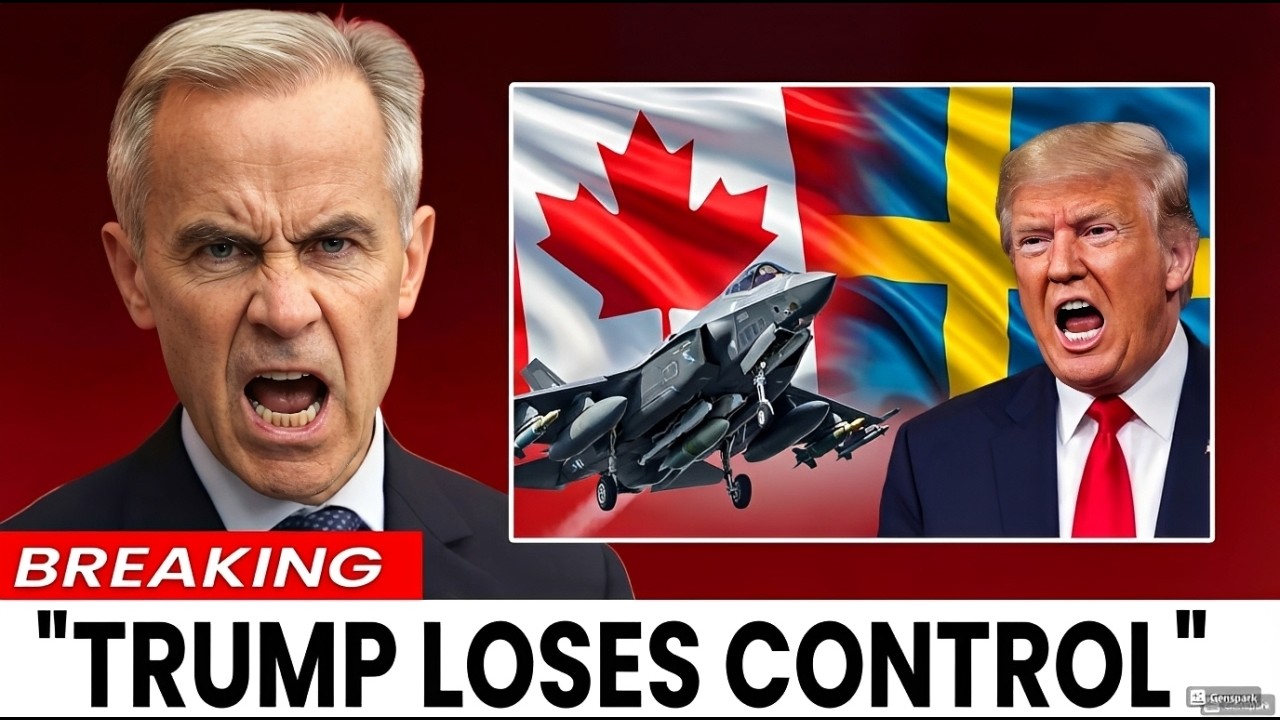
The controversy centers on Canada’s long-delayed replacement of its aging CF-18 fleet. The F-35 Lightning II, built by Lockheed Martin, has been the presumed choice since Canada joined the program as a partner nation years ago. The stealth fighter promises unmatched sensor fusion, network-centric warfare capabilities and seamless interoperability with U.S. forces under NORAD, the joint command that has guarded North American airspace since 1958. Deliveries of the first 16 aircraft are already contracted, with long-lead payments made for 14 more to secure production slots.
Yet rising costs have reignited debate in Ottawa. The Canadian F-35 program has overrun initial estimates by roughly $8 billion, according to recent reporting, straining defense budgets and prompting questions about value for money. Industry Minister Mélanie Joly has publicly stated that the deal has delivered fewer industrial benefits than promised. Canadian companies supply parts for the global F-35 fleet but operate largely under Lockheed Martin’s intellectual property with limited design control.
Saab’s Gripen E has emerged as the leading rival. The Swedish firm has proposed building a domestic production line in Canada, establishing regional support and upgrade centers in Ontario and Quebec, and creating an estimated 12,600 jobs through local manufacturing and long-term sustainment. Unlike the F-35, the Gripen allows full national control over software, mission data and weapons integration. Updates can be managed domestically rather than through U.S.-hosted systems such as ALIS (now replaced by ODIN), reducing vulnerability to external political or technical restrictions.
The prospect has alarmed Washington. Defense officials have warned privately that abandoning the F-35 could weaken NORAD integration, force the U.S. Air Force to increase patrols over Canadian airspace to cover potential capability gaps, and complicate joint operations across the vast Arctic frontier. Ambassador Pete Hoekstra has reiterated concerns about interoperability and long-term readiness, framing the choice as a risk to continental defense.

Carney has responded with measured defiance. His government has emphasized that national security decisions must balance military effectiveness with economic sovereignty and industrial growth. The Gripen’s design aligns with Canada’s unique requirements: operations from austere Arctic strips, short runways and dispersed bases where large, centralized facilities would be early targets in any conflict. The aircraft’s low maintenance footprint and ability to operate with minimal ground support suit the harsh northern environment far better than platforms built around extensive digital infrastructure.
The debate reaches beyond aircraft specifications. The F-35’s strength lies in its deep integration into U.S.-led networks for software updates, electronic warfare libraries and mission planning. Allies gain coalition interoperability but remain dependent on access to American-controlled systems. Critics argue this model limits strategic autonomy, especially in an era of rising great-power competition and potential supply-chain coercion. The Gripen, by contrast, preserves national oversight while remaining fully NATO-compatible, offering a path to reduce reliance on foreign-managed digital backbones.
The stakes are amplified by geography. Canada defends the world’s second-largest airspace, much of it over the rapidly changing Arctic where Russian patrols have increased and new shipping routes are opening. Fast response, endurance and flexibility in extreme conditions are operational necessities. A fighter that can disperse across improvised strips and require little support fits that reality more naturally than one optimized for networked, base-centric warfare.
Washington’s warnings reflect broader anxiety. If a core ally like Canada successfully fields an advanced fighter while retaining full operational control, other partners — including Finland and Norway — may reconsider long-term dependence on U.S. systems. The precedent could erode the assumption that close allies will automatically follow American procurement paths.
For now, Canada remains legally committed to the initial F-35 tranche, but the remaining 72 aircraft are under active review. Industry leaders and opposition figures have urged a hybrid approach or outright pivot to diversify partnerships, potentially aligning interim Gripen acquisitions with future involvement in sixth-generation programs alongside the United Kingdom and Japan.

The fighter question has evolved into a deeper contest over influence, resilience and authority within alliances. Technology integration has quietly become strategic reliance. Canada’s willingness to challenge that reliance without leaving NATO has unsettled expectations in Washington and opened a quiet but significant conversation about the future of transatlantic defense ties.