🔥 BREAKING: Canada PUSHES BACK ON U.S. PROPOSALS — WASHINGTON CAUGHT OFF GUARD ⚡🇺🇸🇨🇦
As the scheduled review of the North American trade pact approaches, a fresh dispute between the United States and Canada is testing the resilience of one of the world’s most integrated economic relationships.
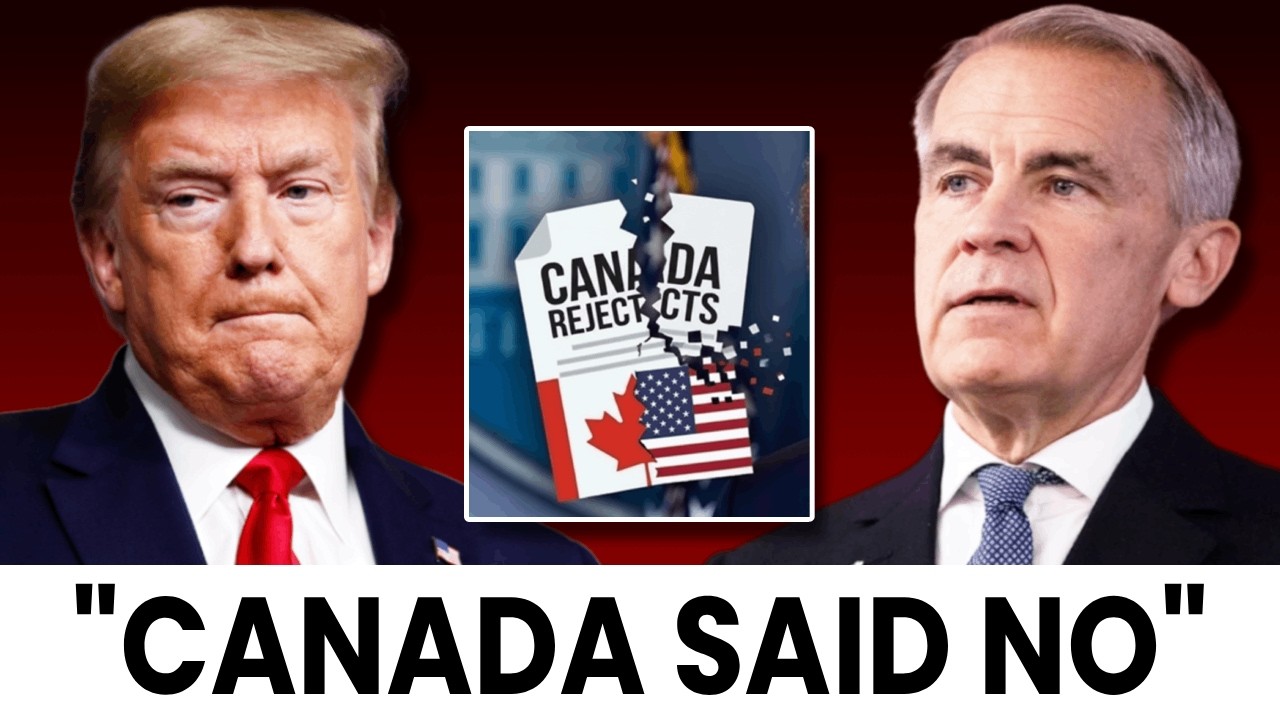
Officials in Washington have outlined a series of demands they say must be addressed if the United States is to extend its participation in the trade agreement known in Washington as the United States-Mexico-Canada Agreement and in Ottawa as CUSMA. The accord, negotiated during the first term of President Donald Trump, governs roughly $1.8 trillion in annual trade among the three countries.
Canadian officials, led by the former central banker Mark Carney in an advisory role, have responded with unusual bluntness: The demands, they say, are nonstarters.
At issue are five areas that American trade officials argue disadvantage U.S. producers and companies: Canada’s dairy supply management system; its digital media regulations; provincial rules governing alcohol sales; certain government procurement policies; and aspects of energy regulation. The United States Trade Representative, currently headed by Jamieson Greer, has framed the proposals as necessary corrections to ensure fair competition and long-term stability.
Canadian leaders see them differently. In their view, the requests would require Ottawa to dismantle pillars of domestic economic and cultural policy in exchange for little more than relief from the threat of tariffs — tariffs that could also inflict significant damage on American industries.
The standoff underscores a broader tension in modern trade politics: how to reconcile national sovereignty with deeply interwoven supply chains.
Few sectors illustrate that interdependence more clearly than autos. Though not explicitly targeted in the latest list of demands, the automotive industry looms over the negotiations. Vehicles assembled in Ontario often contain engines from Michigan and parts that have crossed the border multiple times. Major manufacturers, including General Motors, have warned lawmakers that disrupting this system would drive up costs and jeopardize jobs on both sides of the border.
Energy presents a similar picture. The United States imports millions of barrels of Canadian crude oil each day, much of it processed in specialized refineries along the Gulf Coast. During winter months, parts of the northeastern United States rely on Canadian hydropower. Untangling these flows would require years of investment and significant expense.
Against that backdrop, Canada’s firm rejection of Washington’s demands appears less like brinkmanship than a calculated assessment of leverage. By some estimates, American consumers and manufacturers could feel the effects of renewed tariffs almost immediately, particularly in sectors where Canadian inputs are essential.
The dispute over dairy, however, taps into longstanding political sensitivities. For decades, American officials have criticized Canada’s supply management system, which uses production quotas and high tariffs to stabilize domestic milk prices. U.S. exporters can ship limited quantities tariff-free, but shipments above those thresholds face steep duties.
From Washington’s perspective, the system restricts market access for American farmers. Canadian officials counter that the United States heavily subsidizes its own agricultural sector through direct payments and insurance programs. The mechanisms differ, they argue, but both countries shield producers.
In recent weeks, Canadian lawmakers reinforced the system’s legal protections, effectively narrowing negotiators’ room to maneuver. For political leaders in Ottawa, particularly in Quebec where dairy farming is closely tied to regional identity, concessions would carry significant domestic costs.
If dairy reflects an old economy battle, digital policy represents a newer frontier. Canada’s online streaming and news laws require large platforms to invest in Canadian content and compensate publishers for distributing journalistic material. American technology companies — including Netflix, Spotify and YouTube — would bear much of the financial burden.
U.S. officials argue that such measures unfairly target American firms and undermine open digital trade. Canadian policymakers describe them as essential safeguards for cultural sovereignty in a marketplace dominated by global platforms. Without intervention, they contend, local media and creative industries risk being overshadowed by larger American competitors whose scale allows them to distribute content worldwide at minimal additional cost.
The debate carries echoes beyond North America. Governments in Europe and Australia have pursued similar efforts to compel technology companies to support domestic journalism. At the same time, American regulators have stepped up antitrust scrutiny of major tech firms at home — a contrast that Canadian officials have noted privately.
For now, financial markets appear to be taking a wait-and-see approach. Business groups on both sides of the border are lobbying quietly, urging policymakers to avoid actions that could fracture a trading system built over decades.
Whether Washington ultimately presses its demands or recalibrates remains uncertain. Supporters of a harder line argue that the United States, as the region’s largest economy, can extract concessions. Critics warn that leverage in an integrated system cuts both ways.
What is clear is that the current confrontation extends beyond a handful of policy disputes. It is a test of how North America will manage economic interdependence in an era when trade policy has become inseparable from questions of political identity and national control.
The outcome will shape not only tariffs and quotas, but the broader rules governing how neighbors balance cooperation with sovereignty in a tightly connected world.