🔥 BREAKING: Canada MAKES UNEXPECTED MOVE — WASHINGTON CAUGHT OFF GUARD AS TENSIONS RISE ⚡🇺🇸🇨🇦
As trade tensions resurfaced between the United States and Canada this week, a familiar negotiating script appeared to be unfolding in Washington. Senior American officials signaled that any renewed trade arrangement would require Canada to accept higher tariff rates and open additional sectors of its market, particularly in politically sensitive industries such as dairy. The message, delivered in firm language, suggested that concessions would be the price of progress.
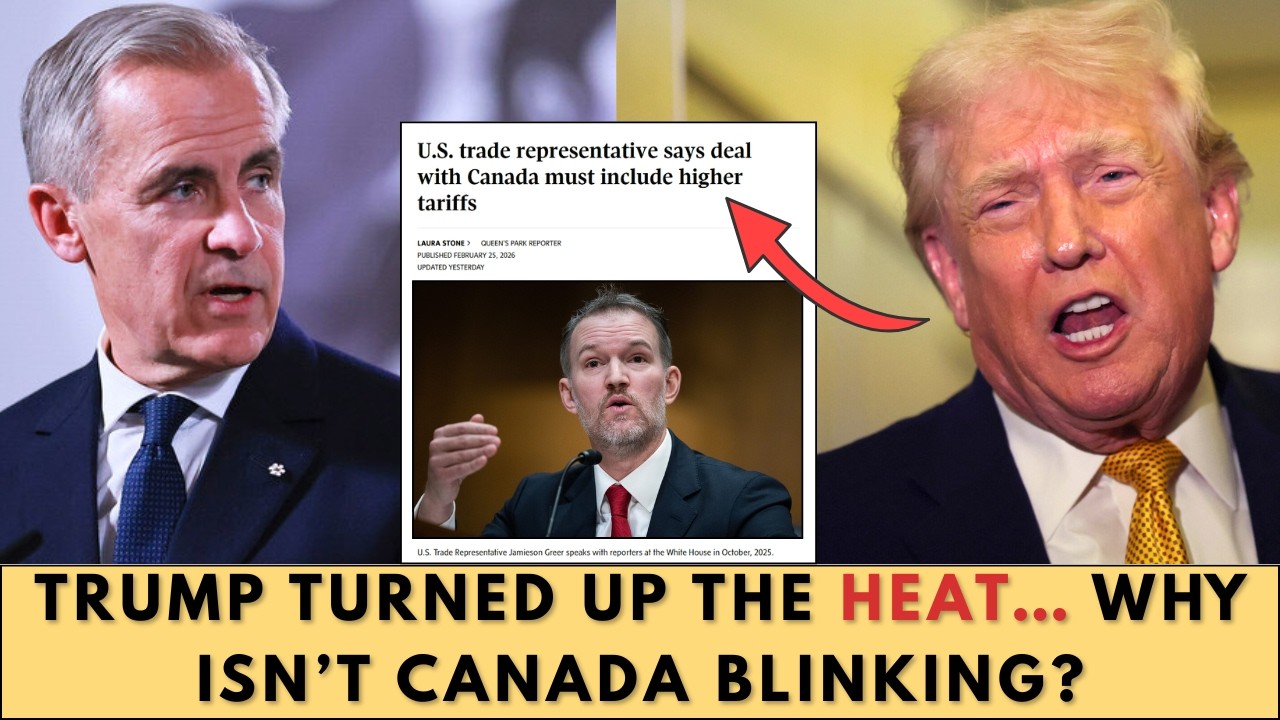
The posture reflects a strategy long associated with President Donald Trump, whose approach to trade has emphasized leverage, asymmetry and the application of economic pressure to secure favorable terms. By raising costs and narrowing alternatives, the theory goes, smaller partners ultimately yield. In previous rounds of negotiations, that formula proved effective, especially when supply chains were deeply integrated and options limited.
But this time, Canada’s response has diverged from expectation.
Rather than rushing to soothe markets or signaling urgency for a quick resolution, Prime Minister Mark Carney has adopted a quieter and more structural strategy. From the capital in Ottawa, officials have emphasized diversification over confrontation. The message has not been one of defiance, but of recalibration.
American trade officials made clear that progress would depend on Canada’s willingness to tolerate higher tariffs and broaden market access. In the abstract, such tactics are a familiar part of international negotiations. Leverage, after all, depends on relative dependence. The greater one country’s reliance on another market, the sharper the impact of economic pressure.
Yet Canadian policymakers appear intent on reshaping that equation.
Over recent months, Ottawa has intensified outreach beyond North America, expanding trade missions and accelerating discussions with partners in Asia, the Middle East and Europe. The effort reflects a longer-term goal: to reduce structural exposure to a single dominant market and distribute economic risk more broadly.
The contrast in tone between Washington and Ottawa has been notable. While American rhetoric has focused on protective measures and reciprocal tariffs, Canadian officials have spoken of resilience, insulation and new growth corridors. Rather than contesting tariff percentages point by point, they have highlighted export targets in emerging consumer markets and investment opportunities in advanced manufacturing partnerships abroad.
India’s expanding middle class, for example, represents a significant opportunity for agricultural and consumer exports. Japan’s advanced manufacturing ecosystem offers potential collaboration in high-technology sectors. Australia provides complementary strengths in natural resources and supply-chain coordination. The European Union, with its integrated industrial and defense frameworks, presents both capital and regulatory alignment. Each relationship, on its own, may not offset the scale of the American market. Collectively, however, they dilute concentration risk.
In practical terms, diversification does not eliminate short-term costs. Tariffs, if implemented, would still disrupt deeply integrated cross-border industries, from automotive production to energy flows. Consumers on both sides of the border could face higher prices, and businesses would need to recalibrate supply chains that have evolved over decades.
But the strategic calculus is shifting. If Canada can demonstrate credible alternatives — not merely rhetorical ones — then tariff threats lose some precision. Economic pressure becomes blunter, less surgical. And blunt tools, while capable of inflicting pain, are less reliable at producing swift political concessions.
Mr. Carney’s approach suggests an awareness of negotiation psychology. Conceding under visible pressure can establish precedent, reinforcing expectations of future compliance. Expanding options, by contrast, reframes the discussion. It introduces time as an ally rather than an adversary.
For decades, Canada’s economic gravity tilted decisively southward. Integrated supply chains, defense procurement agreements, shared infrastructure and energy interdependence created a sense of permanence. Trade friction has exposed the fragility within that assumption. What once felt immutable now appears contingent.
The question confronting policymakers in Washington is not simply whether Canada will ultimately accept higher tariffs in exchange for market access. It is whether the traditional leverage model remains effective when middle powers invest systematically in alternatives. If Canada absorbs transitional strain while building diversified trade corridors, tariffs may generate costs without guaranteeing compliance.
That possibility carries implications beyond bilateral relations. It speaks to a broader global pattern in which countries, confronted with heightened economic nationalism, seek to hedge against overdependence. The resulting landscape is less centralized and more fragmented, marked by overlapping partnerships rather than singular anchors.
None of this suggests that the United States and Canada are destined for prolonged rupture. Their economic and cultural ties remain extensive. But the current episode underscores a subtle transformation: trade negotiations are no longer solely about immediate concessions. They are increasingly about long-term alignment and structural positioning.
In that sense, the unfolding exchange resembles a chess match more than a shouting contest. Moves are measured not just by immediate gain but by future flexibility. Whether the established leverage of the past can command the same results in a more diversified world remains an open question — one that may shape the trajectory of North American trade for years to come.