Canada’s Bet on Fighter Jet Manufacturing Signals a Shift in Defense Sovereignty
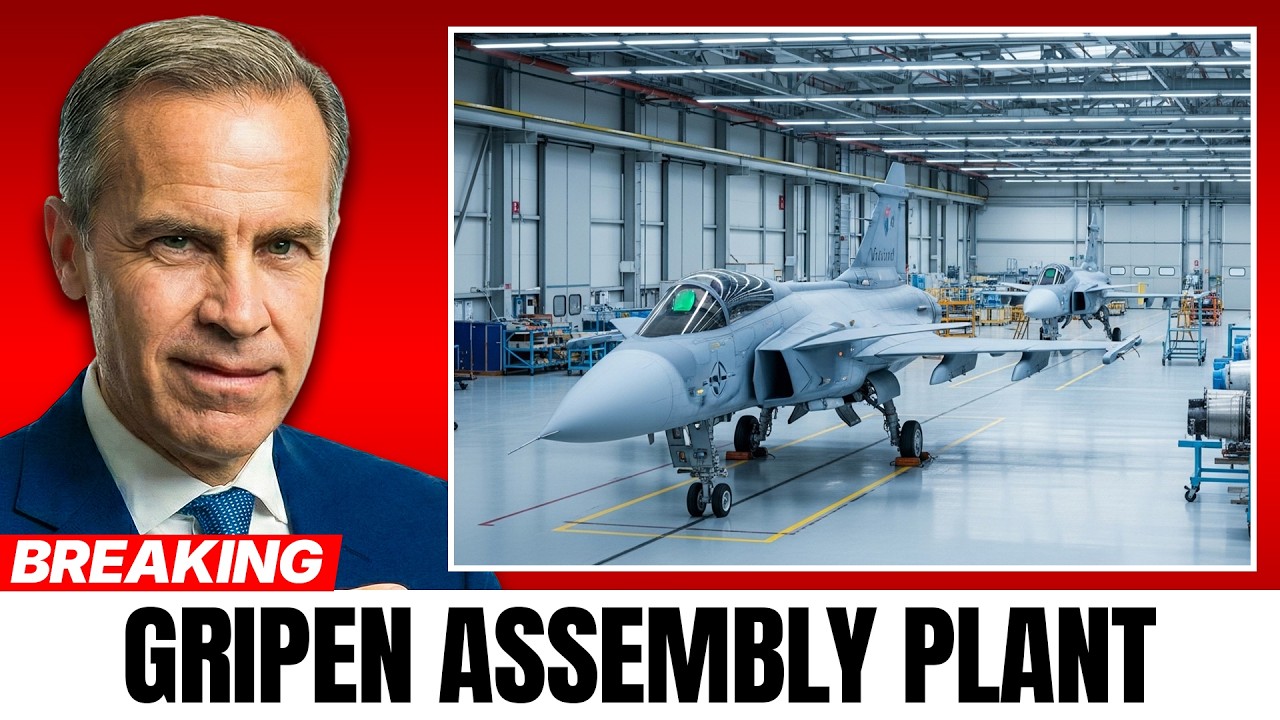
MONTREAL — On an industrial stretch of land where concrete is still drying and steel frames rise against the winter sky, Canada is laying down more than the foundation of a factory. It is constructing a new chapter in its defense and economic strategy.
Bombardier’s planned 126,000-square-foot aerospace facility in the Montreal region — backed by a $400 million investment and slated for completion in 2027 — represents a decisive move toward domestic fighter jet assembly. The plant is intended to produce Saab’s Gripen E and F aircraft under a comprehensive technology-transfer agreement, with the first Canadian-built jets expected to roll off the line in 2028.
For a country long intertwined with American defense supply chains, the symbolism is unmistakable.
The project comes at a moment of heightened economic strain between Ottawa and Washington. U.S. tariffs have weighed on segments of Canada’s export-driven economy, and defense procurement decisions have increasingly taken on geopolitical overtones. Against that backdrop, the expansion of domestic fighter production is being viewed by some analysts as both industrial policy and political signal.
A Facility Designed for Scale

At 126,000 square feet — roughly three acres of advanced manufacturing space — the facility will be larger than a typical big-box retail store and tailored specifically for combat aircraft assembly. High-bay ceilings will allow for vertical fuselage work. Climate-controlled zones will support composite materials fabrication. Dedicated clean rooms will handle avionics integration, and testing cells will verify aircraft systems prior to delivery.
The investment is spread across construction, specialized tooling and equipment, workforce training, and initial operations. Industry experts estimate that the building itself could account for roughly half of the total cost, with the remainder devoted to the high-precision machinery and certification processes required for fighter production.
Unlike temporary assembly lines created for limited contracts, this facility is designed as permanent industrial infrastructure. Its timeline is ambitious but consistent with Bombardier’s experience standing up business jet production lines. Groundbreaking is expected in 2026, with major construction through 2027 and operational readiness by late that year.
Economic Stakes Beyond the Factory Floor

Bombardier has described the employment impact in cautious terms — “hundreds” of jobs. In aerospace manufacturing, that phrasing carries weight. Final assembly technicians, avionics integrators, systems engineers and quality inspectors command specialized skills and salaries well above regional averages.
Economists point to the sector’s multiplier effect: each aerospace job can generate two to three additional positions in the supply chain, from electronics suppliers to logistics providers. If direct employment reaches 500, the broader regional impact could approach 1,500 positions.
Montreal’s established aerospace ecosystem — home to Bombardier’s headquarters, Pratt & Whitney Canada, CAE’s simulation systems and a network of specialized suppliers — provides a ready foundation. The decision to locate production here leverages decades of accumulated expertise rather than building capacity from scratch.
Crucially, engine production capacity from Rolls-Royce is also being developed in the region, aligning propulsion manufacturing with airframe assembly. Proximity reduces logistical complexity and compresses lead times — a practical advantage in a sector where delivery schedules can stretch for years.
Strategic Autonomy in Practice
Under the agreement with Saab, Bombardier would not merely assemble partial components but produce complete aircraft to Swedish specifications. The arrangement includes extensive technology transfer, enabling Canadian-built Gripens to meet identical standards to those manufactured in Sweden.
In political terms, the project has resonance in Quebec, where economic autonomy has long been a sensitive subject. A $400 million investment in high-skilled manufacturing aligns with provincial priorities centered on advanced industry and job creation.
At the federal level, support is expected through tax incentives, workforce development programs or infrastructure assistance, although detailed arrangements have not been publicly disclosed. The project’s alignment with broader NATO defense objectives strengthens its strategic rationale.
Timing also matters. The anticipated 2028 production start would precede some planned upgrades in competing fighter programs elsewhere. While defense procurement decisions are rarely dictated by schedules alone, the prospect of near-term delivery strengthens the case for diversification.
The Irreversibility of Investment
Perhaps the most consequential aspect of the Montreal project is its cumulative effect. Once foundations are poured, equipment ordered and workers trained, the economic and political costs of cancellation escalate rapidly. Contracts ripple outward through suppliers. Communities integrate anticipated employment into local planning. Political leaders acquire constituencies invested in continuity.
Defense analysts describe this phenomenon as industrial entrenchment: the point at which infrastructure and workforce commitments create a form of strategic inertia. In practical terms, reversing course would require absorbing substantial sunk costs and confronting the domestic fallout of lost jobs.
For Washington, the construction of a sovereign Canadian fighter production line carries implications that extend beyond procurement competition. It signals a recalibration of defense dependencies within North America — one driven not by rhetoric but by capital expenditure.
Concrete slabs and steel beams are rarely viewed as instruments of policy. Yet on this Montreal site, they represent more than industrial expansion. They embody a national calculation that economic resilience and defense sovereignty are increasingly inseparable — and that once built, both are difficult to dismantle.