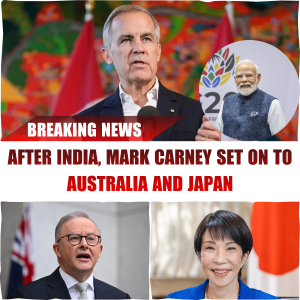
Canadian Prime Minister Mark Carney arrived in Sydney for a three-day official visit aimed at strengthening bilateral economic and strategic relations between Canada and Australia. The trip, which includes business engagements in Sydney and a major address to the Australian Parliament in Canberra, comes at a time of significant geopolitical flux and reflects Canada’s broader push to deepen ties with fellow middle powers.
The agenda was originally framed around trade expansion, investment opportunities, and shared strategic interests. Australian superannuation funds, which manage substantial long-term capital, feature prominently in discussions, with Canadian officials expressing interest in attracting greater inflows to support infrastructure development, critical-minerals processing, and economic-resilience initiatives. Both countries possess complementary strengths—Australia in mining and resource security, Canada in advanced technology, clean-energy expertise, and diversified trade networks—offering scope for mutually beneficial partnerships.

The visit has also been shaped by concurrent developments in the Middle East, where recent US military strikes have heightened regional tensions. Both Ottawa and Canberra have publicly supported the actions while focusing on practical measures such as the safe repatriation of citizens stranded in affected areas. Neither country is directly involved in the conflict, yet both maintain close alignment with the United States on security matters and share concerns over the potential for wider disruption to global energy markets, supply chains, and maritime routes.
Carney’s public remarks are expected to elaborate on themes he has raised in earlier international settings, including the need for middle powers to adapt to an international environment marked by greater unpredictability. In previous statements, he has described the traditional rules-based order as having effectively ended, urging like-minded nations to build new formal and informal coalitions capable of advancing shared priorities in trade, security, and economic stability. The parliamentary address in Canberra is anticipated to provide further detail on this vision, though observers note that Australia tends to adopt a more measured tone in its commentary on great-power dynamics, given its geographic position and alliance commitments.
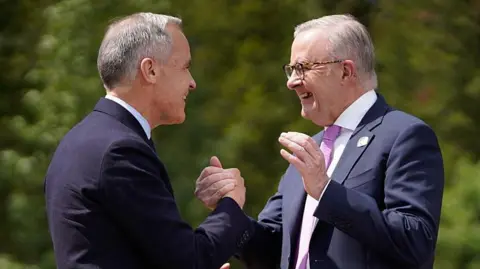
The bilateral relationship has remained robust despite broader global shifts. Annual two-way trade exceeds AUD 20 billion, with strong growth in services, education, and critical-minerals sectors. Recent years have seen expanded cooperation through frameworks such as the Comprehensive and Progressive Agreement for Trans-Pacific Partnership (CPTPP) and bilateral dialogues on supply-chain resilience. Investment links are a particular focus: Australian institutional investors have shown increasing interest in Canadian projects, while Canadian firms seek opportunities in Australia’s resource and renewable-energy sectors.
Carney’s itinerary also reflects a wider diplomatic effort. The Australian visit follows recent engagements in India and precedes a stop in Japan, underscoring a pattern of outreach to Indo-Pacific and like-minded economies. Officials in both capitals describe these interactions as complementary to existing alliances rather than alternatives, aimed at diversifying partnerships and enhancing collective capacity to navigate strategic uncertainties.
Domestic political contexts add nuance to the discussions. In Canada, recent economic reforms—including tax adjustments and accelerated project approvals—have been positioned as signals of openness to foreign investment. Australia, meanwhile, continues to balance its deep security ties with the United States against growing economic interdependence with Indo-Pacific partners. The two leaders are expected to compare notes on managing these dynamics while reinforcing mutual support for democratic norms, open markets, and rules-based approaches where feasible.

No major new agreements are anticipated during the visit, but incremental progress on investment facilitation, joint research in clean technologies, and coordination on multilateral forums remains likely. The parliamentary address is seen as a key moment for articulating Canada’s perspective on global order and middle-power agency, potentially influencing how similar themes are received in other capitals.
As the visit concludes, analysts will assess whether the exchanges yield tangible follow-up mechanisms—working groups, investment roadmaps, or joint statements—that sustain momentum beyond the immediate diplomatic calendar. In a period defined by rapid change, such bilateral engagements serve as quiet but important building blocks for longer-term stability and cooperation.