For much of the past century, the United States and Canada have managed one of the world’s most stable bilateral relationships — a partnership defined less by spectacle than by habit. Trade flowed with minimal friction, defense coordination operated through well-worn channels, and diplomatic disagreements were typically handled behind closed doors. That steadiness has been tested before. But rarely has it been rattled by the public conduct of an American ambassador on Canadian soil.
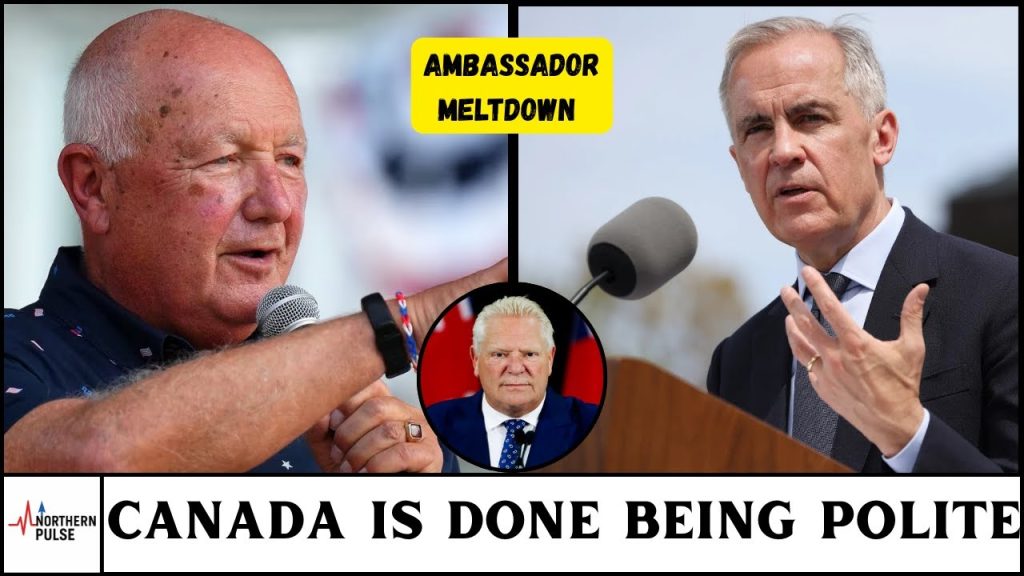
The latest strain emerged at what was intended to be a routine policy conference in Ottawa focused on critical minerals, manufacturing cooperation and cross-border trade. Instead, the event became a flashpoint after the U.S. ambassador delivered remarks that Canadian officials and observers described as combative and unusually partisan. What might once have been dismissed as rhetorical excess quickly evolved into a broader conversation about respect, sovereignty and the boundaries of diplomatic conduct.
At the center of the controversy were accusations that Canada had engaged in political interference in the United States — claims tied to a provincial advertising campaign that featured archival remarks from former President Ronald Reagan criticizing tariffs. Canadian officials viewed the comparison between a policy advertisement and election interference as exaggerated. The ambassador’s tone, critics said, compounded the issue. Diplomacy, in its traditional form, relies on calibration. Public scolding is rarely part of the toolkit.
The episode arrives at a sensitive moment. Trade tensions have flared intermittently over tariffs, industrial subsidies and supply chain strategy. Political rhetoric has grown sharper on both sides of the border. The ambassador’s remarks, delivered amid that atmosphere, were interpreted by some in Ottawa as confirmation that Washington’s approach has shifted from negotiation to pressure.
There is a formal mechanism available to host governments when diplomatic norms are perceived to have been breached: declaring an envoy persona non grata. Such a step is rare between close allies and carries significant symbolic weight. Canadian officials have not indicated that they intend to pursue it. But the fact that the term has surfaced in public commentary reflects the depth of irritation in some quarters.
Beyond the immediate controversy lies a larger structural question. The U.S.–Canada relationship rests on dense institutional foundations: the United States–Mexico–Canada Agreement governing trade, the North American Aerospace Defense Command coordinating continental defense, and extensive intelligence-sharing networks. Those frameworks do not dissolve easily. Yet they depend on trust and predictability. When public diplomacy becomes volatile, even durable systems can feel strain.

In Ottawa, the response has been measured rather than theatrical. Officials have reiterated Canada’s sovereignty and emphasized the importance of respectful engagement. At the same time, policymakers continue to advance diversification strategies aimed at reducing economic vulnerability to any single partner. Expanded trade agreements with Europe and outreach to Indo-Pacific markets predate the current dispute but have taken on new resonance amid uncertainty.
American officials, for their part, have defended the ambassador’s right to speak candidly while stopping short of endorsing every remark. Privately, diplomats on both sides acknowledge that rhetoric can outrun strategy. The challenge now is to prevent a public spat from metastasizing into a structural rift.
History suggests that the relationship can absorb shocks. Disputes over softwood lumber, dairy quotas and steel tariffs have flared before, only to be resolved through negotiation. What feels different this time is the speed with which political messaging travels and hardens public opinion. In a digital age, a single outburst can eclipse months of quiet cooperation.
Whether this episode marks a turning point or a temporary turbulence will depend less on personalities than on process. If channels remain open and grievances are addressed through established mechanisms, the alliance’s foundations are likely to hold. But if public confrontation becomes habitual, the cost will not be confined to diplomatic ceremony. It will be measured in diminished confidence — in markets, in ministries and among citizens accustomed to viewing the border as a line of partnership rather than friction.
The United States and Canada share more than trade flows and defense treaties; they share a tradition of pragmatic coexistence. The test now is whether that tradition can withstand a period of rhetorical strain. Alliances rarely collapse overnight. They erode, if at all, through accumulated distrust. Preventing that erosion will require the very qualities that have long defined the relationship: restraint, professionalism and a recognition that proximity demands patience.\