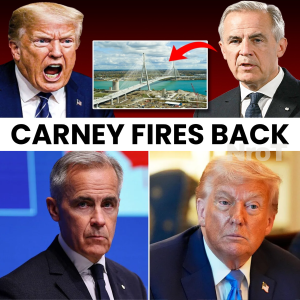
Carney Rejects Delay on $6B Cross-Border Bridge as U.S. Pressure Intensifies
OTTAWA — Prime Minister Mark Carney has reaffirmed that the Gordie Howe International Bridge will proceed toward its scheduled opening, dismissing calls from U.S. President Donald Trump to revisit ownership and compensation terms tied to the multibillion-dollar project.
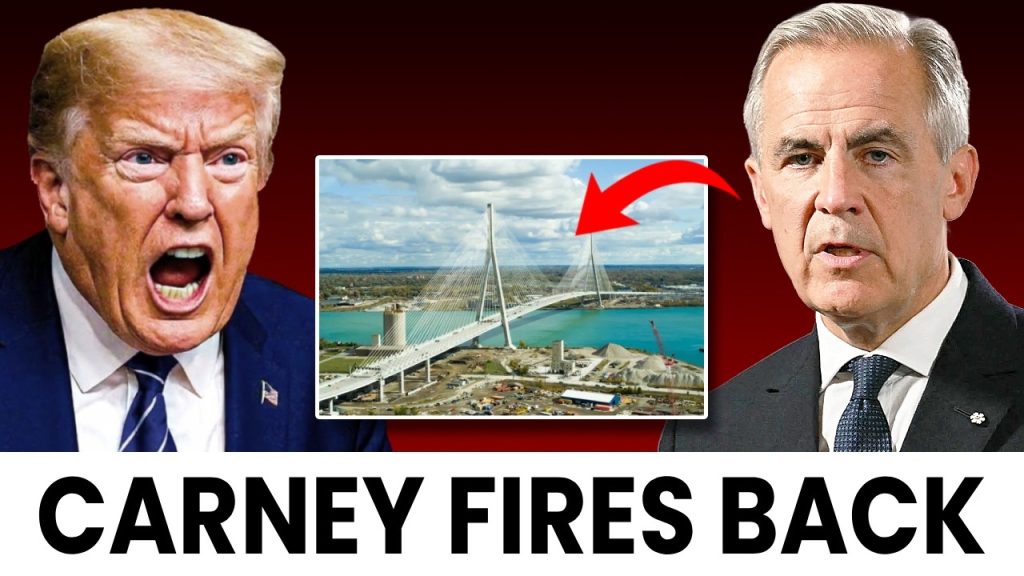
The decision follows renewed criticism from Trump, who argued publicly that the United States should receive greater economic benefit — and potentially partial ownership — of the new crossing linking Windsor, Ontario, and Detroit, Michigan.
A Strategic Trade Corridor
The Gordie Howe International Bridge, valued at approximately C$6.4 billion, is designed to relieve congestion at the aging Ambassador Bridge and modernize one of North America’s most critical commercial arteries. The Windsor–Detroit corridor facilitates hundreds of millions of dollars in daily cross-border trade, particularly in automotive manufacturing and integrated supply chains.
Construction began in 2018, with completion targeted for 2026. The project is overseen by the Windsor-Detroit Bridge Authority, a Canadian Crown corporation.
The Ownership Dispute
President Trump recently stated that the United States should be “fully compensated” and suggested that America should hold at least a 50% ownership stake in the bridge, citing the revenue potential generated through U.S. market access.
Carney responded by reiterating the terms of the 2012 Canada–Michigan Crossing Agreement. Under that framework:
-
Canada financed the full upfront construction cost.
-
The bridge is jointly governed under a binational structure.
-
Michigan will receive 50% of net toll revenues after Canada recovers its investment.
Canadian officials maintain that the legal structure was negotiated over years and remains binding. They argue that reopening ownership discussions after near completion would undermine contractual certainty.
Economic Stakes
Business leaders on both sides of the border have expressed concern that political uncertainty could disrupt supply chains already sensitive to global volatility.
The new span is intended to:
-
Increase freight capacity
-
Reduce wait times
-
Provide redundancy in case of disruptions at existing crossings
-
Support long-term manufacturing stability in Ontario and Michigan
Michigan-based business groups have emphasized that the bridge’s opening is economically necessary, not politically discretionary.
Political Context
The dispute emerges amid broader trade tensions between Washington and Ottawa, including tariff disagreements and upcoming review discussions related to the United States–Mexico–Canada Agreement (USMCA).
While Trump’s statements have framed the bridge as leverage within a larger economic negotiation, Carney has adopted a measured tone, emphasizing treaty obligations and shared economic benefit rather than rhetorical escalation.
Diplomatic channels remain active. However, neither side appears willing to publicly concede ground.
What Happens Next?
Legal experts note that any unilateral attempt to block or renegotiate the bridge’s opening could trigger complex treaty and trade challenges. At the same time, the project’s near-complete status limits practical options for delay without significant economic fallout.
For now, steel cables stretch across the Detroit River, inspections continue, and operational testing proceeds.
The structure itself is ready.
Whether it opens strictly under the original terms — or becomes a broader symbol of shifting trade dynamics — may depend on the next round of negotiations between Ottawa and Washington.
One thing is clear: the bridge was built to connect two economies. Whether it becomes a flashpoint instead remains a political decision, not an engineering one.