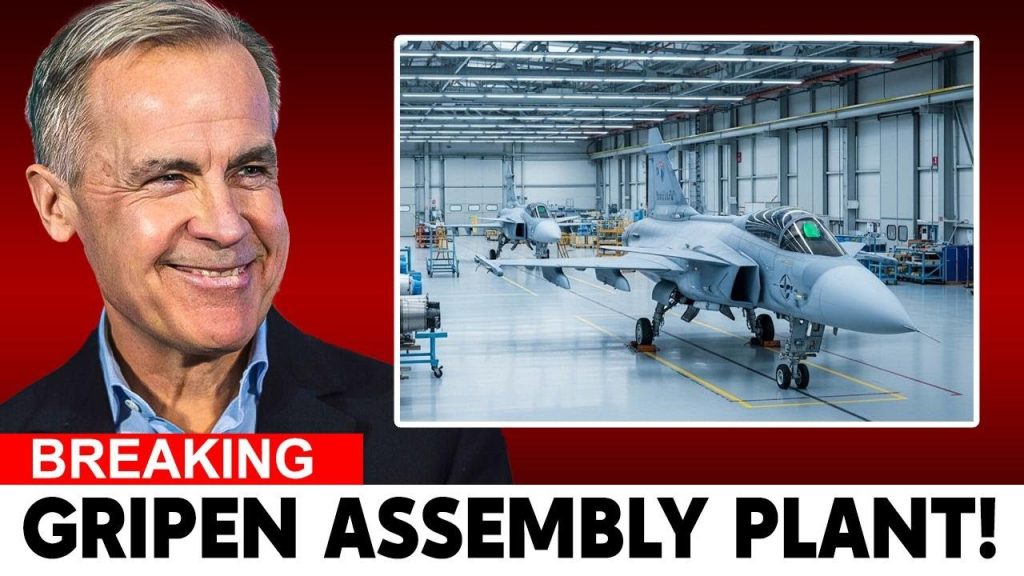
In a city long synonymous with aerospace, another industrial address is taking shape.
A $400 million final assembly and integration facility for Saab’s Gripen fighter jet is rising in the Montreal region, promising hundreds of high-skilled jobs and positioning Canada more firmly inside the global defense manufacturing ecosystem. Concrete foundations are being poured, structural steel is advancing upward and specialized equipment orders have already been placed. By industry standards, the project is no longer aspirational. It is underway.
The facility, tied to production of the Gripen E and F variants, will span approximately 126,000 square feet — larger than many big-box retail stores and purpose-built for advanced aerospace work. High-bay ceilings will allow vertical fuselage assembly. Climate-controlled zones will protect sensitive composite materials. Dedicated integration bays will handle avionics, flight systems and weapons interfaces before aircraft are delivered.
For Montreal, this is less a leap into unfamiliar territory than an expansion of a deeply rooted industrial base. The metropolitan area is already home to Bombardier, whose business jet operations anchor thousands of skilled jobs, as well as major presences from Pratt & Whitney Canada, CAE and other aerospace suppliers. The addition of a Gripen assembly line extends an ecosystem that has taken decades to cultivate.
The economic implications are both direct and multiplied. Final assembly of modern fighter aircraft requires specialized technicians, avionics engineers, quality inspectors and systems integrators — roles that typically command salaries well above provincial averages. While official employment projections are described cautiously as “hundreds of jobs,” industry analysts note that aerospace carries a strong multiplier effect. For every position on the production floor, additional roles emerge in machining shops, electronics manufacturing, logistics, engineering services and training institutions.
If direct employment reaches 400 to 500 workers at maturity, the broader regional impact could approach three times that number when supply-chain effects are counted.
Beyond jobs, the strategic dimension is harder to ignore.

Unlike American platforms such as the F-35, the Gripen is a European-designed aircraft. Its engines, produced by Rolls-Royce under the EJ200/EJ230 family, are expected to be manufactured in Montreal as well, creating an unusually tight geographic loop between propulsion and airframe assembly. That proximity reduces transport time, improves coordination and limits exposure to transatlantic supply disruptions.
For Ottawa, the value extends into sovereignty. Defense manufacturing capability within national borders offers a degree of autonomy in maintenance, upgrades and lifecycle support. While Canada remains deeply integrated with U.S. defense structures through NORAD and NATO commitments, diversification of production sources adds flexibility in a period of global supply-chain volatility.
Political leaders in Quebec have emphasized the long-term industrial benefits. Premier François Legault has frequently framed aerospace as a pillar of provincial economic strength. A multi-hundred-million-dollar facility delivering permanent, high-value employment aligns closely with that narrative. Federal authorities, though measured in public statements, have historically supported aerospace investments through training programs, tax incentives and strategic partnerships.
The construction timeline is ambitious but not unrealistic. Groundbreaking activities are reported to have begun in early 2026, with structural completion expected through 2027. Equipment installation and worker training are slated to overlap, positioning the first locally assembled aircraft for rollout in 2028. By aerospace standards — where new programs often stretch across decades — this is considered a relatively rapid ramp-up.
The global defense backdrop adds context. European manufacturers have experienced renewed demand amid rising security concerns across NATO countries. At the same time, certain U.S. programs have faced well-documented delays in software integration and engine supply. The Gripen facility’s schedule places Canadian production online during a period when alternative supply chains are under scrutiny.
Still, analysts caution against viewing the project as a geopolitical rupture. Canada’s defense and aerospace industries remain heavily interconnected with the United States. Cross-border trade in aerospace components is measured in billions annually, and American suppliers will continue to play roles in avionics, materials and certification processes.
What this project does signal is a recalibration of industrial posture. Instead of relying exclusively on imports or foreign final assembly, Canada is expanding domestic capacity to assemble advanced combat aircraft. That capability, once established, tends to endure. Workers trained in fighter integration accumulate expertise that can be applied to upgrades, modernization programs and future platforms.
The design of the Montreal facility reportedly allows for expansion. Initial output estimates of 20 to 30 aircraft per year could scale upward if demand materializes from export customers seeking North American production options. That flexibility is a hallmark of modern aerospace plants, which are increasingly engineered to adapt to shifting procurement cycles.
For Bombardier, whose commercial aviation business has weathered tariff disputes and global volatility, the Gripen assembly line offers diversification. Military production often operates on longer procurement horizons and steadier funding streams than business aviation markets.
The larger lesson is about industrial permanence. Once hundreds of millions of dollars are invested in specialized infrastructure, trained workforces and supplier networks, reversal becomes costly — financially and politically. Each hire represents a household. Each supplier contract supports additional investment. Over time, the factory becomes less a project than a fixture.
In Montreal, where aerospace already shapes neighborhoods and technical schools, the Gripen facility adds another chapter to a long-running story. It is a bet not just on a single aircraft program, but on sustained relevance in a competitive and rapidly evolving global defense market.