By XAMXAM
A single post on social media rarely rattles a global industry built on redundancy, regulation, and caution. But when Donald Trump declared a 50 percent tariff on Canadian aircraft and threatened to decertify planes built north of the border, the shockwaves moved fast—through boardrooms, hangars, and regulatory agencies on both sides of the border.
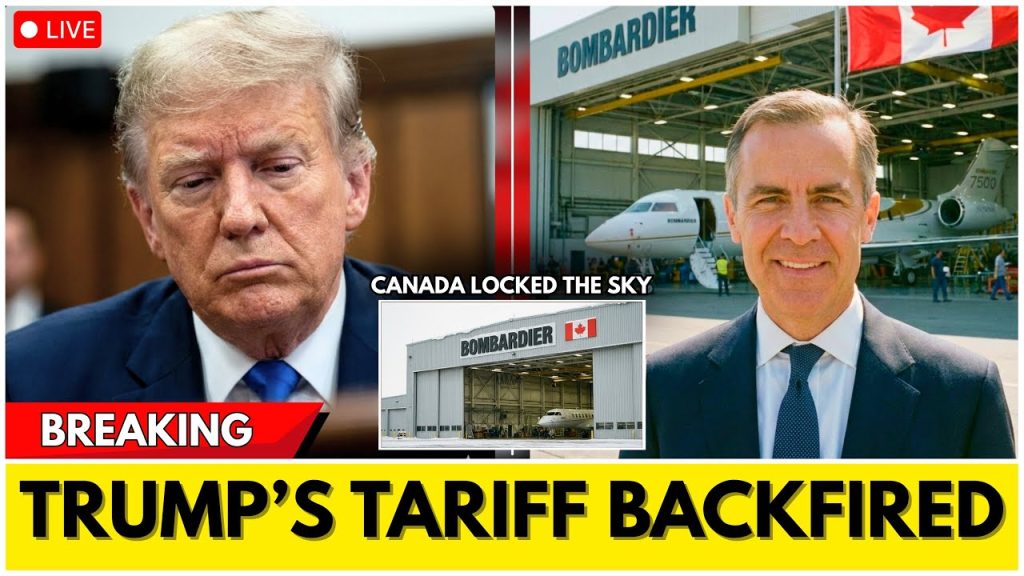
The target was Bombardier, Canada’s flagship aircraft maker and a central pillar of the American business aviation market. The trigger was a dispute over safety certification: Canada’s refusal to accelerate approval of new business jets from Gulfstream Aerospace before required fuel-icing tests were complete. What began as a technical disagreement over engineering standards was abruptly recast as a trade confrontation.
In aviation, certification is not a bargaining chip. It is the system’s foundation. For decades, regulators such as the Federal Aviation Administration and Transport Canada have relied on mutual recognition—each validating the other’s safety determinations to allow aircraft to operate seamlessly across borders. That trust, painstakingly built after disasters and reforms, depends on one premise: safety decisions are insulated from politics.
Trump’s threat punctured that premise.
Bombardier’s exposure in the United States is substantial. More than half of its global fleet operates on American soil. Nearly two-thirds of its sales come from U.S. customers. And its aircraft are not “foreign” in any simple sense: Bombardier relies on roughly 2,800 American suppliers across 47 states, embedding U.S. labor and capital deep inside every jet. A move to decertify Canadian-built aircraft would not merely punish a foreign company; it would destabilize a domestic supply chain.
The immediate reaction captured the scale of the risk. Markets wobbled. Private jet owners questioned whether aircraft worth tens of millions of dollars could be grounded overnight. Airlines that operate Canadian-built regional jets quietly assessed contingencies. Aviation lawyers fielded urgent calls. The uncertainty alone—before any policy took effect—was enough to chill confidence.
The irony is that the dispute may ultimately strengthen Bombardier’s hand. Its newest flagship, the Global 8000, completed full certification in Canada, the United States, and Europe without exemptions, becoming the fastest civilian aircraft since Concorde. By contrast, Gulfstream’s latest models received time-limited exemptions from the FAA while additional testing continued, and remain uncertified in Canada. In a market where buyers prize reliability and regulatory clarity, Bombardier can credibly argue that it meets standards without political intervention.
That distinction matters. Business aviation is not mass consumer commerce; it is a high-stakes, reputation-driven market. Purchasers are not only buying speed and range, but also confidence that their aircraft will remain airworthy across jurisdictions for decades. Weaponizing certification undermines that confidence—especially when it suggests that approvals may hinge on diplomatic pressure rather than engineering evidence.
The broader consequences extend far beyond Canada. The United States is the world’s largest exporter of aircraft. Its manufacturers depend on foreign authorities accepting FAA certifications as legitimate and independent. If Washington signals that certification can be revoked for economic leverage, it invites retaliation. Other countries could question or suspend approval of American aircraft during political disputes, fragmenting a system designed to keep global aviation coherent.
That is why industry experts reacted with alarm. The risk is not simply tariffs or grounded planes, but precedent. Once safety oversight is perceived as negotiable, every certification becomes suspect. Airlines hedge. Insurers raise premiums. Manufacturers lose the certainty that underpins long development cycles. The costs compound quietly but relentlessly.
Canada’s response has been notably restrained. Officials have not engaged in public brinkmanship, reiterating instead that certification will proceed when testing is complete. The posture reflects a regulatory culture that treats aviation safety as a legal obligation rather than a diplomatic concession. Yielding under pressure would not only weaken standards; it would expose regulators to liability if shortcuts later proved costly.
For Trump, the options are all fraught. Following through would disrupt U.S. airlines, wipe out asset values for American owners, and endanger thousands of domestic jobs tied to Bombardier’s supply chain. Backing down would blunt the credibility of future threats. Partial measures—tariffs without decertification—would distort markets without resolving the underlying issue. A negotiated exemption would set the very precedent regulators fear.
In the meantime, competitors watch closely. European and Asian manufacturers see opportunity in uncertainty. Buyers, wary of regulatory turbulence, diversify. And Bombardier, paradoxically, emerges with a narrative it could not have scripted: the manufacturer that finished the tests, met the rules, and refused shortcuts.
The episode reveals a deeper tension in contemporary trade policy. Complex, safety-critical industries do not bend easily to blunt political tools. Aviation, more than most, runs on trust—between regulators, manufacturers, and the traveling public. Undermine that trust, and leverage turns into self-sabotage.
Trump’s tariff threat was meant to coerce. Instead, it exposed how intertwined North American aviation has become, and how fragile American dominance could be if credibility erodes. Whether the policy is enacted or abandoned, the message has already traveled. In global aviation, power is measured less by tariffs than by the confidence others place in your rules.