By XAMXAM
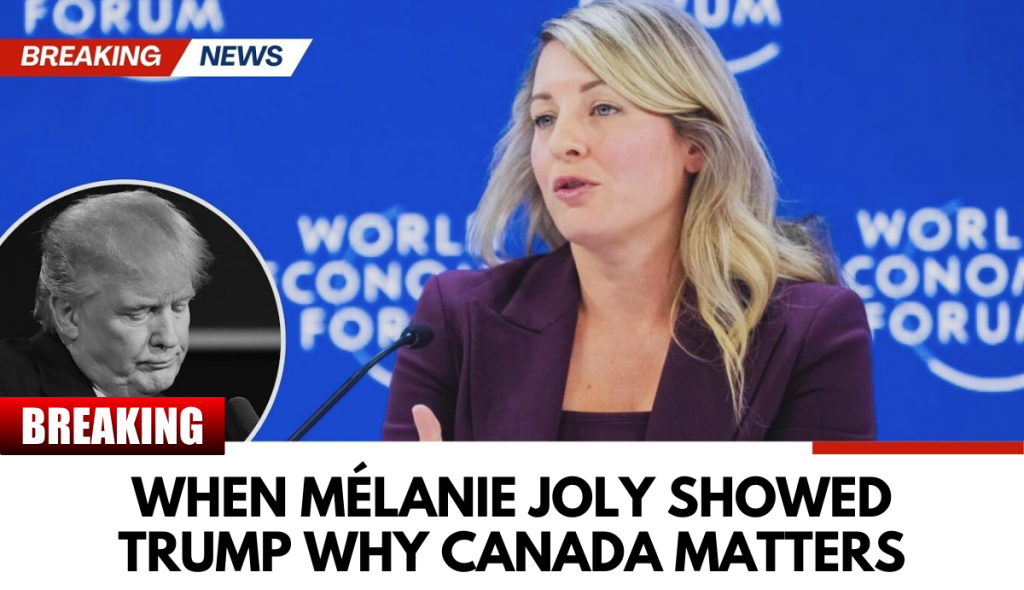
At the annual gathering of global elites in Davos, where platitudes often circulate more freely than policy, Mélanie Joly delivered something different: a measured, unambiguous assertion of national strategy. Speaking on a World Economic Forum stage, Joly did not raise her voice, name names aggressively, or indulge in rhetorical spectacle. Yet the target of her remarks was unmistakable. The era of reacting nervously to Washington’s unpredictability—embodied most starkly by Donald Trump—was over. Canada, she suggested, had learned its lesson.
Joly’s appearance came against the backdrop of renewed anxiety about American politics and the possibility of a second Trump presidency. For many U.S. allies, Trump’s earlier tenure was marked by tariff threats, transactional diplomacy, and a willingness to treat partners as adversaries. Canada, bound to the United States by geography, trade, and history, felt those tremors acutely. Steel and aluminum tariffs, public insults, and the constant threat of economic retaliation forced Ottawa into a posture it had long avoided: strategic self-defense.
What made Joly’s remarks notable was not their tone but their premise. Rather than framing Canada as a victim of American volatility, she described Trump-era pressure as a “wake-up call”—a moment that compelled structural change. “There are many things we can’t control,” she said, alluding to political currents in Washington. “But there are many things we can.” That distinction formed the spine of her argument.
Over the past several years, Canada has quietly pursued diversification with unusual discipline. Joly pointed to free trade agreements spanning Europe, renewed engagement with Asia, and expanding ties in the Middle East. Access to markets representing more than a billion consumers, she argued, had reduced Canada’s vulnerability to any single partner’s political mood swings. The message was implicit but sharp: leverage cuts both ways.
The minister’s comments also reflected a broader shift in how Canada understands power. Long accustomed to sheltering beneath American economic and security umbrellas, Ottawa is now investing aggressively in domestic capacity. Joly outlined an industrial policy that would once have sounded alien to Canadian ears: massive public investment in electric vehicles, autonomous technology, aerospace, artificial intelligence, critical minerals, energy infrastructure, and defense manufacturing. An $81 billion defense-industrial commitment over five years, she said, would help Canada build drones, aircraft, and AI-enabled systems at home.
This was not nationalism in the Trumpian sense—loud, exclusionary, and performative—but something closer to technocratic sovereignty. Joly repeatedly returned to the idea of control: control over supply chains, over energy grids, over data, and over the social consequences of technological change. In an age of artificial intelligence, she warned, governments cannot simply cheer innovation while ignoring its effects on jobs, electricity prices, or democratic trust.
Here, too, the contrast with Trump was striking. Where Trump often framed technology and trade as zero-sum contests demanding blunt force, Joly emphasized governance. She spoke of retraining workers displaced by automation, protecting children online, and ensuring that AI adoption delivers tangible benefits—shorter hospital waits, faster diagnoses, more meaningful work—rather than abstract promises. If people experience AI as a cost rather than a gain, she cautioned, political backlash will follow.
Underlying the speech was a clear reading of global mood. Across democracies, citizens feel squeezed by rising prices, rapid change, and a sense of powerlessness. Joly acknowledged that distrust openly, noting that many people no longer believe elites gathered in places like Davos understand their lives. The task of government, she argued, is not merely to design policy but to bring people along—to demonstrate, concretely, that the state is neither absent nor captured, but capable.
This emphasis on reassurance may prove as important as any trade agreement. Trump’s political success has often rested on exploiting feelings of loss and dislocation, presenting confrontation as strength and chaos as authenticity. Joly offered a different model: confidence without bravado, resilience without melodrama. Canada, she suggested, does not need to shout to signal seriousness.
In that sense, her remarks were less a speech than a declaration of maturity. Canada is no longer defining itself primarily by its relationship to American politics, but by its own strategic choices. The proximity remains; the dependence does not. While Trump continues to dominate headlines with provocation and threat, Ottawa is betting that preparation, diversification, and institutional capacity are the more durable forms of power.
The applause in Davos was polite, not rapturous. There were no viral sound bites engineered for outrage. Yet the silence that followed Joly’s remarks spoke volumes. In a global environment increasingly shaped by noise, Canada’s response to pressure was almost disarming in its calm. That, perhaps, was the point.