By XAMXAM
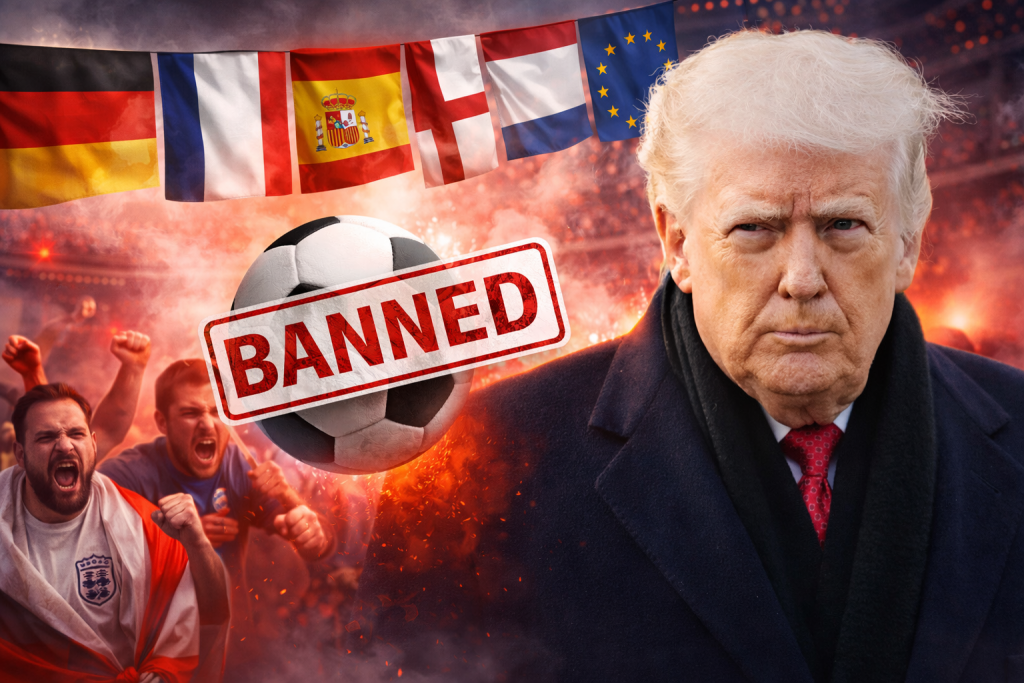
WASHINGTON — The World Cup has survived wars, boycotts and pandemics. What it has rarely faced is the quiet unraveling of its premise: that the host nation will, for one month, open its doors to the world. As the 2026 tournament approaches, that assumption is under strain in the United States, where sweeping visa restrictions imposed by President Donald Trump have turned football’s biggest celebration into a diplomatic fault line.
The crisis crystallized in January, when the administration announced an indefinite suspension of immigrant visa processing from 75 countries, layered atop earlier travel bans affecting dozens more. The measures, officials said, were rooted in national security and public-charge rules. There were no carve-outs for World Cup supporters. Possessing a match ticket, the government emphasized, would not guarantee entry.
For FIFA World Cup, the implications are staggering. The tournament is expected to draw millions of fans across the United States, Canada and Mexico, with 104 matches spread across three countries. Demand has already shattered records, with FIFA reporting ticket requests from all 211 member associations. Yet for supporters from entire regions — Africa, the Caribbean, parts of the Middle East and South America — attending now feels less like planning a trip and more like gambling on geopolitics.
Some of the human consequences are immediate and visceral. Haiti, qualifying for the World Cup for the first time in its history, will play all of its group-stage matches on American soil. Its fans, many of whom have waited generations for this moment, face a full travel ban. Iran’s supporters are similarly locked out, after already being unable to attend the tournament draw in Miami. Senegalese and Ivorian fans, caught in partial restrictions, confront months of uncertainty about whether visas will arrive in time — or at all.
What began as frustration is now tipping into political response. In Germany, a senior lawmaker from the Christian Democratic Union publicly floated the idea of a boycott if Washington escalates its standoff with Denmark over Greenland. Polling showed nearly half of Germans supporting withdrawal under those circumstances — a startling figure in a country where World Cup participation is treated as a national rite. In Britain, members of Parliament from four parties signed a motion urging international sports bodies to consider expelling the United States from major competitions, citing a pattern of military threats and diplomatic coercion.
Such proposals remain unlikely to pass. FIFA has little appetite for reopening host agreements months before kickoff, and national federations are wary of punishing players for political disputes. But the fact that elected officials are raising the possibility at all signals how far the situation has deteriorated.
The imbalance is already reshaping the tournament. Canada and Mexico, co-hosts with fewer visa barriers, are emerging as safe havens for supporters who cannot enter the United States. Matches in Toronto and Vancouver are expected to absorb fans shut out of American venues, shifting not just crowds but economic benefits northward. In effect, a World Cup awarded to showcase North American unity risks becoming a case study in uneven access.

FIFA’s position has been awkwardly constrained. The organization announced a “fan visa facilitation” program and additional consular staffing, while quietly warning that entry decisions rest entirely with national governments. That disclaimer — buried in press releases — may prove more consequential than any marketing campaign. It reframes the World Cup as an event where participation depends not only on sporting qualification, but on diplomatic alignment with Washington.
Supporters of the administration argue that no sporting event should override immigration enforcement. Critics counter that hosting the World Cup is, by definition, a political commitment — a promise to welcome the world. When that promise is selectively withdrawn, the tournament’s legitimacy erodes.
The visual consequences could be stark. Teams will play before partially empty supporter sections, not because interest is lacking, but because borders are closed. Cameras may linger on gaps where color and noise should be. For debut nations like Haiti, the absence will be a second, quieter loss.
Beyond optics lies a deeper question: whether the United States can credibly host global events while treating international mobility as a bargaining chip. Sport has long served as a pressure-release valve in tense moments, a space where rivalry is ritualized rather than weaponized. Turning it into leverage risks breaking something more fragile than ticket sales.
With five months until kickoff, there is still time for adjustment. Visa exemptions could be expanded. Assurances could be offered. But trust, once shaken, is difficult to restore. European governments weighing participation are not merely posturing; they are responding to voters who see their supporters excluded and their values tested.
The World Cup was meant to be a showcase of openness — of packed stadiums, mingling cultures and a shared language of sport. Instead, it is becoming a mirror of a fractured moment, where even football cannot escape the gravity of politics. If allies do choose to walk away, the loss will not be measured only in goals missed or matches forfeited, but in the erosion of an idea: that the world can still gather, freely, on common ground.