By XAMXAM
For decades, Canada’s public-health relationship with the United States rested on an assumption so deeply embedded it rarely needed articulation: when it came to medicines, vaccines, and emergency preparedness, Washington would always be there. The supply chains were integrated, the regulatory frameworks aligned, and American pharmaceutical firms sat at the center of a system that served both countries. That assumption is now gone.
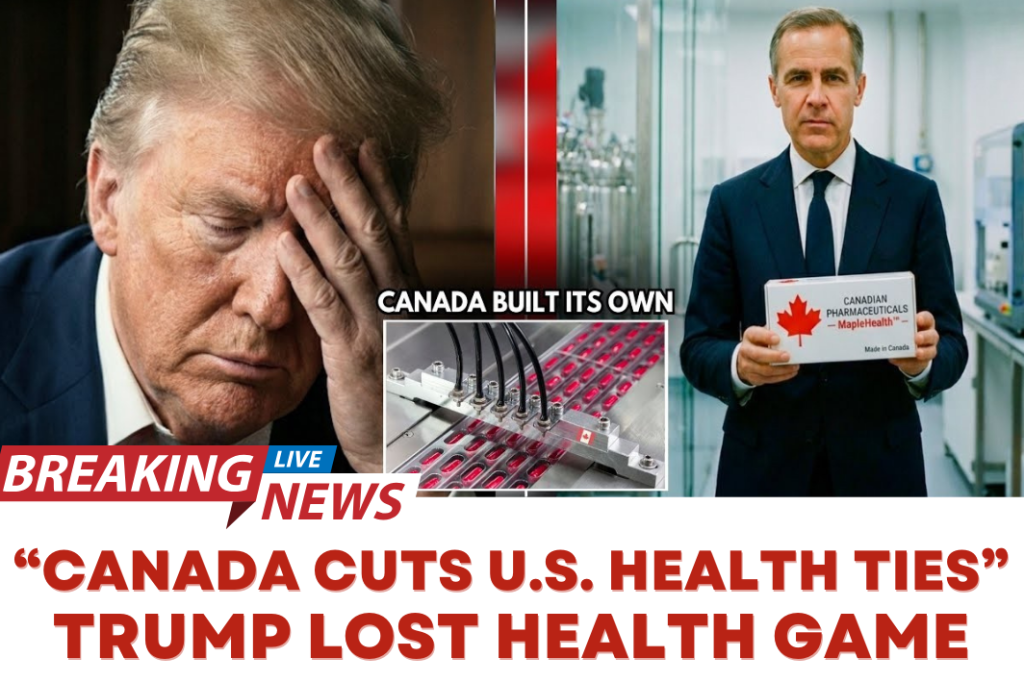
What replaced it was not a dramatic rupture or a televised confrontation. It was something far more consequential: a methodical decision by Ottawa to remove the United States from the role of indispensable partner in Canada’s health security. The result is a transformation that has startled policymakers in Washington and quietly erased a form of leverage they long took for granted.
The shift became unmistakable in late 2025, when senior Canadian officials stated publicly that the United States could no longer be treated as a reliable partner in public health. The remark was not rhetorical. It reflected a conclusion already encoded into budgets, procurement rules, and industrial policy. By the time it was spoken aloud, the infrastructure to support that judgment was already being built.
Canada’s reasoning was not abstract. The Covid-19 pandemic exposed how vulnerable countries were when pharmaceutical production and coordination sat outside their borders. Export restrictions, political interference, and competition between allies revealed that goodwill alone could not guarantee access to life-saving medicines. For Canada, the lesson was blunt: dependence was a risk.
That lesson hardened as Washington’s health institutions became more politicized under Donald Trump. The appointment of Robert F. Kennedy Jr., long associated with vaccine skepticism, sent a signal Ottawa could not ignore. When trust in scientific institutions erodes at the source, downstream partners are forced to adapt.
Canada adapted with money and policy. Since 2020, billions of dollars have flowed into domestic biomanufacturing and life-sciences capacity. These were not symbolic investments. They were designed to replicate, at national scale, functions Canada once outsourced to the United States: vaccine ingredient production, fill-and-finish operations, active pharmaceutical ingredients, and advanced biologics.
The most visible example sits outside Montreal, where a new mRNA facility began producing vaccines entirely within Canada’s borders. For the first time, doses destined for Canadians no longer crossed an American border or relied on American export approvals. Each stage—from drug substance to final syringe—was controlled domestically. The symbolism was powerful, but the strategic meaning was greater. Control had replaced coordination.

This pattern repeated across provinces. Ontario expanded sterile-injectable capacity. Quebec doubled down on biotech manufacturing with tax and research incentives. British Columbia focused on RNA technologies and clinical innovation. The system that emerged was not a satellite of U.S. pharmaceutical giants, but a parallel ecosystem designed to function without them.
The rules governing participation made that clear. American firms were not banned outright, but their role was sharply redefined. They could buy Canadian products or contract for services. What they could not do was sit at the center of Canada’s health strategy. Coordination, priority access, and procurement preference were reserved for domestic and non-U.S. partners.
This mattered because leverage in global health rarely comes from market size alone. It comes from being unavoidable—from controlling chokepoints in supply chains and decision-making. For decades, American pharmaceutical companies occupied that position in Canada by default. Ottawa’s new strategy dismantled it by design.
Active pharmaceutical ingredients, the chemical backbone of modern medicine, illustrate the shift. Once routed largely through U.S. intermediaries, they are now increasingly produced or coordinated domestically or through European and Asian partnerships. Canadian firms expanded fermentation-based production, synthetic chemistry, and biotech inputs, reducing exposure to U.S. bottlenecks. The effect was cumulative: each new facility reduced reliance, each new partnership reinforced independence.
Procurement policy locked the change in place. Medicines deemed critical to national security were prioritized for Canadian sourcing. Provinces were encouraged—sometimes explicitly, sometimes implicitly—to favor domestic producers. Once hospitals and public systems aligned around these rules, reversing them became politically and operationally difficult.
From Washington’s perspective, the shock was not that Canada invested in itself. Countries do that all the time. The shock was the speed and completeness with which Canada restructured a relationship once assumed to be permanent. American pharmaceutical executives discovered that access to the Canadian market now required operating on Canadian terms—or accepting a diminished role.

The implications extend beyond health. Trust, once broken in one domain, rarely stays contained. Canada’s health strategy mirrors similar recalibrations in trade, Arctic security, and supply-chain diversification. In each case, Ottawa chose redundancy over dependence, even at higher upfront cost. The common thread was a reassessment of U.S. reliability in an era of unpredictable governance.
None of this was framed as retaliation. Canadian officials emphasized modernization, resilience, and preparedness. But the effect was unmistakable. By removing the United States as a gatekeeper in health, Canada deprived Washington of influence that no tariff or diplomatic note could restore.
The lesson is not that alliances no longer matter. It is that alliances built on assumptions rather than safeguards are fragile. Canada did not abandon cooperation. It simply redefined it so that cooperation was optional, not existential.
For American policymakers, the episode should be unsettling. Influence lost through erosion of trust is rarely regained through persuasion alone. Once infrastructure is built, once supply chains are rerouted, once professional networks realign, the old center of gravity does not automatically return—even if leadership changes.
Canada’s health-security pivot shows how power shifts in the modern world. Not with speeches or sanctions, but with factories, procurement rules, and long-term planning. Washington may yet remain a major player in global health. But in Canada, it is no longer the default.
And that, more than any press conference or headline, is what truly shocked Washington.