By XAMXAM
For decades, the architecture of North America’s industrial power followed a familiar pattern. Canada supplied the raw materials, the United States coordinated the capital and processing, and global value flowed through Washington’s orbit. That assumption no longer holds. With a series of long-term critical mineral partnerships announced over the past year, Canada has begun to rewire the electric vehicle supply chain—placing itself at the center of a market projected to exceed $400 billion within the next decade.
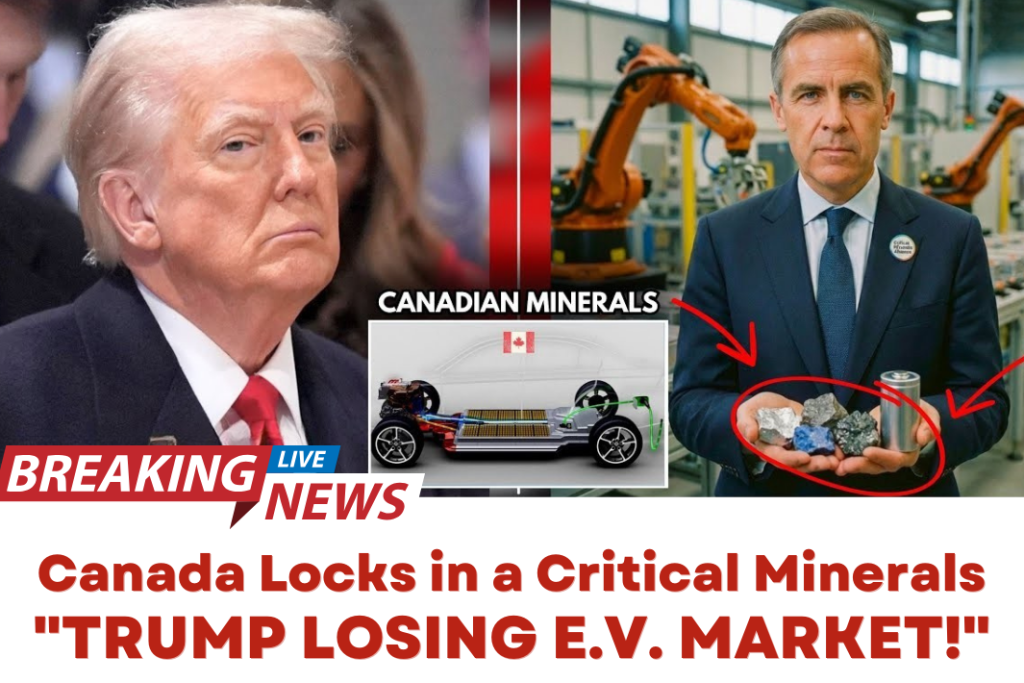
The shift was articulated bluntly last autumn by Mark Carney at the G7 summit in Toronto. Canada, he said, was restructuring critical mineral supply chains through multilateral partnerships that reduce dependency on any single country. The United States, long presumed to be the natural coordinator of Western industrial strategy, was notably not leading those efforts.
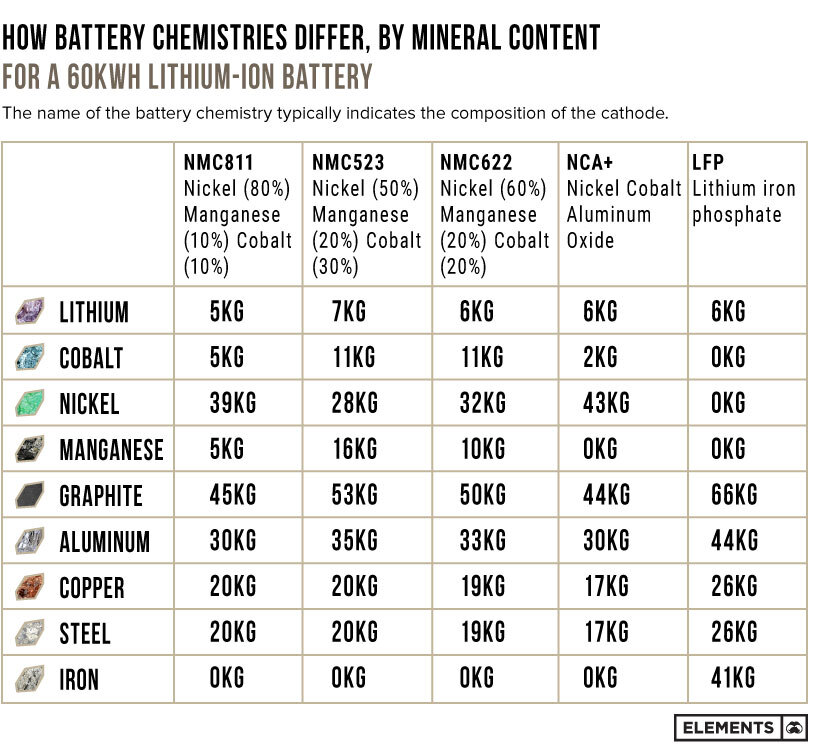
At stake is the foundation of the global EV transition. Electric vehicle batteries depend on a narrow set of minerals—lithium, nickel, cobalt, graphite, and rare earth elements—whose supply chains are highly concentrated. China dominates refining and processing across nearly all of them, while Russia and Indonesia hold outsized positions in nickel. Western governments have spent years warning about this vulnerability. What they have struggled to do is fix it.
Canada, quietly and methodically, is attempting exactly that.
Unlike most Western nations, Canada possesses commercially viable deposits of every major mineral required to build EV batteries from start to finish. For years, those resources were exported largely unprocessed. The value-added stages—refining, chemical processing, and battery-grade conversion—took place elsewhere, often in China, sometimes in the United States. Canada sold the rock; others sold the power.
That division of labor seemed efficient—until politics intervened. Trade threats from Donald Trump, including tariffs and rhetoric about economic annexation, forced Ottawa to confront a risk it had long tolerated: strategic dependence on American coordination for industries that define the next century.
The response has been structural, not rhetorical. Through what it calls the Critical Minerals Production Alliance, Canada has signed more than $6 billion in partnerships with Europe, Japan, Australia, and other allies. The goal is not merely to mine minerals, but to refine and process them within Canada or trusted partner countries—locking in supply chains that bypass traditional American gatekeeping.

The design is deliberate. Graphite projects in Quebec are tied directly to Japanese and European battery manufacturers through decades-long offtake agreements. Rare earth processing facilities in Ontario are being built with German industrial customers in mind. Nickel and lithium projects are aligned with European and Asian automakers seeking secure, long-term access to materials that no longer flow reliably through global markets.
What is striking is not the exclusion of the United States—American companies can still participate—but the loss of primacy. Washington is no longer the hub through which everything passes. Canada is positioning itself as the connector: linking geology to industry, supply to demand, and policy stability to industrial planning.
For partners, the appeal is straightforward. Canada offers political predictability in an era of volatility, regulatory standards that satisfy European scrutiny, and a comprehensive mineral portfolio that few countries can match. Just as important, Ottawa is offering partnership rather than hierarchy. European and Asian governments are not being asked to follow; they are being invited to co-design.
The implications are far-reaching. Control over refined battery materials—rather than raw minerals—captures a disproportionate share of value. Processing can account for up to 40 percent of battery costs, and it determines where downstream manufacturing locates. A secure graphite or nickel supply does more than feed factories; it shapes where those factories are built.
If Canada captures even a modest share of Western battery-material supply, the cumulative value over the next decade could run into the hundreds of billions of dollars. But the strategic significance may matter more than the revenue. Countries that control bottlenecks shape standards, timelines, and industrial geography. In the EV race, Canada is moving from supplier to system architect.
The United States is not absent from this future, but its role is changing. American automakers and battery manufacturers will still need Canadian materials. What they may no longer do is set the terms. Procurement decisions increasingly run through Canadian-led supply chains designed to endure for decades, not election cycles.
None of this is being framed as confrontation. That is precisely the point. Canada has not challenged Washington head-on or rewritten trade rules. It has invested in infrastructure, signed contracts, and built capacity. Once those assets exist—mines operating, refineries online, supply agreements locked in—the balance of influence shifts quietly and irreversibly.
There are risks. Mining and processing projects face environmental scrutiny, cost overruns, and long timelines. Global EV demand could fluctuate. But the direction is clear. Canada is no longer content to export advantage and import dependency.
In the 20th century, oil determined geopolitical power. In the 21st, it may be battery materials. By treating critical minerals not as commodities but as leverage, Canada has begun to redefine its place in the global industrial order—less a junior partner, more a power broker.
The transformation is still unfolding. But the architecture is being laid now, in steel, concrete, and long-term contracts. And architecture, more than rhetoric, decides who leads and who follows when the future arrives.