By XAMXAM
When Toyota quietly committed nearly $40 billion in long-term manufacturing and electrification investment to Canada, the announcement did not arrive with the theatrics that usually accompany industrial megadeals. There were no victory speeches, no triumphalist press conferences. Yet within policy circles and boardrooms, the message landed with unusual force. This was not simply an expansion decision. It was a judgment.
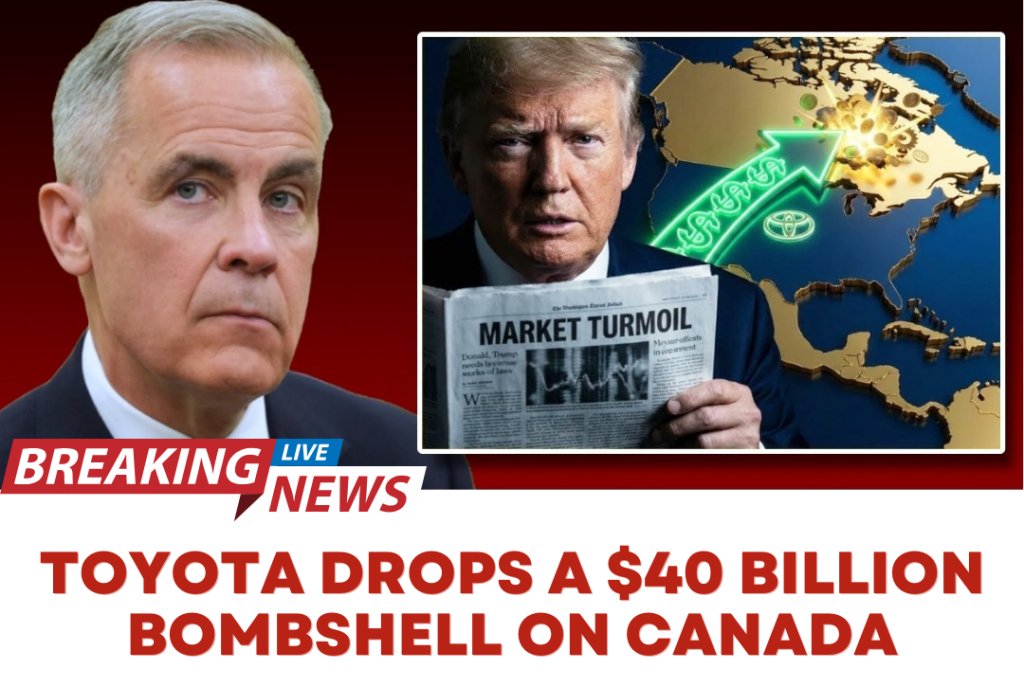
For years, the North American auto industry has operated under an assumption that scale and political pressure would ultimately determine where investment flows. That belief has been especially prominent in Washington, where tariffs, incentives, and rhetorical muscle have been presented as tools capable of pulling manufacturing back across borders. Toyota’s decision challenged that logic in a way no speech ever could.
At the center of the shift sits Toyota’s operation in Cambridge, Ontario, now widely regarded within the industry as one of the highest-quality automotive plants in the world. Measured by defect rates, reliability scores, and cumulative global quality awards, it has surpassed comparable facilities not only in the United States but also in Japan. This was not the result of a sudden breakthrough. It was the product of decades.
The Cambridge plant’s rise was marked by consistency rather than spectacle. Training programs were preserved rather than trimmed. Labor relations emphasized stability and cooperation. Institutional knowledge was treated as an asset worth protecting, not a cost to be minimized. In an industry where quarterly pressures often override long-term thinking, Toyota’s Canadian operations followed a different rhythm.
That difference now carries geopolitical weight. Global automakers do not allocate capital based on campaign slogans or trade threats. They look for places where quality compounds, where risk is reduced over time, and where production systems can deliver reliably across economic cycles. Canada, in Toyota’s calculus, met those conditions more convincingly than anywhere else on the continent.
The timing of the announcement could not have been more awkward for Donald Trump, whose industrial message has long centered on leverage, confrontation, and the promise that pressure alone could restore manufacturing dominance. Toyota’s move did not refute that argument rhetorically; it rendered it irrelevant. Canada operates under the same integrated North American trade framework. It uses many of the same suppliers, machines, and logistics networks. The divergence in outcomes therefore points away from globalization as the culprit and toward governance.

This is what unsettled policymakers in Washington. If a neighboring country playing by the same rules can outperform the United States so decisively in automotive manufacturing, then the explanation cannot rest on foreign cheating or lost sovereignty. It must confront domestic choices about labor, investment horizons, and the structure of incentives.
For decades, much of American manufacturing policy drifted toward financialization. Plants were evaluated by short-term cost reductions rather than long-term output quality. Training budgets were treated as discretionary. Experience was allowed to exit without replacement. Quality problems were deferred until recalls made them unavoidable. These decisions were rarely framed as ideological; they were presented as practical responses to competitive pressure. Over time, however, they hollowed out capacity.
Canada’s approach diverged in small but cumulative ways. Governments treated auto manufacturing as a strategic capability. Unions retained a meaningful role. Companies were expected to demonstrate long-term commitment in exchange for market access and public support. None of this guaranteed success, but together it created conditions under which excellence could accumulate rather than reset every cycle.
Toyota’s $40 billion commitment transformed that quiet divergence into a visible realignment. Capital followed performance. Reputation became leverage. Canada now enters trade and industrial negotiations not as a junior partner seeking accommodation, but as the benchmark within the North American auto system. Disrupting that position would risk destabilizing the very supply chains on which global brands depend.
The broader lesson extends well beyond one company or one country. Manufacturing outcomes are not determined by rhetoric or intimidation. They are shaped by institutions, training pipelines, workplace governance, and patience. Where systems reward extraction and speed, quality erodes. Where systems reward continuity and skill, quality compounds.
This is why the Toyota decision resonated so deeply. It exposed a tension at the heart of modern capitalism: the gap between short-term financial incentives and long-term productive capacity. For years, that gap was obscured by narratives of inevitability. Factories closed, skills faded, and communities were told there was no alternative. Canada’s experience suggests otherwise.

The uncomfortable implication is that decline, in many cases, was not unavoidable. It was profitable for someone. Insecurity weakened labor’s bargaining power. Fragmentation limited collective demands for reinvestment. Governments anxious about capital flight became more accommodating. The system functioned, but not for everyone.
Toyota’s Canada bet did not overturn that system overnight. But it introduced a counterexample powerful enough to unsettle it. In an integrated market, excuses collapse quickly. The same company, the same technology, and the same trade rules produced sharply different results. What remained were choices.
Washington’s muted response reflected more than embarrassment. Acknowledging the significance of this moment would reopen debates long deferred: about labor rights, public investment, and whether markets left entirely to short-term logic can sustain long-term prosperity. Those are harder conversations than blaming tariffs or rivals.
The $40 billion did not merely shift production. It shifted the frame. In doing so, it reminded policymakers that industrial power is not commanded; it is built. And once built elsewhere, it cannot easily be coerced back.