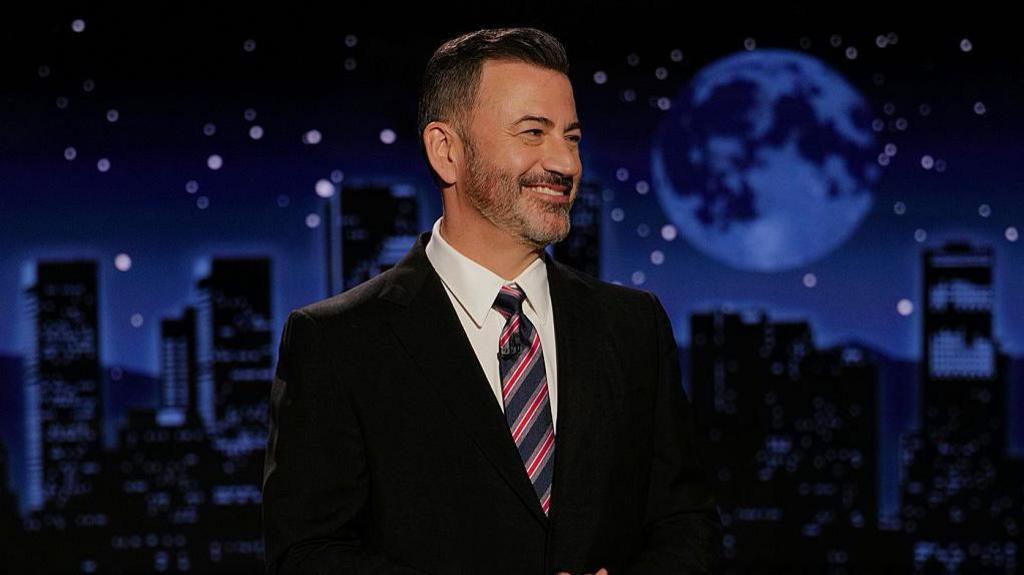
Late-night television is usually built for momentum, not pause. Jokes move quickly, laughter fills the gaps, and the news cycle resets by morning. But during a recent episode of Jimmy Kimmel Live, that rhythm broke. What began as a routine monologue evolved into a moment of deliberate stillness, as Jimmy Kimmel lined up the public statements of Mike Johnson alongside the long-documented rhetoric of Donald Trump—and let the contrast speak before the punchline arrived.
The studio reaction told the story. Laughter gave way to silence. Silence turned into gasps. Then, when Kimmel finally delivered the line he had been building toward, the room erupted in applause that felt less like entertainment and more like recognition. Within hours, clips spread across social platforms, framed by headlines describing a “meltdown” and a “career-level roast.” The reality, as with most viral moments, was more precise—and more revealing.

A monologue built on the public record
Kimmel’s segment did not hinge on leaks, allegations, or speculation. Instead, it relied on verbatim quotes and positions already on the record, many of them reported extensively by outlets such as The New York Times, The Washington Post, and Reuters. Kimmel juxtaposed Johnson’s recent talking points—particularly his framing of institutional authority and accountability—with Trump’s own words about power, grievance, and legitimacy.
The technique was surgical. Rather than exaggerate or impersonate, Kimmel slowed the pace, repeating phrases back-to-back so the audience could hear the dissonance. Media critics often describe this approach as receipt-based satire: humor that emerges from comparison rather than caricature. When done well, it minimizes claims and maximizes clarity.
Why the studio froze
Jimmy Kimmel returns to late night after ruptured appendix caused ‘heap of trouble’
Late-night silence is risky. It can signal a joke that failed. Here, it signaled processing. Kimmel paused after aligning the quotes, inviting viewers to connect the dots themselves. The moment stretched just long enough to feel uncomfortable—long enough for recognition to settle in. When the punchline arrived, it didn’t accuse; it summarized. The applause that followed was delayed but thunderous.
Television historians note that these pauses are rare and powerful. They recall moments when satire has temporarily dropped its mask to foreground context—Jon Stewart after 9/11, Kimmel’s own congressional testimony years earlier—instances when comedy borrowed the cadence of commentary.

Mike Johnson enters the frame
As Speaker of the House, Mike Johnson has positioned himself as a defender of institutional norms while navigating a conference shaped by Trump’s influence. That tension has been widely covered, with reporting noting Johnson’s careful calibration between constitutional language and partisan loyalty. Kimmel’s monologue didn’t invent that tension; it compressed it, placing Johnson’s stated principles beside Trump’s record of attacking institutions that constrain him.
The effect was to ask a question without asking it out loud: What happens when rhetoric about norms collides with allegiance to a figure who routinely challenges them? The answer was left to the audience.
Trump’s familiar orbit
US House Speaker Johnson survives ouster attempt, but future …
Trump was not on stage, but his presence loomed through clips and quotations that have circulated for years. Kimmel avoided new accusations, instead relying on Trump’s own words—an approach that has become a late-night staple because it is difficult to refute without refuting the speaker himself. Trump’s relationship with late-night television has long been adversarial, marked by denunciations of bias and personal attacks on hosts. That history gave the segment additional charge.
Online commentary quickly claimed that “Trump world scrambled.” As with many viral assertions, specifics are unverified. What is documented is a pattern: sharp satire airs; allies denounce it; denunciations amplify the clip. Outrage becomes distribution.

The internet afterlife
Within minutes, excerpts traveled across X, TikTok, and YouTube, where nuance compressed into spectacle. Headlines hardened into absolutes—“destroyed,” “obliterated,” “meltdown.” Yet the segment itself was restrained. Kimmel did not allege wrongdoing or reveal secrets. He rearranged known information into a form that felt newly coherent.
Research from Pew Research Center helps explain why such moments travel so fast. A growing share of Americans, particularly younger viewers, encounter political narratives first through satirical programs. When those programs translate dense reporting into memorable contrasts, they shape how facts are emotionally processed—even if they don’t introduce new facts.
Criticism and counter-criticism
As expected, critics accused Kimmel of partisan bias, arguing that late-night comedy functions as advocacy rather than entertainment. Supporters countered that satire reflects public sentiment and holds power to account by highlighting inconsistency. Both arguments have merit. Empirical studies suggest satire can polarize while also setting frames that migrate into mainstream discourse.
What insulated Kimmel’s segment from charges of misinformation was sourcing. Every quote traced back to public statements. Every comparison mirrored mainstream reporting. By staying within that boundary, the monologue invited debate about interpretation rather than accuracy.
What Kimmel did—and didn’t—do
Trump brings 2024 campaign to the Jersey Shore • New Jersey Monitor
He did not break news. He did not claim insider knowledge. He did not assert motive. He curated the public record and trusted the audience. That restraint is why the moment held up under scrutiny even as headlines escalated.
Why it felt like a “meltdown”
The term describes reaction more than event. The real disruption wasn’t chaos on set; it was clarity. Kimmel’s alignment of words exposed a tension many viewers already sensed but hadn’t seen rendered so plainly. The pause made room for that recognition.
The larger significance
In a fragmented media environment, late-night satire occupies a peculiar role. It doesn’t replace journalism; it repackages it. When hosts slow down and foreground documentation, they can momentarily command attention in ways press conferences cannot.
For Mike Johnson, the segment underscored the difficulty of balancing institutional rhetoric with partisan reality. For Trump, it reinforced a long-running dynamic in which televised mockery becomes a proxy battlefield over narrative control. For audiences, it offered a brief respite from noise—an invitation to notice patterns rather than react to outrage.
The takeaway
There was no live confrontation, no hidden file, no shouted accusation. There was a desk, a pause, and a series of quotes arranged to illuminate contradiction. The studio froze because viewers recognized the picture being drawn. The applause followed because recognition can feel cathartic.
In an era when political communication is constant and trust is scarce, a few minutes of fact-anchored satire can still stop the room. That may be why this monologue resonated—and why it continues to circulate long after the lights went down.