This was not a conventional year-end interview, nor was it a routine exchange of political talking points. When Mark Carney sat down with the CBC, the conversation unfolded less like a recap of past decisions than a signal about how Canada intends to govern itself in an increasingly unstable world.
The moment that lingered did not come from a sharp line or a viral confrontation. It came from Carney’s insistence on a simple but consequential distinction: there are forces Canada cannot control—and responsibilities it must. “We can’t necessarily control Donald Trump,” he said, referencing Donald Trump and the broader shift in U.S. trade behavior. “What we can control is what we build here at home.”

That framing set the tone for the entire interview. As the host pressed him on tariffs dropped, taxes abandoned, and gestures made since the election, Carney resisted the gravitational pull of defensiveness. Instead, he recentered the discussion on outcomes rather than optics. Canada, he argued, is in a stronger position than it was nine months ago—not because of any single concession, but because of structural changes underway: domestic investment, diversified trade relationships, and a deliberate effort to reduce economic vulnerability.
The exchange briefly grew tense, as interviews often do when expectations collide. The interviewer suggested Canadians may wonder what, precisely, has been gained. Carney’s response was not dismissive, but firm. Canada, he said, now enjoys tariff-free access on roughly 85 percent of its trade with the United States—an advantage unmatched by most other countries. That does not mean the work is finished, he added, only that the baseline has improved.
What distinguished the moment was not the substance alone, but the posture. Carney did not raise his voice. He did not personalize the disagreement. When interrupted, he asked to finish his point and then returned to it, calmly. In a media environment conditioned to reward escalation, the effect was striking. The interview felt less like a debate and more like a briefing on how this government understands its role.
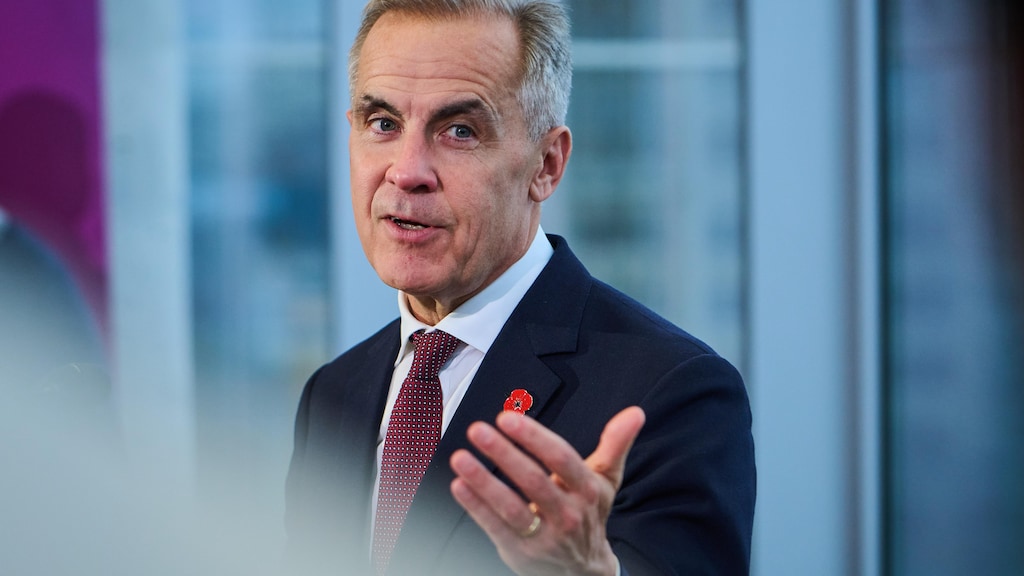
That sensibility reflects Carney’s unusual path to office. Unlike most political leaders, he did not spend decades honing instincts for partisan combat. His career unfolded in institutions where credibility is measured not by applause lines but by stability: central banks, international negotiations, crisis management. That background was evident throughout the conversation. He spoke in terms of systems, incentives, and long-term positioning, not villains or victories.
At one point, he emphasized that leadership is not about reacting to every provocation, but about ensuring that something actually changes. The line resonated because it captured a broader public fatigue. Many Canadians are tired of politics that feels performative—loud in the moment, hollow in the result. Carney’s insistence on seriousness, on the slow work of building resilience, tapped into that mood.
The interview also highlighted a deliberate contrast in political styles. Where contemporary politics often leans on outrage and immediacy, Carney leaned on patience and sequence. Trade negotiations, he noted, move in phases. The review of CUSMA will come next year. Preparation now matters more than theatrics today. It was not a message designed to excite, but one designed to orient.
Perhaps most telling was what Carney did not do. He did not attack opponents by name. He did not frame the conversation as a contest of personalities. He did not suggest that disagreement was illegitimate. Instead, he treated governing as a responsibility to protect Canada’s capacity to choose—its economic independence, its negotiating leverage, its internal cohesion.
When the interview ended, many viewers described an unusual reaction: not confusion or anger, but a sense of quiet recalibration. The exchange did not dominate social media because it lacked drama. It stayed with people because it felt serious. And seriousness, at this moment, is rare.
As the year closes, the interview reads less like a retrospective than a marker. It suggested that the next phase of Canada’s story will not be shaped by reaction alone, but by decisions made deliberately, sometimes without fanfare, and with an eye beyond the next headline. Whether one agrees with every policy choice or not, the tone itself marked a shift.
In a political era defined by noise, Mark Carney used the quiet to make his point.