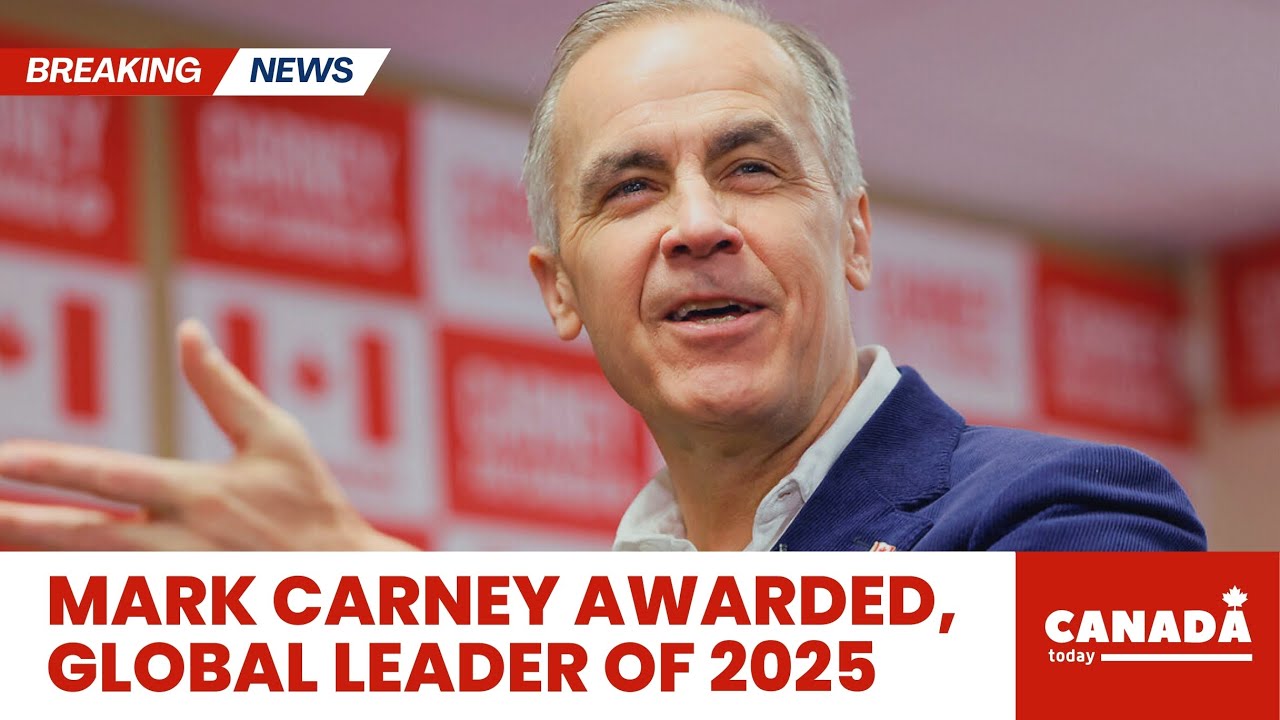
In a year marked by political volatility at home and economic turbulence abroad, Mark Carney has emerged as the dominant figure in Canadian public life. That judgment was formalized this week when The Canadian Press named Carney its Newsmaker of the Year—an honor determined by editors and news organizations across the country, and one that reflects more than momentary popularity.
Carney’s ascent has been as rapid as it has been unusual. He entered electoral politics only months ago, winning the Liberal leadership in a first-ballot landslide before calling—and winning—a national election that many analysts once considered unwinnable. Just weeks earlier, polling suggested a decisive Conservative victory. Instead, voters delivered Carney a mandate to govern at a moment of deep uncertainty.
What distinguishes Carney’s rise is not simply speed, but circumstance. He did not inherit a stable governing coalition. He took over a governing party widely assumed to be in terminal decline, following the departure of Justin Trudeau after nearly a decade in office. Internal divisions, collapsing public trust, and a demoralized caucus defined the Liberal landscape. Carney, a former central banker with no prior elected experience, was an improbable solution to a political crisis.
Yet improbability has become the throughline of his first year. Carney unified the party quickly, reframing its identity around competence and economic stewardship rather than continuity. He then led the Liberals into an election campaign dominated by affordability pressures, global instability, and an increasingly unpredictable relationship with the United States under Donald Trump. Instead of running as a partisan warrior, Carney presented himself as a stabilizer—a leader fluent in markets, institutions, and international negotiation.
That positioning resonated with voters who appeared less interested in ideological confrontation than in reassurance. Analysts note that Carney’s background—having led both the Bank of Canada and the Bank of England through periods of crisis—gave him immediate credibility at a time when economic anxiety eclipsed cultural debate. Where other leaders might still be learning the mechanics of power, Carney arrived with a working knowledge of global finance and statecraft.
Political commentators have been careful with their language, but unusually consistent in their assessment. Several have described Carney’s first year as “historic,” not as rhetorical flourish but as analytical conclusion. No Canadian prime minister has previously moved from political outsider to national leader so quickly, or under comparable pressure. And few have done so while simultaneously navigating an intensifying trade and diplomatic standoff with Canada’s largest economic partner.
The pressures have not abated since the election. Tariff threats, energy negotiations, and supply-chain realignments have placed Canada at the center of broader geopolitical shifts. Carney has responded with a mix of firmness and restraint, signaling a willingness to defend Canadian interests while avoiding rhetorical escalation. His approach has been closely watched abroad, particularly in Europe, where his tenure at the Bank of England remains well regarded.
What has also set Carney apart is the contrast between his governing style and the political climate that preceded him. The Trudeau years, particularly their final chapter, were defined by fatigue—among voters and within the party itself. Carney has benefited from that contrast, offering not novelty but seriousness. His public appearances are measured, his language technical but accessible, his emphasis consistently on long-term capacity rather than short-term applause.
That does not mean his position is unassailable. The opposition Conservatives remain formidable, and the structural challenges facing Canada—housing, productivity, regional inequality—are unresolved. Nor is it clear whether Carney’s technocratic appeal will sustain the emotional loyalty that modern politics often demands. Governing competence, while valued, does not always translate into enduring political affection.

Still, the significance of Carney’s first year lies in how decisively it altered expectations. Canada entered the year braced for political upheaval and emerged with an unexpectedly stable government led by a figure whose authority extends beyond partisan lines. That is what the Newsmaker designation ultimately recognizes: not celebrity, but consequence.
For now, Carney has done something rare in contemporary politics. He has shifted the national conversation away from collapse and toward capacity. Whether that shift endures will define not just his tenure, but the next chapter of Canadian politics.