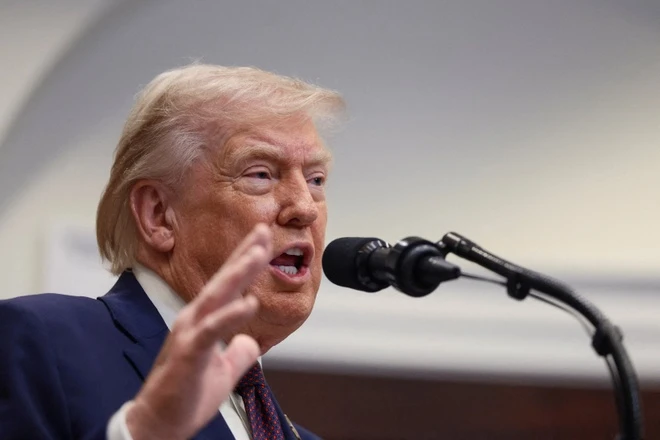
At a recent rally, Donald Trump delivered one of his most incendiary speeches of the campaign, unleashing a torrent of accusations aimed at political opponents, immigration enforcement, and Minnesota’s Democratic leadership. The remarks—rapid, repetitive, and confrontational—were greeted with applause from supporters and immediate condemnation from critics, who warned that the language blurred the line between grievance politics and incitement.
Trump’s speech centered on immigration enforcement and his long-standing criticism of Democrats who have supported reforms to Immigration and Customs Enforcement. He framed the issue as a stark test of authority, dismissing nuance and demanding “yes or no” answers from officials who have previously called for changes to ICE’s mandate. In doing so, he echoed a theme that has become central to his political messaging: that firmness, not deliberation, is the measure of leadership in matters of national security.
The rhetoric extended beyond policy. Trump targeted Ilhan Omar, repeating allegations that have circulated in conservative media for years and have been denied by Omar and rejected by multiple fact-checking organizations. By reintroducing these claims from the stage—without evidence—Trump reignited a controversy that legal experts say illustrates a broader pattern: the strategic use of unproven accusations to mobilize a base and dominate news cycles.
Democrats responded swiftly. Omar’s office condemned the remarks as “dangerous misinformation,” while party leaders urged restraint and emphasized the importance of factual discourse. Civil rights groups warned that the speech risked inflaming hostility toward immigrant communities and elected officials alike. Within hours, clips of the rally were trending across platforms, fueling a polarized debate over whether Trump’s approach represents candor or recklessness.
The rally also intersected with a tense week on Capitol Hill. During a marathon House Oversight hearing, Republican members grilled Democratic governors over immigration policies, with exchanges that often turned personal. One of the most viral moments featured Nancy Mace, who pressed Minnesota Governor Tim Walz with a series of rapid-fire questions. The exchange—clipped and shared widely—became emblematic of a broader Republican strategy: frame Democratic governance as evasive and ineffective, then amplify moments of hesitation as proof.
Walz, for his part, rejected the premise of the attacks, arguing that immigration enforcement must be paired with due process and federal coordination. His aides noted that many of the questions referenced past statements taken out of context, a claim echoed by Democratic colleagues who accused Republicans of turning oversight into spectacle.
The cumulative effect of the rally speech and the hearing has been to harden lines on an already volatile issue. For Trump’s supporters, the bluntness signals resolve. For opponents, it underscores concerns about the normalization of accusations untethered from evidence. Analysts say the strategy is familiar: escalate rhetoric, force a reaction, and keep attention fixed on conflict rather than policy detail.

What remains uncertain is how this plays beyond the base. Polling has shown that while voters express concern about border security, they also favor solutions that balance enforcement with legality and humanitarian considerations. As the campaign accelerates, the question is whether confrontational rhetoric continues to mobilize—or whether fatigue sets in among voters seeking clarity over confrontation.
For now, the episode illustrates the dynamics of a campaign season defined by maximalist language and viral moments. The speech, the hearing, and the online backlash form a single feedback loop—one in which outrage travels faster than verification, and attention becomes its own currency. Whether that loop ultimately benefits Trump or galvanizes opposition may depend less on the volume of the rhetoric than on how voters weigh spectacle against substance in the months ahead.