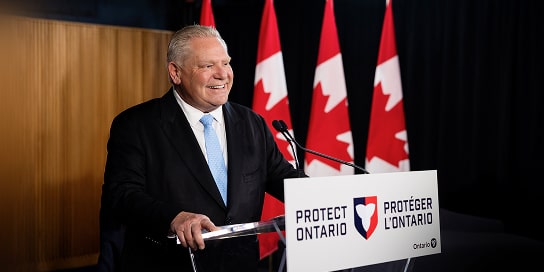
Toronto — A newly announced nuclear cooperation agreement between Canada and New York is drawing attention well beyond the ceremonial photo opportunities that accompanied its unveiling, highlighting how energy policy is increasingly being shaped through regional partnerships rather than grand federal initiatives.
Officials on both sides of the border described the pact as a practical response to mounting pressure on power grids, driven by electrification, population growth and the rapid expansion of energy-hungry data centers. The agreement outlines cooperation on nuclear technology, workforce development, fuel supply coordination and cross-border electricity planning, with an emphasis on low-carbon generation.

While the language of the announcement emphasized jobs and climate goals, analysts say the deal reflects deeper strategic calculations.
“Nuclear energy has quietly reentered the center of the clean power conversation,” said an energy policy scholar at McGill University. “What’s different now is the speed and the cross-border alignment.”
Canada, with its long-established nuclear sector and uranium resources, has positioned itself as a stable supplier of both fuel and expertise. New York, facing ambitious climate mandates and the retirement of fossil-fuel plants, is searching for firm, emissions-free power that intermittent renewables cannot always provide.
The partnership, according to officials familiar with the negotiations, was shaped by practical constraints rather than ideology. Grid operators in the northeastern United States have warned for years about capacity shortfalls as demand rises faster than new generation comes online. At the same time, Canada has sought long-term markets for its nuclear technology and fuel amid global competition.
The result is an agreement that moves faster than many expected. While no single reactor project was announced, the framework allows for collaboration on advanced nuclear designs, regulatory coordination and potential power-sharing arrangements across the border.

That pace has raised questions in Washington.
Energy policy in the United States is typically the domain of the federal government, particularly when it involves nuclear regulation and international cooperation. But states retain significant authority over electricity planning, and New York has used that latitude to pursue aggressive climate targets. The Canada–New York agreement sits at the intersection of those authorities, prompting scrutiny over how federal agencies will engage.
“This is not a treaty, but it’s also not trivial,” said a former U.S. energy official. “It signals where the momentum is.”
Supporters argue that the deal complements, rather than undermines, federal objectives. Nuclear power is increasingly viewed by both Democratic and Republican policymakers as a necessary component of decarbonization, particularly as electrification accelerates. Cross-border cooperation, they say, reflects the reality that grids and supply chains do not stop at national boundaries.
Critics, however, have raised concerns about oversight and transparency. Environmental groups in both countries have called for clearer details on safety standards, waste management and public consultation. Others worry that enthusiasm for nuclear power could sideline investment in renewables and energy efficiency.
Officials involved in the agreement say those concerns will be addressed through existing regulatory frameworks. Nuclear projects remain subject to extensive review, and any physical infrastructure would require approvals from national regulators, including the U.S. Nuclear Regulatory Commission and the Canadian Nuclear Safety Commission.
Beyond energy, the deal has geopolitical implications. Control over nuclear fuel supply, including uranium processing and enrichment, has become a strategic issue as countries seek to reduce dependence on adversarial suppliers. Canada’s role as a reliable source is increasingly valued by U.S. allies.
“Energy security is national security,” said a Canadian trade official. “This agreement reflects that reality.”
The announcement has been welcomed in parts of western New York, where officials see potential economic benefits in engineering, construction and skilled labor. Local leaders in Buffalo and Rochester highlighted the prospect of long-term, unionized jobs tied to clean energy infrastructure.
In Washington, reactions have been more muted. Federal officials have acknowledged the agreement but emphasized that any nuclear cooperation involving international partners must align with U.S. law and policy. Privately, some aides expressed concern that regional deals could complicate national energy planning.
Still, experts note that similar arrangements are likely to follow as states and provinces confront the same challenge: how to meet rising electricity demand while cutting emissions.

“This is a preview,” said the McGill scholar. “The era of isolated energy planning is ending.”
The agreement does not resolve longstanding debates over nuclear power. Questions about cost overruns, waste disposal and public trust remain. But it underscores a shift in tone. After decades of hesitation, nuclear energy is being reframed not as a last resort, but as a cornerstone of clean power strategy.
For Canada and New York, the partnership is a calculated bet: that cooperation can deliver stability in an era of energy transition. Whether it becomes a model for broader North American alignment will depend on execution, regulation and public acceptance.
What is clear is that the center of gravity in energy policy is moving. Not with sweeping declarations, but with targeted agreements that respond to immediate pressures. In that sense, the Canada–New York nuclear pact is less a sudden rupture than a sign of where the future is already heading.