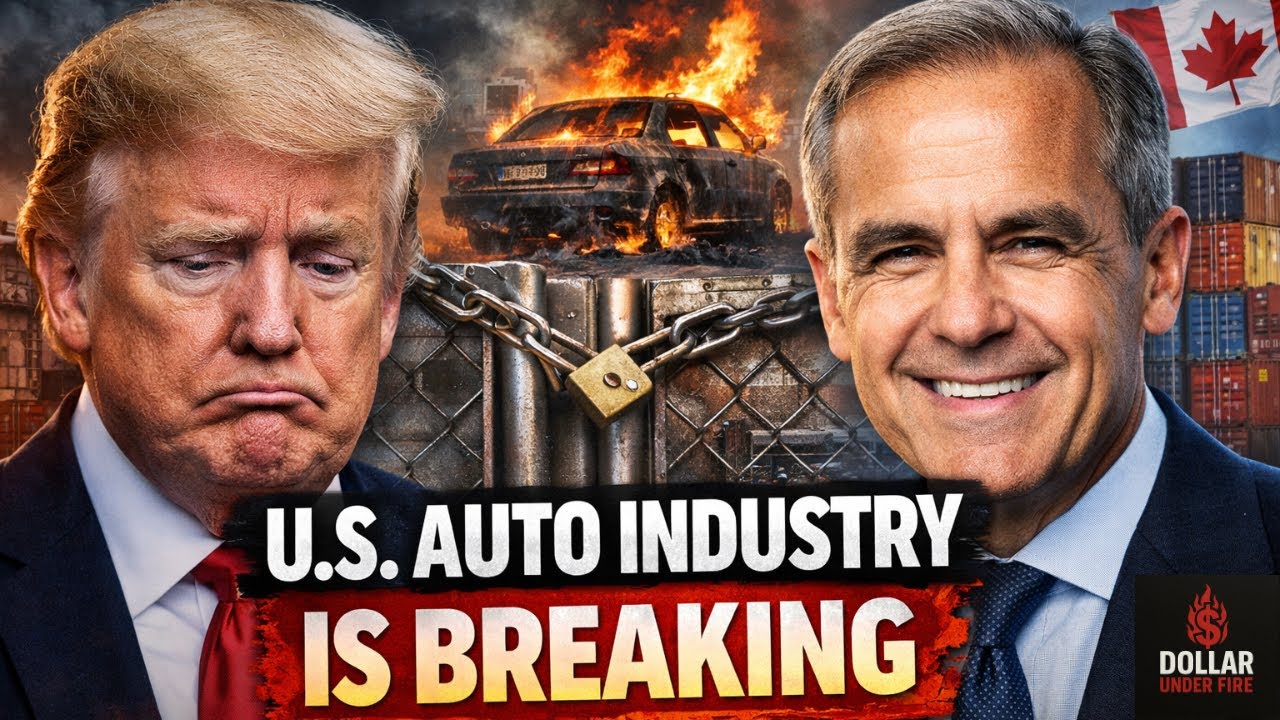
Detroit — When Stellantis announced the temporary shutdown of several U.S. manufacturing lines this week, the decision landed abruptly for workers but not entirely unexpectedly for industry insiders. The pauses, which affected facilities across the Midwest, sent hourly employees home, froze supplier schedules and reignited a broader debate over whether trade policy meant to protect American industry is instead magnifying its vulnerabilities.
Company officials described the moves as operational adjustments driven by rising costs and supply disruptions. But interviews with people familiar with internal planning suggest the shutdowns were the culmination of pressures that had been building for months, as tariffs reshaped pricing, sourcing and logistics in ways that left manufacturers with fewer options.
Automaking, long optimized for just-in-time production, depends on predictability. Tariffs introduced uncertainty into that equation. Components sourced across borders became more expensive or slower to secure. Contracts locked in prices that no longer reflected reality. Over time, executives say, flexibility eroded.
“When margins get thin enough, stopping the line becomes cheaper than running it,” said an auto industry analyst who has reviewed recent cost models. “That’s the point companies try desperately to avoid.”
The immediate human impact was visible in factory towns from Michigan to Ohio. Workers received notices of idled shifts with little advance warning. Local officials warned of ripple effects for restaurants, logistics firms and parts suppliers that rely on steady production. The United Auto Workers, which represents many Stellantis employees, said it was seeking clarity on the duration of the shutdowns and protections for affected workers.
“This is what instability looks like on the ground,” a union representative said. “People plan their lives around these jobs.”
The political implications followed quickly. Critics of Donald Trump pointed to the shutdowns as evidence that tariff-based protection can backfire, especially in industries as globally integrated as autos. Supporters countered that the disruptions reflect a necessary adjustment period and that reshoring supply chains takes time.

Economists caution against simple cause-and-effect conclusions. The auto industry faces multiple headwinds: slowing demand in some segments, the costly transition to electric vehicles, and lingering aftershocks from pandemic-era disruptions. Tariffs are one factor among many. Still, several analysts said trade policy has amplified existing stresses rather than alleviating them.
“Tariffs don’t operate in a vacuum,” said a professor of international economics at the University of Michigan. “They interact with supply chains that took decades to build. When you change the rules quickly, the system doesn’t absorb it smoothly.”
Stellantis executives have not publicly blamed tariffs for the shutdowns, emphasizing instead the need to balance inventories and costs. But people briefed on internal discussions say contingency planning increasingly assumed intermittent pauses if conditions worsened. What surprised some observers was how fast those plans moved from spreadsheets to reality.
The shutdowns also underscore a broader shift in how companies manage risk. Rather than absorbing losses in hopes of policy relief, firms are more willing to idle production, preserving cash even at the cost of short-term pain for workers and communities.

Markets took note. Shares of suppliers with heavy exposure to Stellantis dipped, and analysts revised forecasts to account for potential knock-on effects across the auto corridor centered around Detroit. State officials warned that prolonged pauses could complicate revenue projections and workforce programs.
For policymakers, the episode highlights the tension between industrial ambition and operational reality. Tariffs are often framed as leverage, but in practice they redistribute pressure unevenly. Large firms may weather disruptions; smaller suppliers, operating on thin margins, often cannot.
“The first shock isn’t in Washington,” said the Michigan economist. “It’s on the shop floor.”
Historically, the U.S. auto industry has adapted to trade shocks through gradual reconfiguration — sourcing shifts, model changes, negotiated relief. Abrupt shutdowns suggest a system with less slack than in the past. Global supply chains, optimized for efficiency, leave little room for sudden cost spikes.
Whether production resumes quickly or remains uneven will depend on negotiations, inventories and policy signals in the coming weeks. Stellantis has said the pauses are temporary, but analysts note that “temporary” in manufacturing can stretch if conditions do not improve.
For workers, the distinction matters less than the uncertainty. Paychecks stop immediately; bills do not. Community leaders worry that repeated disruptions could erode trust in an industry that has already endured decades of restructuring.
The shutdowns do not prove that tariffs are inherently flawed, nor do they alone define the future of American manufacturing. But they offer a case study in unintended consequences — how measures designed to protect jobs can, under certain conditions, put them at risk.
As one veteran auto executive put it privately, “Protection only works if the system can still move. When it freezes, everyone pays.”
In the coming months, the debate will likely intensify: whether trade policy should prioritize leverage or stability, and how much disruption workers are expected to absorb in pursuit of long-term goals. For now, the darkened assembly lines serve as a reminder that economic strategy is ultimately tested not in rhetoric, but in whether factories run — and people keep working.