Canada has reached a decisive moment in its relationship with President Donald Trump. What once appeared as cordial diplomacy, friendly handshakes, and reassuring public rhetoric has now been fully stripped of its illusion in Ottawa. Behind the smiles and staged moments, Canadian officials increasingly see a pattern they believe is dangerous not only for bilateral relations, but for the stability of North American trade itself. The contradiction between Trump’s friendly public gestures and his aggressive trade actions has become impossible for Canada to ignore.
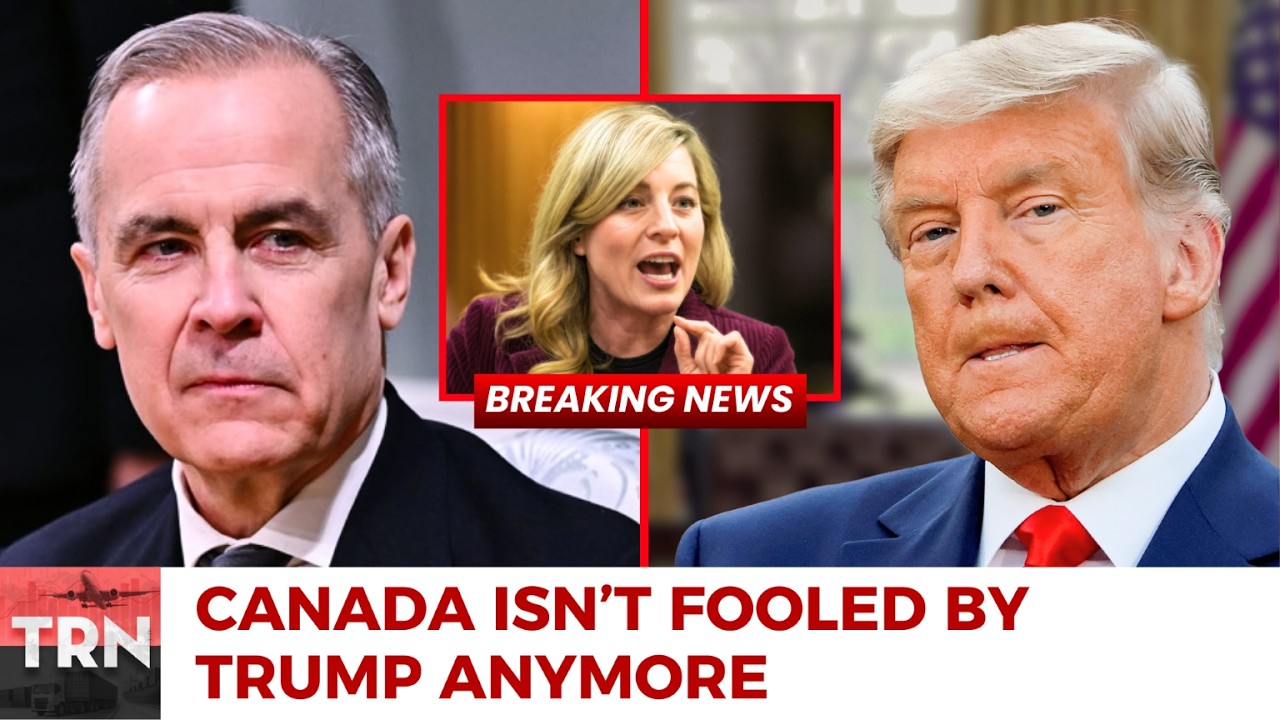
The episode that crystallized this realization unfolded during a high-profile FIFA event, where Trump appeared relaxed and amicable alongside Prime Minister Mark Carney. Cameras captured warm exchanges, easy smiles, and gestures that suggested a stable and cooperative Canada–U.S. relationship. Yet almost immediately afterward, Washington renewed its pressure campaign against Canada through tariffs and trade threats across multiple sectors, including steel, aluminum, autos, and softwood lumber. For Ottawa, the contrast was stark. Friendly optics on the surface, economic hostility underneath.
Canadian officials no longer treat this contradiction as confusion or chaos. Instead, they view it as a deliberate political strategy. Trump’s diplomacy, they argue, functions as performance rather than policy. Public friendliness serves to soften headlines and manage appearances, while substantive decisions are driven by domestic political pressure, short-term leverage, and an aversion to multilateral trade structures. The result is an environment in which verbal assurances carry little weight and policy stability cannot be assumed.
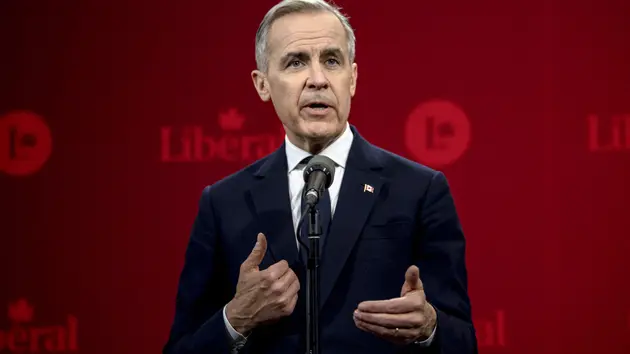
This understanding has shaped Canada’s response. Rather than reacting emotionally to every tariff threat or rhetorical shift, Carney’s government has adopted a disciplined and methodical approach. Ottawa has kept communication channels open with Washington while simultaneously preparing for the mandatory 2026 review of the USMCA. The objective is clear: preserve multilateral frameworks that constrain unilateral action and prevent the United States from forcing Canada into bilateral negotiations where power imbalances are most pronounced.
At the heart of Canada’s concern is Trump’s long-standing distrust of multilateral trade agreements. He has repeatedly criticized NAFTA, questioned the relevance of USMCA, and signaled a preference for bilateral deals that allow the United States to dictate terms. Analysts note that this approach aligns with Trump’s broader worldview, one that treats trade not as a cooperative system but as a zero-sum contest where leverage is the only currency. For Canada, accepting this framework would mean exposing itself to constant volatility driven by U.S. domestic politics.
Trump’s political pressures amplify this instability. With approval ratings under strain and economic anxieties persisting among American voters, his trade policy often shifts in response to immediate political needs. When markets react negatively or key constituencies complain, positions soften. When political threats intensify, tariffs and pressure escalate. This cycle makes long-term planning nearly impossible for U.S. partners and reinforces Canada’s decision to reduce reliance on American predictability.

As a result, Canada has accelerated its trade diversification strategy. Relationships with the European Union, Japan, South Korea, and other Asian partners have deepened. Export growth beyond the United States has strengthened, reinforcing Ottawa’s view that economic resilience depends on multiple channels rather than a single dominant partner. Canada has also cautiously reopened select channels with China, balancing economic opportunity with strategic risk.
The contrast between leadership styles has become a defining element of the story. While Trump’s approach is marked by improvisation and spectacle, Canada’s strategy emphasizes consistency and structure. Officials in Ottawa increasingly frame stability itself as a competitive advantage. Investors and multinational firms have taken notice. Several major companies expanding operations in Canada have cited U.S. policy volatility as a factor influencing their decisions, positioning Canada as a safer long-term environment for capital and production.
This dynamic has broader implications. Each instance in which Trump pairs friendly rhetoric with punitive action undermines U.S. credibility while strengthening Canada’s reputation as a predictable partner. The more Washington relies on pressure tactics, the more Ottawa reinforces systems designed to limit that pressure. What appears outwardly as calm restraint is, in reality, a calculated shift in how Canada defines its economic future.

The central lesson Canada has drawn is straightforward: trust cannot be built on optics. Diplomatic smiles do not outweigh tariffs, and warm words cannot substitute for stable rules. As trade tensions continue to simmer and the 2026 USMCA review approaches, Canada is no longer calibrating its policy around Trump’s tone. It is preparing for his actions. In doing so, Ottawa signals a deeper transformation — one in which Canada no longer allows U.S. unpredictability to define the boundaries of its economic destiny.